


Mariupol is Putin’s blueprint for occupation, and the world is barely paying attention
18.05.2026
When Russia launched its full-scale invasion of Ukraine in 2022, Mariupol quickly became the site of…
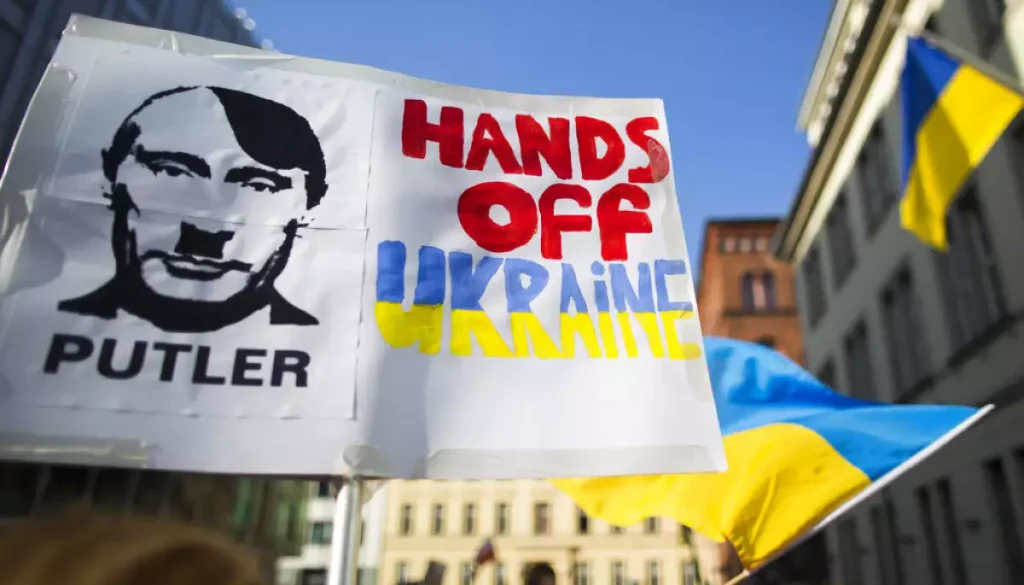
On May 9, Russia marked Victory Day over Nazism in World War II. It is one of the most revered holidays there and forms the foundation of modern Russian ideology. The myth of the great victory over Nazism is one of Russia’s core state-building myths, for the sake of which the use of certain historical facts has even been banned, including those about cooperation between the USSR and Germany. Russian ideology promotes the notion that the “Russian nation” was almost the sole victor over the Third Reich, while the term Nazism (fascism) has been maximally demonized.
At the same time, for decades Russian propaganda has embedded a militant slogan into the masses: “We can repeat it.” And that day has come. It was precisely through “denazification,” or the “fight against Nazism” in Ukraine, that the Kremlin explained why Russia launched the bloodiest war in Europe since the end of World War II.
This manufactured propaganda image and the modern state ideology of the “Russian world” allow the Kremlin to maintain support for the aggressive war against Ukraine among 77% of Russians.
And this is despite the fact that the majority of Russian residents still do not understand the definition of “denazification,” nor can they explain who the Nazis are. Nevertheless, according to statements by Russian leader Vladimir Putin, “the issue of denazification is relevant,” and therefore this “process” will continue.
Denazification of the Russian Federation in Ukraine
While the Kremlin and Russian propaganda continue to invent stories about fighting “Ukrainian Nazism,” real denazification is indeed taking place in Ukraine—but not the one Moscow claims. Ukraine’s Defense Forces continue to eliminate openly Russian neo-Nazis who are fighting in the Russian army and often openly boast about the war crimes they have committed.
Russian Nazis were among the first to take part in the aggression against Ukraine back in 2014. Even then, they formed their own paramilitary units composed of Russian citizens who share Nazi views. With the start of the full-scale invasion, these units were officially placed under the command of Russia’s Ministry of Defense.
For example, the sabotage and assault reconnaissance group “Rusich,” suspected of committing war crimes in Ukraine, continues to fight there. In particular, the “Rusich” group has specific and detailed instructions on the “disposal of Ukrainian POWs,” whose key points include directives to brutally kill prisoners after interrogation and encourage forcing the families of the deceased to pay “Rusich” for information about the whereabouts of their relatives’ bodies. On February 26, 2024, militants published footage of the execution of Ukrainian prisoners of war, captioning the video that “agitation to destroy prisoners is bearing fruit.” In addition, the group’s official page contains calls for genocide of Ukraine’s adult population through “scientific experiments” and “carpet bombing” of residential neighborhoods in Ukrainian cities. One of the leaders of this Nazi paramilitary formation, Alexey Milchakov—also known in Russia as a sadist—openly states that he is a Nazi. In 2017, the mercenary unit joined the “Wagner PMC,” after which they were deployed to Syria to take part in the war on the side of Bashar al-Assad’s government forces.
In addition to “Rusich,” neo-Nazis are also represented by a unit of the monarchist Russian organization “Russian Imperial Movement”—the “Russian Imperial Legion.” They have also been fighting in Ukraine since 2014 and have taken part in wars in the Middle East. In 2020, the movement was designated a terrorist organization by the United States, and its leaders—Stanislav Vorobyov, Denis Gariev, and Nikolai Trushchalov—were designated terrorists. This marked the first time in U.S. history that an organization espousing white supremacist ideology was added to the terrorist list. Russia’s Foreign Ministry called Washington’s decision “unfounded.”
The so-called “denazification” in Ukraine, given the presence of openly neo-Nazi fighters within the ranks of the Russian army itself, is criticized even by Russian militants themselves. “It is difficult to pursue a line of denazification when someone in your own ranks proudly displays Nazi symbols tattooed on their body or defiantly declares that they are a Nazi,” said Alexander Khodakovsky, former commander of the “Vostok” militant unit.
Yet the Russian authorities appear to see no problem in this. For instance, in 2017 the “DSHRG Rusich” even trained the youth military-patriotic organization Yunarmiya (children aged 8 and up), founded by Russia’s Ministry of Defense, at MoD facilities. And in 2022, representatives of the “Russian Imperial Movement” announced partial mobilization and recruitment of volunteers who would receive official status within the Russian Ministry of Defense, along with corresponding payments and guarantees.
It is also worth mentioning the Wagner PMC, a significant portion of whose fighters held Nazi views and were implicated in serious war crimes not only in Ukraine, but also in Africa. In particular, the unit commander and GRU officer Dmitry “Wagner” Utkin had tattoos in the form of SS captain insignia.
This phenomenon in Russia cannot be reduced to the activities of isolated groups of fanatics, as it is in fact a product of Russian propaganda and ideology, shared by Putin himself and disseminated throughout the Russian Federation with all the resulting consequences. It is based on the idea of Russia’s uniqueness and the alleged parasitism of the entire Western world. One can also recall the popularity of Russian war criminal Yevgeny Prigozhin, head of the aforementioned Wagner PMC, who enjoyed 29% popularity among Russians even after an attempted coup (and 55% before those events).
Interestingly, Russian neo-Nazis often criticize Russia’s domestic political situation and its military leadership. They are particularly outspoken when it comes to migrants and representatives of Caucasian (Muslim) republics of the Russian Federation. Chechen leader Ramzan Kadyrov and his “Akhmat” special forces are also frequent targets. In Russia, such behavior usually leads to serious consequences—but not in the case of neo-Nazis, suggesting that such units are under the protection of Russian security services.
For example, in Russia a music concert was canceled due to accusations of “promoting Nazi ideology” allegedly found in runic symbols on the musicians’ merchandise, prompting an investigation. At the same time, no cases have been opened against “Rusich” militants or other formations that openly identify as Nazis.
The idea of destroying Ukrainian statehood, Russia’s supposed uniqueness, and its confrontation with the West are not new. As early as 1997, one of the leading “philosophers” of modern Russia—fascist or “rashist” Alexander Dugin—called Ukraine’s independence an “existential danger” to Russia, viewing the world through the prism of confrontation between the Eurasian world (led by Russia) and the Atlanticist world (led by the United States).
It was Dugin whom American “journalist” Tucker Carlson recently interviewed, likely as part of the Kremlin’s attempt to legitimize its “philosophy” among Western conservatives.
Dugin began his path in the late 1980s when he joined the “Pamyat” society—an organization of militant nationalist anti-Semites. He later began studying philosophy and promoting theories of “Eurasianism,” calling himself a Eurasianist. He gained some recognition in Russia’s intellectual circles and became popular among European far-right and traditionalists. Dugin also has ties to academic and ideological circles in China, Iran, and Turkey—countries with strong anti-Western, particularly anti-American, sentiments.
In honor of May 9, Dugin wrote a short column stating that Russian troops are fighting NATO and that the goal of the new Patriotic War called the “Special Military Operation” in Ukraine is to restore Russia’s status as a global superpower—not “denazification.” Therefore, Putin is ready to fight to the end, regardless of the cost.
All of this clarifies what Russia is truly seeking—and it has nothing to do with NATO expansion, the “denazification” of Ukraine, or the “defense of Donbas.” It is because of these imperial ambitions that Ukrainian civilians are killed every day and entire cities are destroyed.
Moscow wants to be feared and regarded as a superpower—but will the capture of several Ukrainian regions be enough? The Kremlin seeks victory over the modern world order, international law, and the collective West—the unipolar world—as Putin himself has stated. The question is whether the West is ready to give Russia what it wants: to appease a new Hitler, or to confront him collectively?
The material was published on The Hill
18.05.2026
When Russia launched its full-scale invasion of Ukraine in 2022, Mariupol quickly became the site of…

05.05.2026
Russia pressed every Donbas sector in April, with assault tempo at a two-month high. The territorial…

16.03.2026
It is in the war against Ukraine that Russia is trying to adhere to this non-linear…


