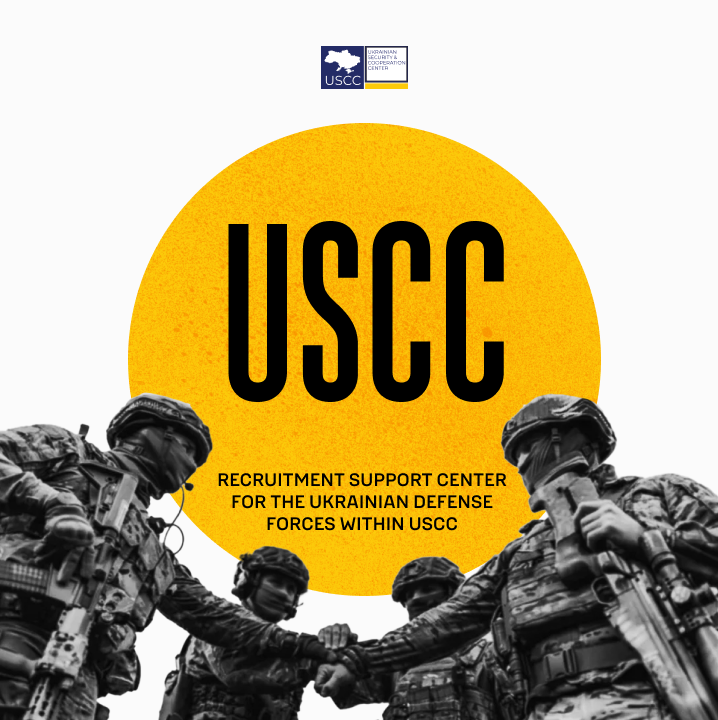

Why we do it:

Ukrainian Security and Cooperation Centre involvement into recruiting is a natural progression of the team’s work spanning more than a decade in strengthening Ukraine’s national resilience. The team started to form back in 2010, working with youth and civic education programmes. During the Revolution of Dignity, team members took part in personnel support of the Maidan Self-Defense Forces and protest activity coordination.
In 2021 USCC led the advocacy campaign to support the draft law “On the Fundamentals of National Resistance,” which was approved by constitutional majority of the Ukrainian Parliament. This law laid the legal foundation for creation of Territorial Defense Forces and the Resistance Movement.
After its adoption and after the start of the Russian full-scale invasion in 2022, USCC joined to develop public communications of the TDF and establish the interaction of the new kind of forces with society.
In this context, development of the volunteer recruiting system in 2024 was a natural stage of evolution of the Center’s activity.

Our principles/our approach:

principles
1
Voluntary recruitment is widening — if there is trust
Demand for voluntary military service exists even in wartime, but it directly depends on the level of trust. Transparency of procedures, clarity of roles and honesty in communication directly impact a person's decision to join the army. Models that allow to choose a unit and position demonstrate significantly better results than centralised approaches.
2
Decentralisation improves efficiency, but requires investment in capacity
Giving units the opportunity to directly recruit candidates speeds up the process and improves the quality of staffing. At the same time, without developing internal capabilities (HR processes, communications, data processing), decentralization does not give sustainable results.
3
Recruitment is also an information space
Hostile information operations are systematically aimed at undermining recruitment: reducing trust, demotivation, increasing fears. An effective recruitment system should integrate strategic communications and countering disinformation as its core element, not an additional function.
4
A data-driven approach significantly improves results
Ongoing monitoring of applications, campaigns effectiveness and public sentiment enables to adapt approaches quickly. Data-driven units demonstrate more stable growth and better conversion.
5
Social legitimacy determines the scale of recruitment
The level of engagement depends on public attitudes towards the military service. Systematic work with the media, opinion leaders and local communities is critical to normalizing voluntary service and expanding the pool of potential recruits.

Areas of our work

The USCC Recruitment Support Center works at the intersection of strategic communications, institutional development, and applied analytics:
1
Strategic communications and information campaigns
  • National campaigns to promote voluntary military service, including the return of servicemembers from AWOL.
  • argeted campaigns to support specific units
2
Development of recruiting infrastructure
  • Building internal recruitment capabilities of units
  • Support for the development of sustainable recruitment processes at the unit level
3
Analytical support and consulting
  • Monitoring and assessing the effectiveness of recruitment and communication activities
  • Analysis of hostile information operations aimed at undermining recruitment
  • Conducting sociological research to measure public opinion and the effectiveness of communications

Operational results (January 2025 — March 2026)

154 657
applications to
partner units
+110%
average growth in the number of applications
6 to 36
scaling up units during the year
9 units
switched to fully independent recruitment management

Recruitment ambassadors

To strengthen the impact, USCC has formed a wide network of recruitment ambassadors among representatives of the media and digital platforms.
200
media outlets
350
Telegram channels
27 500
media
mentions
5.25 billion
Total potential coverage

This network plays a key role in countering disinformation, normalizing voluntary military service, and expanding access to recruitment opportunities for citizens.

USCC is open to partnerships aimed at further scaling effective recruitment models, institutionalizing them, and expanding proven practices.

Partner units

1 Land Forces Recruitment Centre
3 Navy Recruitment Centre
30th Separate Mechanised Brigade
157th Separate Mechanised Brigade
Separate Presidential Brigade
14th Separate Mechanised Brigade
23d Separate Mechanized Brigade
43d Separate Artillery Brigade
63 Separate Mechanized Brigade
33d Separate Mechanized Brigade
4th Territorial Defense Recruitment Center
141st Separate Mechanized Brigade
57th Separate Motorized Infantry Brigade
55th Separate Artillery Brigade
59 Separate Assault Brigade
43d Separate Artillery Brigade
72nd Separate Mechanised Brigade
24th Separate Mechanised Brigade
28th Separate Mechanised Brigade
3d Separate Heavy Mechanized Brigade
47th Separate Mechanized Brigade
92nd Separate Assault Brigade
93d Separate Mechanised Brigade
116th Separate Mechanized Brigade
36th Separate Marine Brigade
95th Separate  Air Assault Brigade
100th Separate Mechanised Brigade
128 Separate Mountain Assault Brigade
80th Separate  Air Assault Brigade
Together, we can do more — support our project

Join us with a donation in a way that is convenient for you and help make our work more effective and impactful. To everyone who contributes — endless thanks and hugs.

Learn more about our activities...

Contact for media:

[email protected]