


“Free Ukraine Fund” encourages investments
25.02.2026
The Ukrainian Security and Cooperation Center, which celebrates its 3rd anniversary on April 2, is implementing…
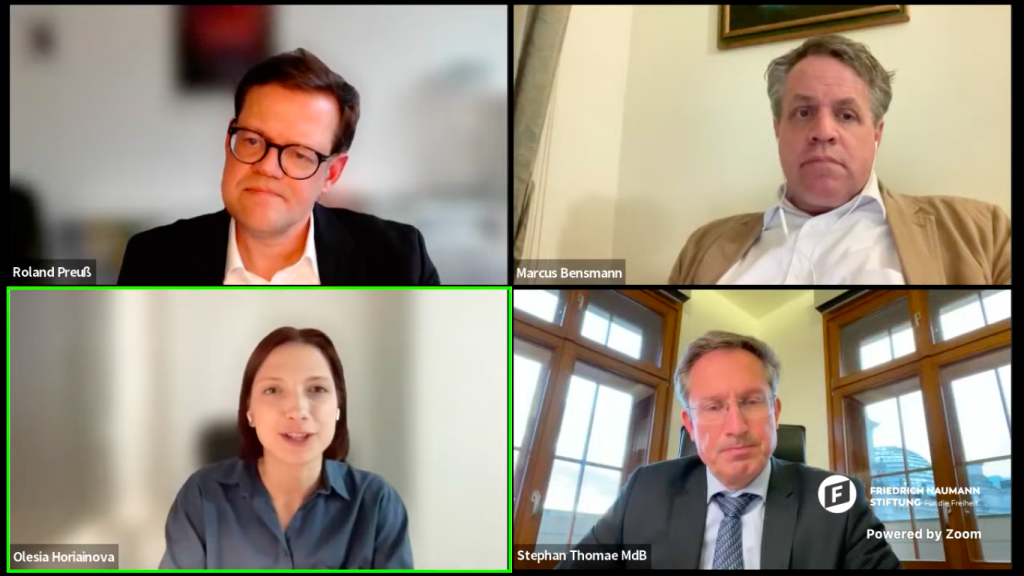
In Germany, with the support of the Ukrainian Center for Security and Cooperation, a discussion was held on Russia’s influence on politics and public opinion in the country. Among the participants was UCSS co-founder and deputy head Olesia Horiainova.
During the event, the speaker in particular addressed Russia’s manipulation of democratic principles in democratic states.
“Russia is not burdened by such constraints and has always actively positioned itself as a ‘defender of democracy’ everywhere except within its own borders. This is the foundation of the activity and success of its global network of influence.”
noted Olesia Horiainova.
The discussion speakers also included Stefan Thomae, a member of the German Bundestag’s Committee on Internal Affairs; investigative journalist Markus Bensmann from the CORRECTIV research network; and moderator Roland Preuss, a journalist. They examined Russia’s influence on German politics, including through its support for pro-Russian parties.
In Germany, one such party is the nationalist and right-wing populist pro-Russian political party AfD – Alternative for Germany.
As noted during the discussion, representatives of this party are accused by intelligence services in both Germany and the United States of close ties and receiving financial rewards for cooperation with the FSB. They also took part in a secret meeting with neo-Nazis, where plans were discussed to deport millions of foreigners and German citizens with migrant backgrounds. In addition, AfD leader Alice Weidel stated in an interview with the Financial Times that a referendum on Germany’s exit from the EU could be held if her party were to form a coalition government.
“Russia, which built its key myth of the last century on being the sole victor over German Nazism and fueled collective guilt among Germans over past events, is now financing people from a party that engages in discussions with neo-Nazis, calls for the expulsion of all migrants and even citizens with migrant backgrounds from Germany—frankly, according to the same principle as Hitler—while at the same time waging a genocidal war in Ukraine based on pure xenophobia and the desire to destroy every Ukrainian simply for being Ukrainian.”
said Olesia Horiainova.
The discussion showed that there is an understanding among Germans of the Kremlin’s true intentions. In particular, journalist Markus Bensmann directly stated that “Russia’s goal is not Ukraine, but all of Europe, and that Germany is not a moderator in this confrontation, but a final target.”
Accordingly, every vulnerability that can be exploited within a specific country will be used to destabilize the situation there, with the ultimate aim of advancing Russian interests or restoring Russian control. Therefore, the task of democracies in these challenging times is to learn how to effectively counter this influence.
We thank the Friedrich Naumann Foundation for Freedom, the Thomas Dehler Foundation, and the Munich Institute for Social Sciences on Future Issues for organizing and hosting the event.
25.02.2026
The Ukrainian Security and Cooperation Center, which celebrates its 3rd anniversary on April 2, is implementing…
24.06.2024
An advocacy summit, Nordic Ukraine, took place in Helsinki, the capital of Finland. Participants included the…

15.04.2024
The Summit of the World Congress of Ukrainians was held in the halls of the Romanian…


