


Ukraine Is a Key Pillar of Europe’s Defense
13.06.2025
At the summit of the Bucharest Nine (B9) and Nordic countries held on June 2, 2025,…
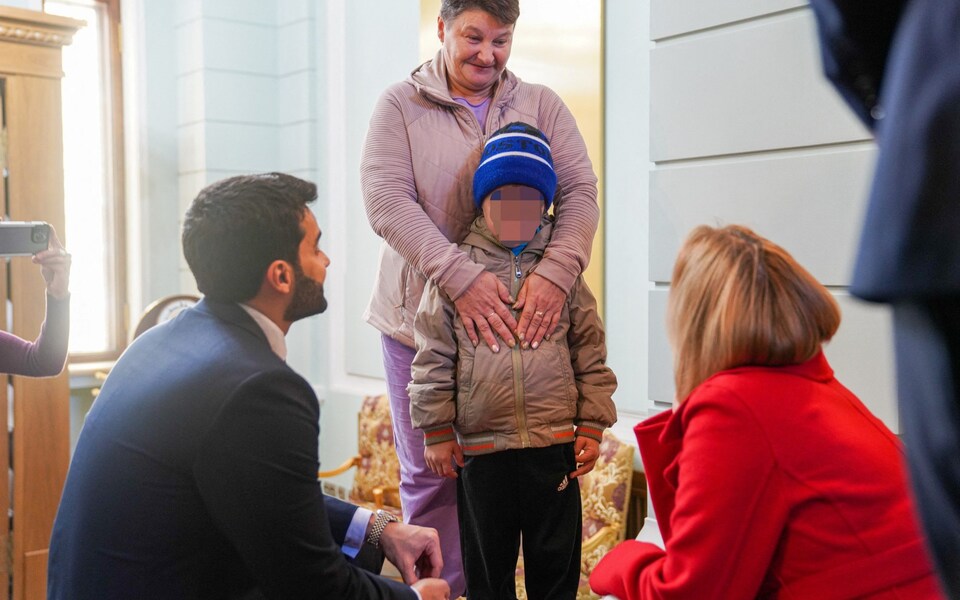
A 7-year-old Ukrainian boy, who became the first child released under a new mechanism created by Qatar to repatriate children from Russia to Ukraine, stands with his grandmother during a meeting with Russia’s Children’s Rights Commissioner Maria Lvova-Belova and a Qatari diplomat in this handout photo taken at the Qatari Embassy in Moscow, Russia.
Calls for Ukraine to concede territory ignore the reality of life under Russian occupation: this is not just about land — it is about children.

The original commentary by Jade McGlynn was prepared and published by The Telegraph and is republished by the Ukrainian Center for Security and Cooperation with the author’s permission.
Russia’s chief child abductor, Maria Lvova-Belova, has boasted about indoctrinating abandoned children from Mariupol. Speaking on Russian state television, she described how these children initially sang the Ukrainian anthem even in Russian captivity. But after months of experimental psychological pressure, they broke and professed their love for Russia. Four Ukrainian children who were taken to Russia after the full-scale invasion of Ukraine will be returned to their families under a deal brokered by Qatar following months of “secret negotiations”.
Every child rescued and returned to their family is, of course, a cause for celebration — but let us not be deceived by Kremlin photo ops. This is a cynical move by Putin to portray the Russian government as misunderstood and as a partner with whom one can negotiate.
Two weeks ago, Ukraine’s National Resistance Center, which supports the Ukrainian underground in Russian-occupied territories, warned Western journalists of upcoming, well-funded attempts to whitewash Maria Lvova-Belova, Russia’s “Children’s Rights Commissioner”, whom the International Criminal Court prosecutor has accused of deporting Ukrainian children to Russia.
While celebrating the return of four children, it is crucial not to forget the other 20,000 children whom Kyiv says remain in Russian captivity — abducted from devastated cities and towns in eastern Ukraine, from orphanages and boarding schools for children with mental and/or physical disabilities.
Some were separated from their parents during hostilities; others were orphaned as a result of the Russian invasion. Still others, known as “children of the state,” were already orphans or had no relatives able to care for them.


Ukrainian children returned from Russian territory.
13.06.2025
At the summit of the Bucharest Nine (B9) and Nordic countries held on June 2, 2025,…

13.06.2025
The full-scale war against Ukraine is setting new rules and military doctrines that must be taken…

09.06.2025
In the fall of 2024, the Kremlin took another step toward renewed nuclear blackmail. On September…


