


Mariupol is Putin’s blueprint for occupation, and the world is barely paying attention
18.05.2026
When Russia launched its full-scale invasion of Ukraine in 2022, Mariupol quickly became the site of…
At the end of 1999, an explosion occurred in an apartment building in one of the residential districts of Moscow, and this effectively gave Putin a carte blanche to continue the war in Chechnya, since, according to the Kremlin’s version, a “Chechen trace” led to the bombing of the building.
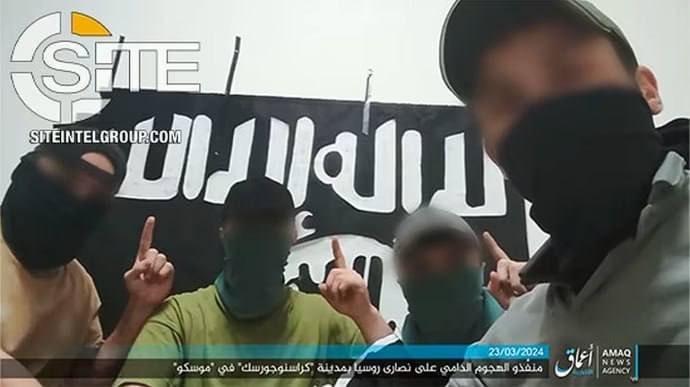
On March 22, 2024, a shooting, arson, and explosions took place in the large concert hall Crocus City Hall in Krasnogorsk near Moscow. As of 5:00 p.m. on March 23, 133 people were reported dead. And once again, Russia is waging a war — this time in Ukraine. And once again, the Kremlin is going to look for those responsible among the people it itself has gone to kill.
Yet it tries to do this so clumsily, putting forward such contradictory interpretations of the terrorist attack, that even without making much effort one can clearly recognize the familiar Russian propaganda in these versions.
For instance, it became known that the U.S. Embassy had information about the possibility of a terrorist attack and shared it with the Kremlin’s hosts. But the attack still happened. This means that Putin and his security services either saw the Americans’ good intentions as an attempt to groundlessly intimidate Russians, or they deliberately chose not to respond to these warnings, possibly because they themselves were the organizers of a crime against their own people. “All this resembles outright blackmail and an attempt to intimidate and destabilize our society,” Putin said while speaking at a meeting of the FSB board on Tuesday, March 19, thereby confirming the existing warnings.
Or take their attempts to link Ukraine to the terrorist attack. For this purpose, they even aired a fake on their television, allegedly showing Ukraine’s National Security and Defense Council Secretary Oleksii Danilov confirming Ukraine’s involvement.
Although by that time a version about ISIS involvement in the shooting had already begun circulating, information also emerged about the detention of a car with the perpetrators, in which passports of citizens of Tajikistan were found. Yet the location where this happened — in Russia’s Bryansk region, 150 kilometers from Ukraine’s Sumy region — is again meant to suggest to Russians Ukrainian involvement in the crime, or, for that matter, the involvement of Russian volunteer fighters.
That Moscow is not going to simply dismiss this version is also evidenced by Putin’s own words. After a long silence, only in the afternoon of March 23 did he address Russians, stating that allegedly a “window” had been prepared for the suspects in the attack to cross the border with Ukraine. At the same time, Putin promised to identify all those who ordered the attack and who would “face just punishment.”
The story is, to say the least, strange, because an hour earlier Russian media reported that Belarusian security forces had helped capture the terrorists. That is, they were apprehended near the Belarusian-Ukrainian border, not the Russian-Ukrainian one.
There are dozens of such inconsistencies, ranging from the number of terrorists to how they managed to reach the Bryansk region without changing vehicles.
It is also telling that while media controlled by the Russian authorities deliberately downplay the raid by Russian volunteer fighters, videos from Crocus City Hall began spreading actively almost immediately after the shooting and arson. Presumably, this was calculated to evoke empathy for the victims of the attack. And this is despite the fact that Russia itself kills tens of thousands of civilians in Ukraine every day.
Thus, in light of all this, the conclusion suggests itself that this is yet another attempt by the Kremlin to mislead the international community and portray itself as a victim — whether of Ukraine, ISIS, or perhaps some third party. And for all democratic countries that do not share Russia’s values, it is crucial not to fall for such narratives and to remain consistent in their efforts to rein in the aggressor.
18.05.2026
When Russia launched its full-scale invasion of Ukraine in 2022, Mariupol quickly became the site of…

05.05.2026
Russia pressed every Donbas sector in April, with assault tempo at a two-month high. The territorial…

16.03.2026
It is in the war against Ukraine that Russia is trying to adhere to this non-linear…


