


Mariupol is Putin’s blueprint for occupation, and the world is barely paying attention
18.05.2026
When Russia launched its full-scale invasion of Ukraine in 2022, Mariupol quickly became the site of…
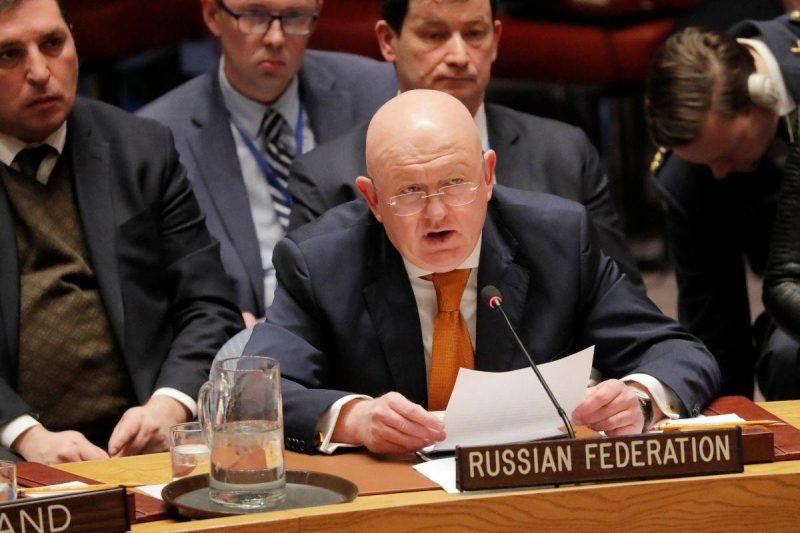
April 2023: the city of Sloviansk — 15 civilians killed, including a two-year-old boy; the city of Uman — 22 killed, including five children; the city of Kostiantynivka — six killed; the city of Dnipro — two killed, a mother and her three-year-old daughter. These lives were cut short by Russian artillery and missile strikes at a time when Russia was not only waging a full-scale war against Ukraine but was also presiding over the world’s key security body — the United Nations Security Council.
The UN Security Council is an international body responsible for maintaining international peace and security. It was established after the victory over Nazism in World War II. As the self-proclaimed legal successor of the Soviet Union, Russia continues to occupy a seat on the UN Security Council as a full member.
A STEP INTO THE ABYSS
In April, according to the UN Charter, Russia assumed the rotating presidency of the UN Security Council for one month. A country that destroys peaceful cities of an independent European state, whose army commits grave war crimes by killing and torturing civilians and abducting children. Despite all warnings and appeals from the Ukrainian and international communities, on April 1 the Russian Federation took the chair. Predictably, having gained additional power, Russia used it to whitewash its image and attempt to increase its influence on Western states through manipulation, distortion of facts, and the spread of propaganda.
RUSSIA’S MONTH AT THE UN
During its month-long presidency, Russia convened the Security Council twice. The first meeting was devoted to abducted Ukrainian children. At it, Russia attempted to justify its “benevolent” and “legal” motives by inviting as a speaker Maria Lvova-Belova, Russia’s Commissioner for Children’s Rights and the main organizer of child deportations, for whom the International Criminal Court issued an arrest warrant together with President Putin.
The British delegation blocked the public broadcast of her speech and stated: “If Maria Lvova-Belova wants to talk about her actions, she can do so in The Hague.” A total of 49 UN member states and the EU as a separate entity opposed the meeting.
A few days later, Russia again convened a Security Council meeting, attempting to block the export of Western weapons to Ukraine. Russian ambassadors promoted the familiar false narrative that large volumes of Western military aid were allegedly being resold by Ukraine and falling into the hands of criminals. This meeting also outraged most member states. The U.S. representative to the UN emphasized: “Today’s meeting is a thinly veiled attempt by the Russian Federation to portray itself as a responsible actor in arms control, an effort to obscure the reality that it launched an unjustified armed invasion of a neighboring country.”
A YEAR OF TERROR
Unfortunately, none of the issues raised by Russia during this month, nor its attempts to weaken international support for Ukraine, became a trigger for its removal from the organization. Over a year of war, Russia’s army and authorities have committed such a volume of crimes against humanity that they can be equated with genocide (indeed, PACE recognizes the forced deportation of children as a modern manifestation of genocide). A UN commission concluded that Russia committed numerous violations of international humanitarian law and the Universal Declaration of Human Rights, including the European Convention on Human Rights, in addition to countless war crimes.
Killing of civilians. According to UN data alone, from February 24, 2022 to May 1, at least 8,709 civilians were killed as a result of Russian aggression. The actual number may be dozens or even hundreds of times higher, but it is impossible to determine due to the lack of access to active combat zones and temporarily occupied territories. Russia deliberately targets civilians, as evidenced by missile strikes on Ukrainian cities, most often aimed at residential buildings and public squares, and sometimes even humanitarian aid distribution points.
Execution of prisoners of war. The execution of POWs is a grave war crime that has become a routine practice for Russia. Beheadings and shootings of prisoners are not isolated cases. According to Dmytro Lubinets, Ukraine’s Human Rights Commissioner, the Ombudsman’s Office has received dozens of videos showing the execution of allegedly Ukrainian soldiers by Russian troops. Some of the most horrific cases of shootings and dismemberment became known only recently.
Hostage-taking and deportation of children. According to the National Information Bureau, as of February 24 Russia had abducted 19,393 children, with only 364 returned home. These actions led the International Criminal Court to issue arrest warrants for Putin and Children’s Ombudsperson Maria Lvova-Belova. On April 27, the Parliamentary Assembly of the Council of Europe in Strasbourg adopted a resolution condemning the forced deportation of Ukrainian children. The deportation and forced “Russification” of Ukrainian children constitute elements of the crime of genocide.
The Russian Federation — a country that for more than a year has been committing war crimes and crimes against humanity on the territory of a sovereign state — killing, abducting, raping, and torturing. The logical consequence of such a policy should be full international isolation and accountability for every perpetrator. Yet the aggressor remains a member of the world’s key security body — the UN Security Council — and even presides over it.
“Russia’s presidency demonstrated that by yielding to Russian influence and manipulation by a terrorist state, the United Nations is no longer capable of preventing war crimes and aggression. The logical continuation is either Russia’s exclusion from the UN Security Council or the dissolution of the organization,” emphasized Serhii Kuzan, Head of the Ukrainian Center for Security and Cooperation.
Unfortunately, this incapacity cost Ukraine at least 130 innocent lives. This was the price of Russia’s month of presidency of the UN Security Council.
18.05.2026
When Russia launched its full-scale invasion of Ukraine in 2022, Mariupol quickly became the site of…

05.05.2026
Russia pressed every Donbas sector in April, with assault tempo at a two-month high. The territorial…

16.03.2026
It is in the war against Ukraine that Russia is trying to adhere to this non-linear…


