


Mariupol is Putin’s blueprint for occupation, and the world is barely paying attention
18.05.2026
When Russia launched its full-scale invasion of Ukraine in 2022, Mariupol quickly became the site of…
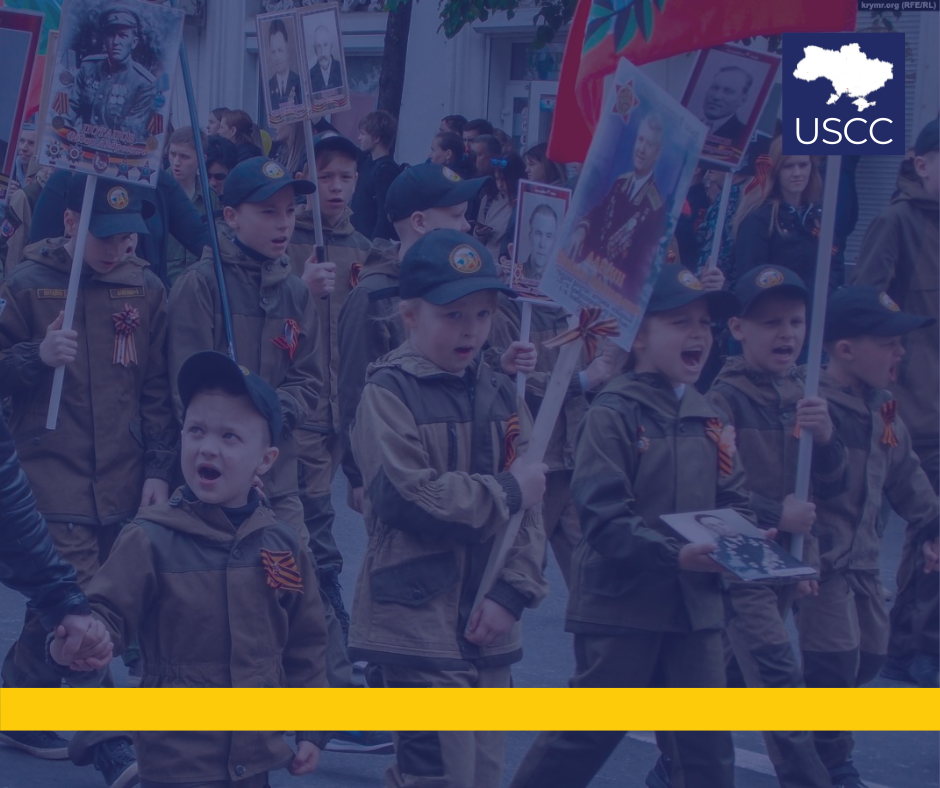
The Russian authorities continue their attempts to turn the new generation of Russians into obedient soldiers.
In addition to the well-known youth militarized organization Yunarmiya, founded by the Russian Ministry of Defense, and special cadet classes, propaganda will now reach all schoolchildren this year.
Starting in September, Russian schools will introduce 30-minute patriotic lessons every Monday titled “Conversations About What Matters”. Methodological materials for third- and fourth-grade students make it clear that children will be instilled with ideas such as “the happiness of the Motherland is more valuable than life” and that “it is not scary to die for the Motherland” (sources: kommersant.ru, ug.ru, go31.ru).
For older students in grades five through seven, lessons will focus on the “historical unity of the Russian people.” Apparently, the Russian authorities are concerned about potential interethnic tensions within the country. Students will also be asked to explain sayings such as “He who stands like a mountain for the Motherland is a true hero.”
The recommendations also mention the topic of the so-called “special military operation.” In particular, students will be presented with the Kremlin’s version of the reasons for launching the operation, as well as the claim that “military assistance from the collective West increases the number of victims of the special operation.” In effect, responsibility for civilian casualties is shifted not onto the Russian army, which is attempting to occupy Ukraine and shells major cities daily, but onto the West.
In the eighth and ninth grades, the lesson will begin with a comparison of the territory of Russia and the United States… and will also address the goals of the war in Ukraine.
Students in grades 10–11 will be told that true patriots can defend the Motherland with weapons in their hands. In addition, every Monday the school week in Russian schools will begin with the raising of the flag and the performance of the national anthem. This innovation, by the way, has sparked considerable criticism on social media.
The Kremlin has not overlooked Dagestan either, a region particularly problematic for the authorities.
At the end of August, the website of the Ministry of Education and Science of the republic published an order to establish specialized “Rosgvardia classes” in 14 general education institutions. All of this will be implemented in cooperation with the regional branch of the Federal National Guard Troops Service of the Russian Federation (source: mk.ru).
The justification for the minister’s order states that this initiative follows an instruction from the head of Dagestan “with the aim of further improving military-patriotic education and military-professional orientation in the republic’s general education institutions.” The training is expected to cover 425 seventh-grade students, and most likely the number of such classes will increase next year.
It should be recalled that Dagestan is one of the regions with the highest number of soldiers killed in the war against Ukraine. This gives analysts reason to speak of another Russian “special operation” being conducted within the republic itself. Dagestan is known as one of the most rebellious regions: social media contains plenty of criticism of the “special operation,” and in 1999 the region saw several weeks of armed clashes between units of the “Islamic Peacekeeping Brigade” and the Russian army.
Thus, it is likely that the Russian authorities are acting out of fear and have decided to raise a new generation of regime-loyal fighters inside the country—much as they are doing across Russia as a whole.
Oksana Kuzan
18.05.2026
When Russia launched its full-scale invasion of Ukraine in 2022, Mariupol quickly became the site of…

05.05.2026
Russia pressed every Donbas sector in April, with assault tempo at a two-month high. The territorial…

16.03.2026
It is in the war against Ukraine that Russia is trying to adhere to this non-linear…


