


Mariupol is Putin’s blueprint for occupation, and the world is barely paying attention
18.05.2026
When Russia launched its full-scale invasion of Ukraine in 2022, Mariupol quickly became the site of…
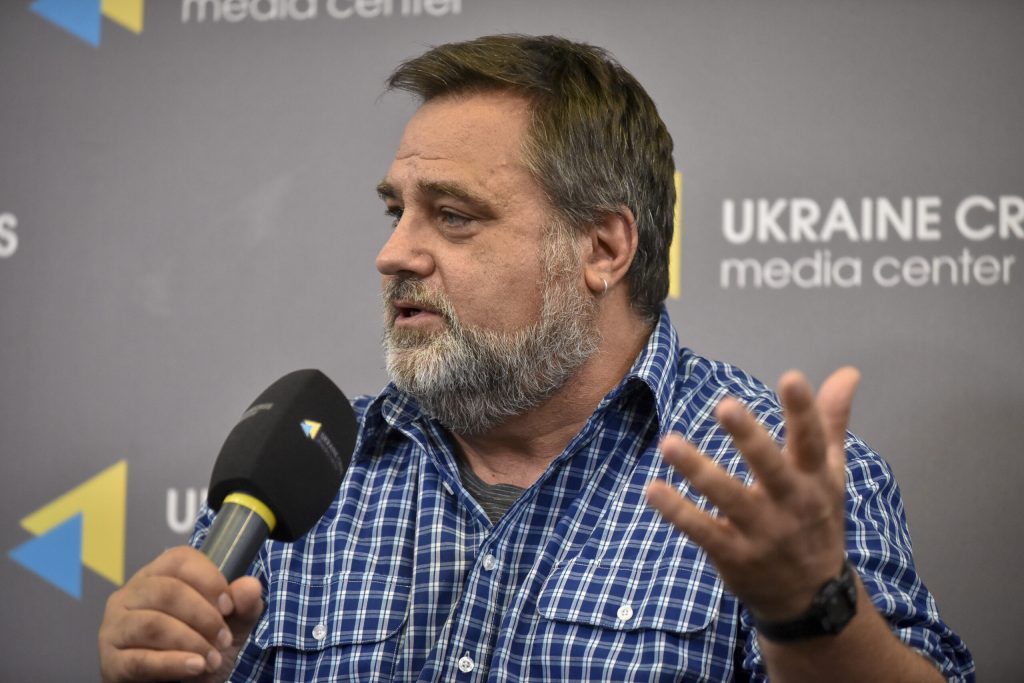
Pete Shmigel, Australian author, civic and political activist
According to the worst April Fools’ joke of all time, on April 1 the Russian Federation will assume the chairmanship of the UN Security Council.
Author: Pete Shmigel, Australian author, civic and political activist, in his blog on Medium
I am not an analyst, a subject-matter expert, or a practitioner of international law. First and foremost, I am a writer. My role, therefore, is to look at social problems through the lens of a writer — from the perspective of history.
When we consider Russia’s chairmanship of the Security Council, we must recognize something important. This Russia — whether we like it or not — has successfully told a credible story that allowed it to occupy a seat on the Council. This, in turn, reflects the West’s failure to recognize and address the risk that Russia represents.
Because of this “preconditioned trust,” the international community currently shows almost no:
· doubt about, or challenge to, Russia’s chairmanship;
· discussion of the absolute disconnect between the UN’s stated goals and Russia’s actions in Ukraine over the past 12 months;
· questioning of whether the UN should even continue to exist under such disgrace.
In essence, Russia’s chairmanship symbolizes the success of its long-term strategic propaganda and international influence operations. The truth is that Russia has deceived and coerced the world into de facto recognizing its legitimacy — instead of recognizing it for what it is: a terrorist state deserving total expulsion from recognized global institutions such as the UN, the WHO, or the International Olympic Committee.
Read also: Campaign #unrussiaUN to expel Russia from the UN Security Council
The methods and narratives Russia relied upon to maintain legitimacy at the UN and elsewhere have endured even in the face of objective evidence of an illegal invasion, countless war crimes, and ethnocidal activity in Ukraine. This is because Russia has been playing this game for nearly 70 years. Ukraine, by contrast, has told its international story in roughly one year — and has built credibility with key actors that withstands even atrocity.
Drawing heavily on the practices of Goebbels and Nazi Germany, Russia’s playbook includes:
· embedding “maskirovka” (deception) into Russian military doctrine after World War I;
· the official use of propaganda as a weapon of war, and its integration into Russian military structures since the 1930s;
· consistent (and clearly fabricated) themes and narratives, including cultural contribution, anti-colonialism, victory over fascism, justice for minorities and women, and global peace;
· disciplined use of repetitive, emotion-based messaging;
· spending billions of dollars not only on communications infrastructure (troll farms or state television), but also on buying influence where needed.
Russia has also mastered how to target specific audiences, including at the continental level (for example, in Africa), and how to exploit both the strengths and weaknesses of democratic institutions.
In Australia, we have seen Russia pay for:
· sponsored editorial content — and who knows what influence — in major newspapers;
· Russian channels on cable television;
· useful idiots such as Simeon Boikov, an ultra-right-wing organizer currently seeking refuge in the Russian Federation’s consulate in Sydney;
· the provision of “exclusive” content to mainstream commentators.
Recently, this has become even more sophisticated (read: grotesque). Russia actively identifies and exploits — if not creates — trends around “post-truth” and alternative realities. Here it has “raised the stakes,” deploying multiple narratives across numerous channels that appear contradictory and illogical. Russia understands that chaos, confusion, and subjectivity are its allies.
As noted by prominent British analyst Peter Pomerantsev:
“The last thing those who propagate a phantom, fabricated past want is facts… Conspiracy is a way of maintaining control. Everyone’s motives are questioned; no one can be trusted. Newspapers, politicians, judges, experts — everyone has an agenda, everyone is biased. So what is the inevitable solution? In this darkness, it is best to rely on a strong hand to guide you.”
On Putin’s Russia, Pomerantsev says:
“For Moscow, it is vital to destroy the very idea of truth. If nothing is true, then anything is possible. We are left with the sense that we do not know what Putin will do next — that he is unpredictable and therefore dangerous. We are stunned, disoriented, and confused by the Kremlin’s weaponization of absurdity and unreality.”
We are now seeing this play out in the United States. Knowing that positions on Ukraine are currently filtered through either a red or blue lens, and that bipartisan trust has collapsed, the Kremlin is encouraging MAGA Republicans not to support aid to Ukraine.
So, as April 1 approaches and with the repugnant prospect of a murderous regime formally responsible for a global peacekeeping organization, we must ask ourselves: do we allow this to happen? Do we want Russia’s “story” to remain unchallenged? Are we prepared to accept the defamation of our democratic institutions? I hope not. It is time for a different story — one grounded in truth.
18.05.2026
When Russia launched its full-scale invasion of Ukraine in 2022, Mariupol quickly became the site of…

05.05.2026
Russia pressed every Donbas sector in April, with assault tempo at a two-month high. The territorial…

16.03.2026
It is in the war against Ukraine that Russia is trying to adhere to this non-linear…


