


Mariupol is Putin’s blueprint for occupation, and the world is barely paying attention
18.05.2026
When Russia launched its full-scale invasion of Ukraine in 2022, Mariupol quickly became the site of…
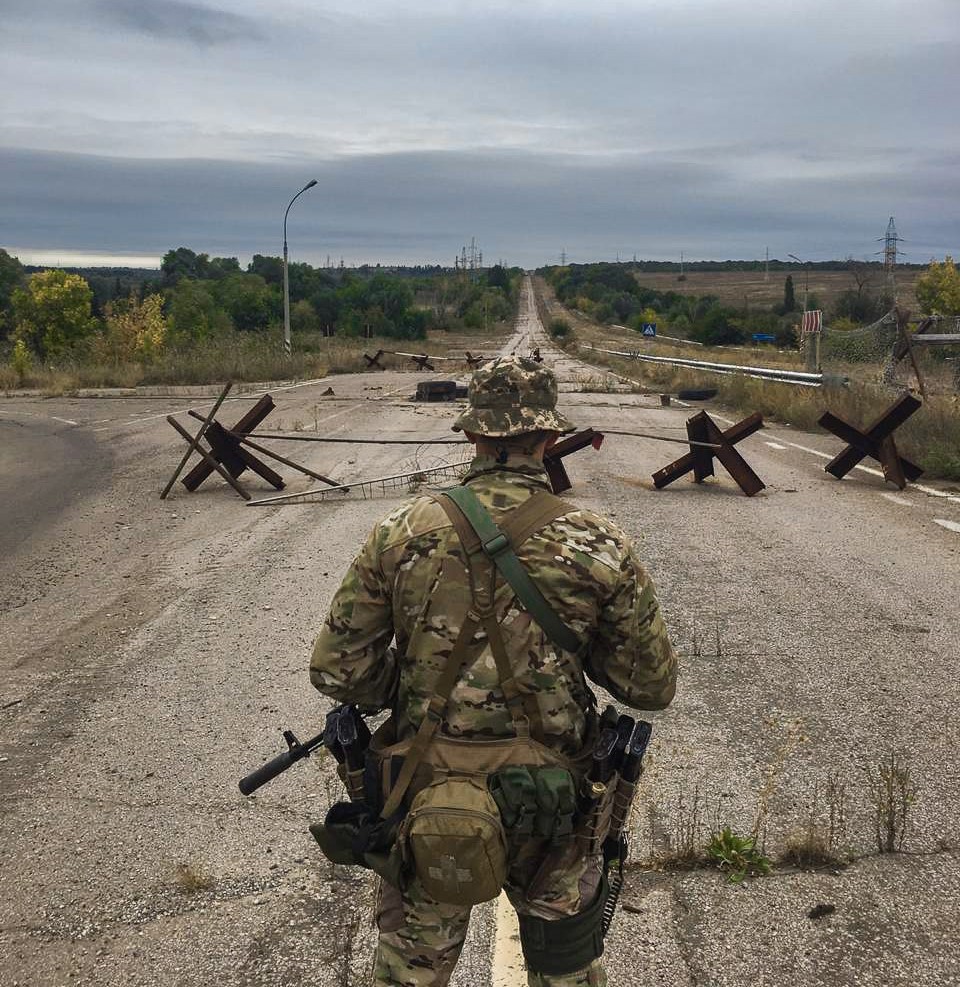
“We can defend ourselves, and we must defend ourselves against an attack—any attack, personal, social, or general. We have the right to defend ourselves, and even the duty,” — these are the words of Cardinal Lubomyr Husar of the Ukrainian Greek Catholic Church.
Our duty.
We fulfilled it during the Revolution of Dignity, when together we defended our European choice and our free future. When volunteers, civic activists, and millions of concerned Ukrainians, together with the army, stopped the advance of a much stronger aggressor.
In our case, “together” is not just an adverb. It is all-encompassing mutual support that, even now, overcomes the most difficult challenges and forces us to move forward. That is why our “together” has never been limited to the front line alone. Because our “together” has always been about love for one another and an unshakable belief in the future.
In 2014, no one expected that we would be able to withstand the onslaught of the Russian military. That our resistance would be so strong that Russia would revise its plans for the further occupation of Ukraine. All because our resistance was national—from ordinary citizens who gave their last resources to support the army, to soldiers who defended every inch of Ukrainian land to the very end. Since 2014, Russian aggression has not stopped for a single day. Of course, in the eighth year of the war, time has dulled the sense of danger. But has the need to continue our joint struggle disappeared? No, because Russia still poses the most serious threat to us.
In 2014, we were not ready for war. Our struggle, though filled with ideas, was chaotic and spontaneous. We held back the aggressor, but paid a terrible price—thousands of lives.
Do we want a repeat? No. That is why today our struggle is moving to a different, professional level—an organized system of comprehensive resistance enshrined in the Military Security Strategy. And it must be implemented through the adoption of Draft Law No. 5557 on the Fundamentals of National Resistance.
Like most countries, our state has limited defense capabilities. First of all, because maintaining regular military units in every region requires significant financial and economic resources. We cannot compete with the Russian Federation in achieving military parity or building up similar volumes of armaments, as this would lead to serious economic exhaustion. However, we must guarantee that occupiers will face scorched earth beneath their feet in the event of an advance. Therefore, the need for rapid counteraction and repelling aggression from any direction is critical.
This means that absolutely every Ukrainian plays a key role in defense. That is why the preparation of citizens of Ukraine for defense and national resistance, provided for in Draft Law No. 5557, is so important. In addition to forming patriotic awareness, the foundation of citizen training also includes general military training—that is, the knowledge and practical skills necessary for the defense of Ukraine. At the same time, Draft Law No. 5557 provides for the development of territorial defense and the resistance movement.
For full development, territorial defense will be established as a new, fifth branch of the Armed Forces of Ukraine, alongside the Ground Forces, Air Forces, Naval Forces, and Special Operations Forces. Each region will have its own brigade, and each district will have a territorial defense battalion. At the level of territorial communities, there will be opportunities to form volunteer units. Territorial defense participants will be involved in carrying out specific tasks assigned to the Armed Forces, primarily the defense of territory from occupiers, if necessary, in any region of Ukraine. If a territory is occupied, resistance to the enemy there will be carried out by the resistance movement.
All these steps are intended to significantly strengthen defense capabilities. Thus, when planning further offensive actions, even the Russian Federation will be forced to take into account the presence of territorial defense—which will increase the size of the Armed Forces of Ukraine by 11,000—as well as the potential activity of the resistance movement in the temporarily occupied territories of the Autonomous Republic of Crimea, the city of Sevastopol, and the Donetsk and Luhansk regions.
Author: Solomiia Khoma
18.05.2026
When Russia launched its full-scale invasion of Ukraine in 2022, Mariupol quickly became the site of…

05.05.2026
Russia pressed every Donbas sector in April, with assault tempo at a two-month high. The territorial…

16.03.2026
It is in the war against Ukraine that Russia is trying to adhere to this non-linear…


