


Mariupol is Putin’s blueprint for occupation, and the world is barely paying attention
18.05.2026
When Russia launched its full-scale invasion of Ukraine in 2022, Mariupol quickly became the site of…
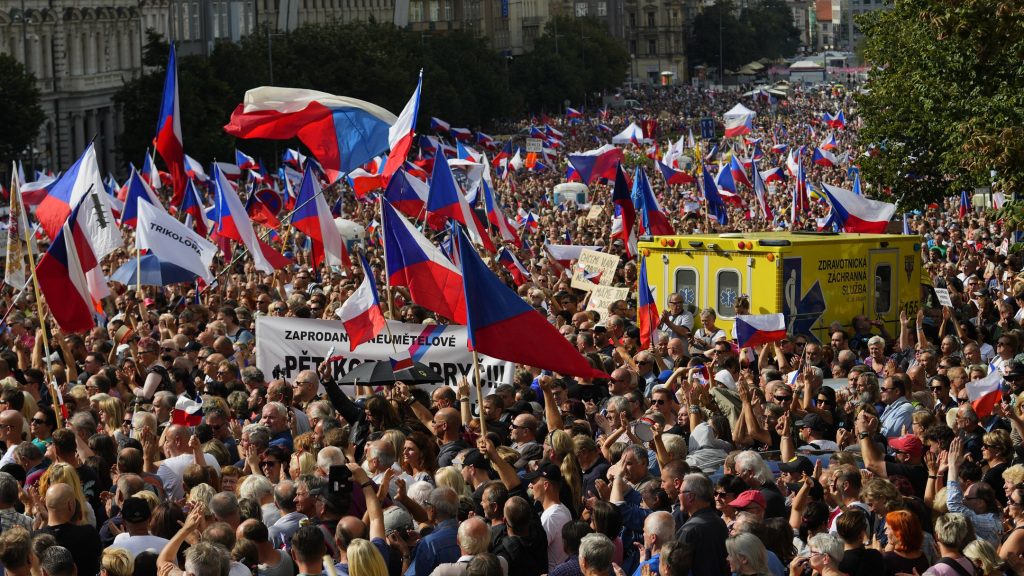
An anti-government rally in the Czech Republic that gathered tens of thousands of protesters. Source — RTVI
To destabilize the internal political situation in European countries, Russia is waging a hybrid war that began long before the full-scale invasion of Ukraine. Countries that actively support Ukrainians are under the greatest pressure.
An analysis of Russian-language groups in Western countries revealed several narratives most frequently promoted there: Ukrainian refugees are unwanted in Europe; Russia takes better care of refugees; Ukraine harms and abuses civilians; Ukrainians pose a threat to host countries; Ukrainians receive far better conditions than refugees from other countries. The findings were published by the analytical center “Institute for Strategic Dialogue (ISD)” after analyzing Russian-language discussions since the start of the invasion.
We debunk the latest documented global attempt by the Kremlin to turn Western societies against Ukrainians and explain how Russia works to weaken the coalition supporting Ukraine and Western democracies as a whole.
CZECH REPUBLIC IN THE SPOTLIGHT
Even during the Soviet era, Russia projected its influence into Western Europe through Czech territory—a country at the heart of Europe. Then-occupied Czechoslovakia served as a frontier between the West and Moscow. Russian influence was so extensive that pro-Russian networks partially remain to this day, despite years of independence and the current pro-European government.
For example, the family of Russian missile factory owner Boris Obnosov—Rostyslav and Olha Zorikov—who owned several properties in Prague, were added to the Czech sanctions list only in the summer of 2023 after public pressure and a UCSC campaign in the Czech Republic. This family is directly linked to killings in Ukraine: Obnosov’s factory produces Kh-101 and Kh-22 missiles used by Russia to strike residential buildings in Uman and Dnipro, as well as a shopping mall in Kremenchuk.
Attempts to destabilize the country’s internal political situation continue. Rallies are organized across the Czech Republic spreading Euroscepticism, calling for the resignation of the current government, withdrawal from NATO, opposition to military aid for Ukraine, and resistance to supporting Ukrainian refugees.
Just this spring in Prague, several high-profile protests under the slogan “Czech Republic Against Poverty” took place, during which participants called for the government’s resignation. Among the demonstrators were open representatives of the “Russian world” with Z symbols and Wagner PMC patches, as well as individuals who openly supported Russia’s aggression against Ukraine. On September 16, 2023, the PRO party announced another anti-government rally in Prague. Participants are being mobilized, among others, by Czech Roma, who have recently become part of a broader Kremlin campaign aimed at destabilizing the Czech Republic and discrediting Ukrainian refugees.
THE ROMA CONFLICT
Background
On June 10, 2023, Czech authorities announced criminal proceedings against a Ukrainian citizen for the killing of a Roma man. According to Czech outlet “Romea,” citing police, the altercation that resulted in injuries and death began on public transport. Some witnesses claimed the Ukrainian asked a group of Roma youths to stop loudly playing music and shouting inside a tram; the situation escalated into a fight, after which the Ukrainian used a knife in self-defense. The case is currently classified as intentional homicide, but the investigation is ongoing and police may reclassify it as self-defense.
This incident became the starting point of a chain of events involving Ukrainians and Roma in the Czech Republic.
Disinformation Spread
An analysis of news coverage from June–July 2023 regarding the conflict shows at least eight subsequent accusations against Ukrainian refugees for crimes against Roma. However, Czech police confirmed only three incidents: the fatal stabbing in Brno on June 10, a mass fight between three Ukrainians and Roma on July 2, and one clash between Roma youth and a Ukrainian on July 29 in Nový Bydžov. Neither of the latter incidents resulted in fatalities.
The remaining five alleged crimes attributed to Ukrainians turned out to be disinformation aimed at artificially escalating tensions following the June 10 incident in Brno.
False narratives spread on social media included:
CHAIN REACTION
Immediately after the first reports of the killing, social media saw direct accusations against Ukrainians for aggression toward Roma. These posts also criticized the presence of Ukrainians in the Czech Republic and the government of Petr Fiala for allowing Ukrainian refugees into the country.
On June 17, the first demonstration “For the Safety of Citizens in the Czech Republic” took place in Brno. Organizers claimed to oppose collective blame of Ukrainians, yet some participants were far more radical. Xenophobic and racist slogans were heard, including “Black and white—unite!”, “We are the Czechs!”, “This is our home!”
Since June 10, at least eight protests and rallies with similar narratives have taken place. Czech journalists reported the presence of Roma extremists and pro-Russian politicians attempting to incite unrest and politicize the events. In several cases, participants and organizers opposed such “guests,” fearing peaceful protests could be radicalized and exploited by extremists.
The peak of tensions escalated into open threats. On July 18, protests in Brno and Krupka nearly turned into pogroms against Ukrainian refugees’ housing. “Ukraine, go away. Get out, scum,” protesters (mostly Roma) shouted outside a dormitory housing Ukrainians in Brno. Brno municipal councilor Matěj Hollan commented: “Roma communities are being massively influenced by Russian disinformation.”
That same day, about 500 Roma demonstrators in Krupka demanded police investigate an alleged conflict between Ukrainians and Roma. It later emerged that this was another piece of disinformation and that Ukrainians had no involvement. Nevertheless, the Roma community organized a march that turned into an overtly anti-Ukrainian demonstration. Video footage captured chants of “This is our home,” “Damn Ukrainians,” and “Glory to Putin” in areas where Ukrainian refugees live.
REACTIONS
18.05.2026
When Russia launched its full-scale invasion of Ukraine in 2022, Mariupol quickly became the site of…

05.05.2026
Russia pressed every Donbas sector in April, with assault tempo at a two-month high. The territorial…

16.03.2026
It is in the war against Ukraine that Russia is trying to adhere to this non-linear…


