


Mariupol is Putin’s blueprint for occupation, and the world is barely paying attention
18.05.2026
When Russia launched its full-scale invasion of Ukraine in 2022, Mariupol quickly became the site of…
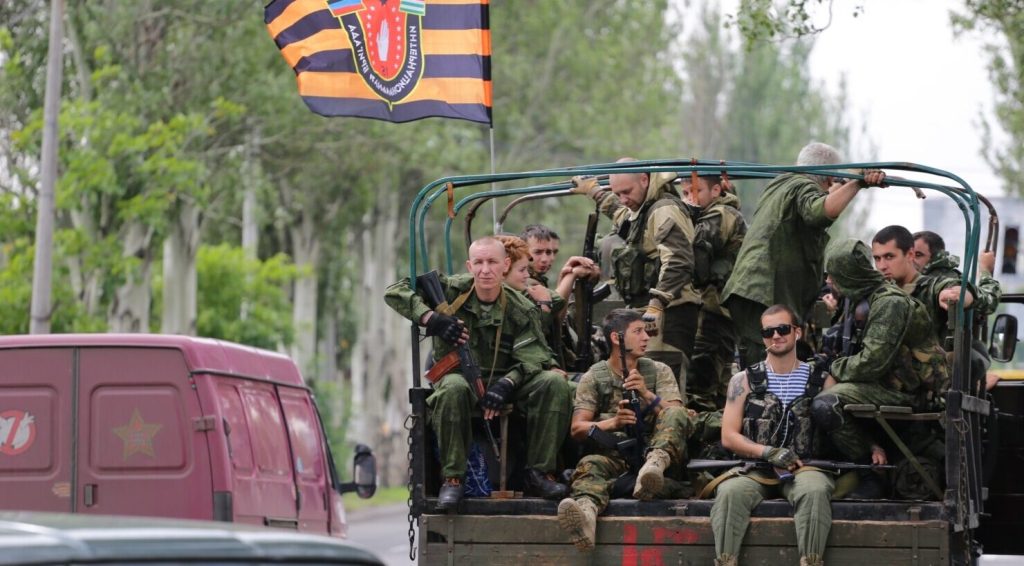
In the parts of Luhansk and Donetsk regions temporarily occupied by Russia, recruitment for military service into the so-called 1st and 2nd Army Corps continues.
In particular, sources of the Ukrainian Center for Security and Cooperation (UCSC) within Ukrainian special services report that in the territory of the so-called “LPR,” announcements were distributed about recruiting local residents for so-called military service in units of the 2nd Army Corps, with promised pay starting from 24,000 Russian rubles (approximately 8,700 UAH) plus additional bonuses. Contract service recruits people aged 18 and older for counter-battery radar units and air defense units.
As stated in an interview with UCSC by the Head of the Main Intelligence Directorate of the Ministry of Defense of Ukraine, Kyrylo Budanov: “Russia was preparing and continues to prepare for a serious annexation of Ukrainian territory.”
The words of the head of Ukrainian intelligence are confirmed by facts. As of early November, Russia had concentrated a force of about 90,000 troops near the Ukrainian border and in temporarily occupied territories.
Between August and October 2021 alone, the Armed Forces of Ukraine, the OSCE mission, and civilians recorded the transfer of military equipment and ammunition from Russian territory, while the occupation authorities, in addition to conscription, conducted large-scale reserve exercises.
Transfer of Equipment and Restrictions on the OSCE Mission
Between August 9 and 15, 2021, the OSCE Mission recorded the deployment of 419 units of weapons and military equipment in the temporarily occupied territory, including 45 units in violation of withdrawal lines, 179 outside designated storage sites, and 195 in the security zone.
The OSCE also reports almost daily on restrictions on mission movement, particularly at militant checkpoints, and notes GPS signal interference affecting SMM UAVs. This once again indicates that occupation forces have something to hide from international observers.
On August 28, civilians also recorded a column of military equipment in Donetsk and shared it on social media: https://t.me/donetch/6336
All these activities coincided with the shelling of Avdiivka, including civilian infrastructure. As a result, eight Ukrainian soldiers were wounded, and Ukrzaliznytsia was forced to suspend train traffic in this direction.
On August 30, Ukrainian intelligence reported that since early August Russia had delivered through sections of the border not controlled by Ukraine:
On August 31, social media users reported shelling from Donetsk toward Ukrainian positions in Pisky and Krasnohorivka:
On September 3, Ukraine’s intelligence reported that militants under Russian Armed Forces command conducted rotations of forward units, combat coordination, and tactical exercises with artillery fire adjustment using UAVs.
All these actions occurred against the backdrop of Russia’s announcement that after September 30 it would not support the extension of the OSCE mission at the “Donetsk” and “Gukovo” checkpoints on the Russian-Ukrainian border. As a result, since October 1 there have been no international observers at these points.
Mobilization
From August 23 to 27, large-scale reserve training exercises were held in the so-called “LPR,” involving 3,500 people and 252 units of equipment.
According to Ukraine’s Main Intelligence Directorate, during the same week the Russian Armed Forces organized exercises for units of the 1st and 2nd Army Corps, supervised by commissions from the 8th Army of Russia’s Southern Military District.
Social media also reports serious personnel shortages in the so-called “republics,” as local residents are unwilling to fight. As a result, people with criminal records or alcohol and drug dependencies are being recruited. Even Russian propagandist bloggers admit problems with staffing, food supply, and morale.
Given the mobilization problems and internal issues within the 1st and 2nd Army Corps, confident statements and actions by Ukrainian forces may further deepen the crisis in the militants’ ranks.
Hybrid warfare in action.
Photo: TASS
Author: Oksana Kuzan
18.05.2026
When Russia launched its full-scale invasion of Ukraine in 2022, Mariupol quickly became the site of…

05.05.2026
Russia pressed every Donbas sector in April, with assault tempo at a two-month high. The territorial…

16.03.2026
It is in the war against Ukraine that Russia is trying to adhere to this non-linear…


