


Ukraine Is a Key Pillar of Europe’s Defense
13.06.2025
At the summit of the Bucharest Nine (B9) and Nordic countries held on June 2, 2025,…
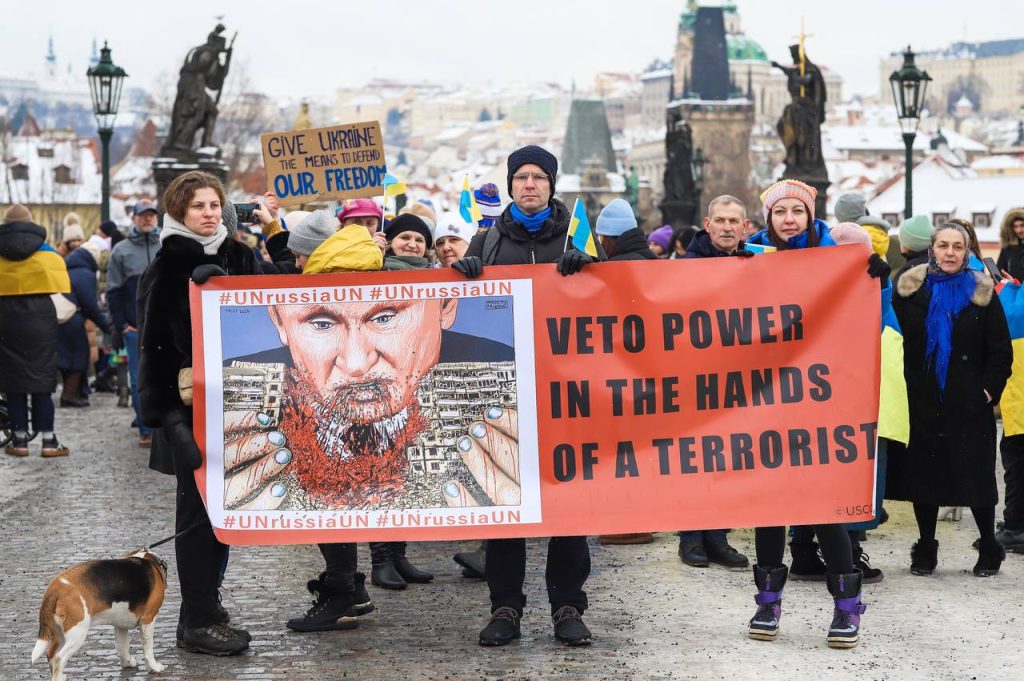
The United Nations is long overdue to either expel Russia or admit that it is no longer functional.
Over the past eleven months, the world has fundamentally changed, and these intense changes will inevitably continue in the near future.
Russia’s full-scale invasion of Ukraine, as well as the brutality, arrogance, and impunity of Russians, are unfortunately becoming normalized in our new world.
Russia strikes critical infrastructure, kills children, bombs schools and hospitals, commits sexual violence, loots homes, engages in nuclear blackmail, and occupies nuclear power plants. It commits war crimes while the entire world watches.
This is the first war in which humanity can witness all these crimes as they are being committed. It is the first war recorded on millions of phones, tens of thousands of video and photo cameras, with evidence instantly shared in the public domain.
This is the first war where fingerprints in the global network can lead to the names and addresses of rapists, looters, and murderers. It is difficult to find such transparency and clarity in previous wars.
Another defining feature of this war is the extraordinary, almost phenomenal self-organization of people into communities of support, characterized by decentralization, autonomy, and remarkable effectiveness.
Moreover, the uniqueness of these horizontal formations lies in their global solidarity — millions of people of different nationalities, races, and identities around the world have united to help Ukraine. This is undoubtedly an extraordinary phenomenon that will be studied for years after our victory.
Read also: Campaign #unrussiaUN to expel Russia from the UN Security Council
One reason for such global engagement is that people can instantly understand who is who in this war. Access to information through social media, direct contact with refugees and witnesses of crimes, and even the ability to travel to Ukraine and see everything firsthand create powerful public support for Ukraine among citizens of different countries worldwide.
The world has changed dramatically over the past 30 years, but Russia has failed to change even over three centuries. Neither its methods (total destruction, mass rape, glorification of war, justification of violence) nor the behavior of Russians (ranging from “we support the Führer” to “there is nothing we can do”) have changed.
At the same time, this war has surprised many with the relatively rapid adoption of certain political decisions. Sweden, which for decades viewed neutrality as a core principle — and where discussions about NATO membership were still considered marginal anarchism as recently as February 2022 — within six months, together with Finland, was already awaiting final confirmation of NATO membership. In addition, along with other countries, Sweden continues to supply Ukraine with necessary weapons.
Wars become a litmus test for evaluating the effectiveness of institutions created after World War II to promote and maintain peace. Many of them have proven ineffective because they are unable (or unwilling?) to recognize and adapt to the rapid changes demanded by the times.
The UN’s Failure
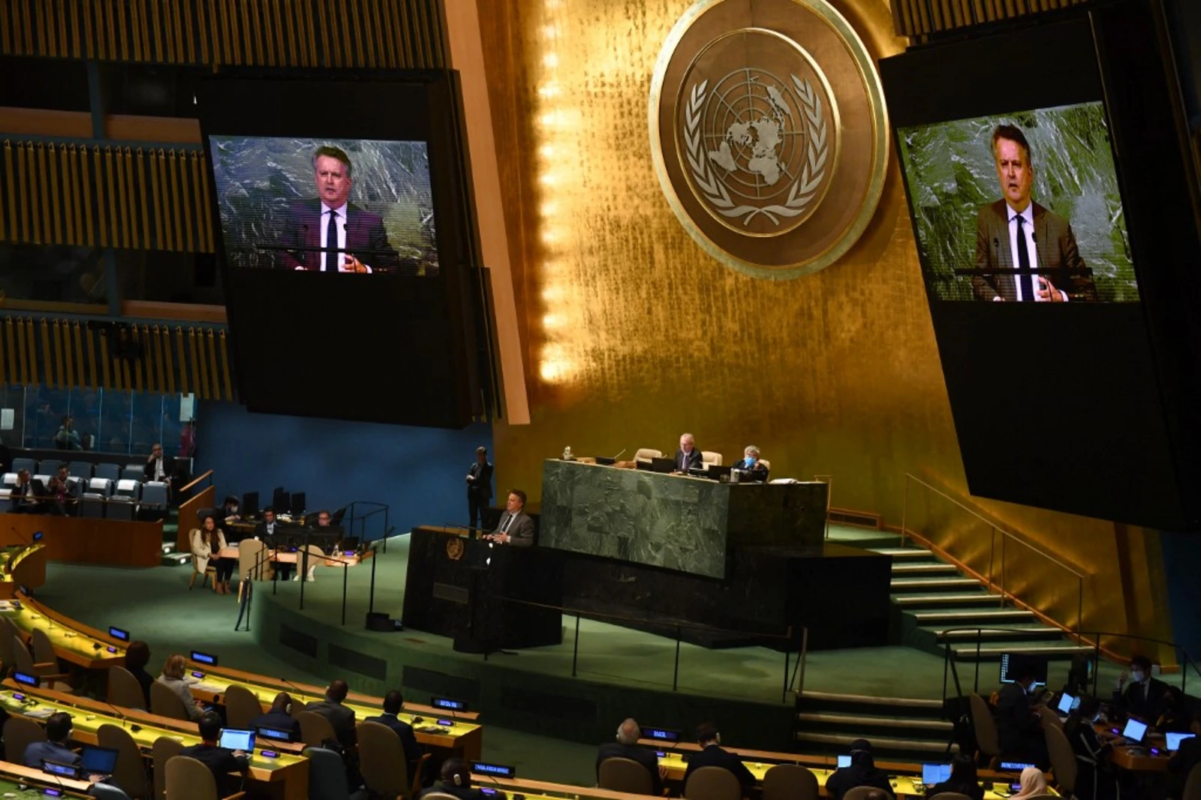
I recall participating in a meeting at UN headquarters dedicated to the situation in Crimea and the Crimean Tatars — people whom Russia attempted to suppress after occupying the peninsula because they were the leading force opposing the occupation. The lasting feeling after that discussion was one of clumsiness and carnival-like absurdity.
There was form, there was protocol. A speaker spoke, and a collective audience listened. Everything was recorded, and the required reports were submitted. Was there any therapeutic effect from this meeting? Personally, I see none. On the contrary, it felt like pointless formalities.
Another observation was the grotesque ethnicization of the collective “self.” Some participants wore feathers on their heads, others dressed in traditional ethnic costumes. Clearly, these people did not dress this way in everyday life — it was deliberate, because otherwise they could not be seen or heard. A cry for survival and grotesque articulation — all to speak about Stone Age crimes within an institution of the previous century. Leaving the institution, the image that remained was that of a sad carnival.
We are becoming accustomed to unspeakable tragedy, to death and terrorism, while Russia continues to commit fundamentally inhuman acts without being held accountable.
How did it happen that after systematic war crimes in Mariupol, Bucha, Kharkiv, Kherson, and Dnipro, the UN still did not do what was required of it — at the very least, to block Russia’s presence in the organization?
I am left with the same feeling: the UN functions solely to continue its own existence. What is its value? Why should citizens’ taxes fund an institution that causes harm through inaction?
If the UN wants to survive and overcome this crisis, the first thing it must do is permanently strip the Russian Federation of its status as a permanent member of the UN Security Council and expel it from the UN.
Russia systematically violates the UN Charter and therefore has neither the legal nor moral right to be a privileged member of the group of countries responsible for peace on the planet.
In fact, the Russian Federation uses its only effective instrument — the veto power in the UN Security Council. Any actions that could stop further Russian aggression are blocked by Russia itself. Exploiting its veto power and the inefficiency of the Security Council as a tool to counter aggression, Russia continues to commit systematic war crimes.
Paralysis of the UN Security Council
The UN Security Council, the body responsible for maintaining international peace, is completely paralyzed. Russia’s actions contradict the very concept of a “peace-loving” state. Three decades of its illegal presence in the UN have been marked by wars and the seizure of other countries’ territories, the violent redrawing of internationally recognized borders, and attempts to satisfy its expansionist and neo-imperial ambitions.
The root causes of these crimes lie not only in Russia’s policy of fomenting conflict but also in the systematic blocking of decisions necessary to address these issues. Since 1991, the Russian Federation has exercised its veto in the UN Security Council 31 times — nearly twice as often as any other permanent member.
Most importantly, Russia has no legal right to be part of the UN, because the seat it occupies belonged to the USSR. After the collapse of the Soviet Union, the transition was never properly formalized, and the words “Russian Federation” do not appear anywhere in the UN Charter. They are also absent from Article 23 of the Charter, which lists the permanent members of the Security Council.
It is time to take simple steps: designate Russia as a “temporarily suspended member” and freeze its status. Only then can progress be made.
The only argument I have encountered in favor of preserving this institution is that there is no more effective alternative, and that this one, somehow, restrains aggression. Yet the scale of genocide, ecocide, urbicide, nuclear threats, mass deportations, mass torture, and terrorist attacks that Russia has openly carried out for almost a year should prompt a supposedly concerned institution to immediately and openly acknowledge its weakness and inefficiency.
The UN needs new leadership and new management willing to implement urgent changes truly required in these extremely difficult times. Only the actions outlined above will help the UN overcome its deep crisis and become a stronger, more reliable institution. Otherwise, the UN will collapse — just as the Russian Federation will.
What About the UN’s Humanitarian Role?
To justify the organization’s existence, its defenders argue that it at least performs critical humanitarian functions. Indeed, it operates as any organization with a budget exceeding $3 billion would. However, the efficiency and cost-effectiveness of its activities raise serious concerns.
What portion of the budget is allocated to administrative costs? The official figure is only 10–20%. But given that projects cost millions, administrative expenses amount to hundreds of thousands. Inflated salaries, per diems, the need to purchase new vehicles and equipment, travel — all of this significantly affects how the relatively small group of donor countries’ contributions are spent on humanitarian needs.
How much does the person running the Secretary-General’s Twitter account earn? Or how much are content producers for the UN’s official pages paid to reproduce form that, in reality, carries little substantive meaning?
“I do not see an end to the war in the near future” or “I do not see any chance at this time for serious peace negotiations between the two sides.”
These are just random examples of notable statements attributed to Mr. Guterres. This is hardly what the world needs from the UN Secretary-General.
Alina Zubkovych, Director of Nordic Ukraine Forum.
13.06.2025
At the summit of the Bucharest Nine (B9) and Nordic countries held on June 2, 2025,…

13.06.2025
The full-scale war against Ukraine is setting new rules and military doctrines that must be taken…

09.06.2025
In the fall of 2024, the Kremlin took another step toward renewed nuclear blackmail. On September…


