


Mariupol is Putin’s blueprint for occupation, and the world is barely paying attention
18.05.2026
When Russia launched its full-scale invasion of Ukraine in 2022, Mariupol quickly became the site of…
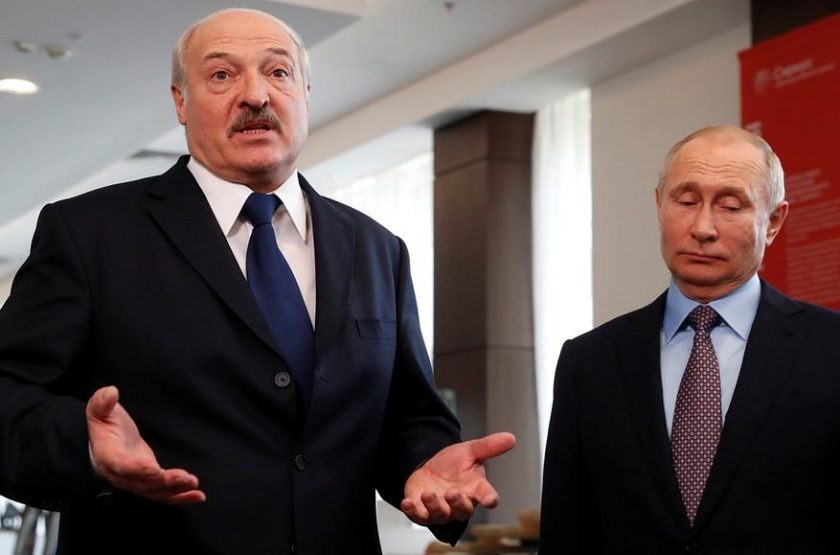
In the summer of 2020, presidential elections were held in Belarus. According to many experts, the real winner of those elections was Sviatlana Tsikhanouskaya.
Election fraud led to a wave of protests that had almost completely subsided by the beginning of 2021. This transformation of Belarusian society became an unexpected and unpleasant surprise for the authorities, who used all mechanisms at their disposal to suppress the protest movement — from mass repression and dismissals from work to imprisonment and even killings.
As a result of the latest political crisis, the absolute majority of opposition politicians in Belarus either ended up behind bars or were forced to emigrate.
In late May 2021 alone, a number of high-profile detentions took place in Belarus.
On May 22 in Minsk, six employees of the Polish satellite TV channel “Belsat”, which broadcasts in Belarusian, were detained. A few days earlier, 15 employees of the popular online portal TUT.by had been arrested.
On May 23, following an unprecedented violation of European air traffic protocols, former editor-in-chief of the opposition channel NEXTA Raman Pratasevich and his girlfriend were detained at Minsk airport. They were flying on a Ryanair flight from Athens to Vilnius. The plane carrying the opposition activist was forcibly landed with the help of a MiG-29 fighter jet, which caused serious outrage in the international community.
Together with those detained, two Belarusian citizens and four Russian citizens left the plane, presumably employees of the Belarusian KGB and Russia’s GRU.
If charged with terrorism, Pratasevich could face the death penalty.
After these events, Belarus found itself even deeper in de facto international isolation. The only strategic partner of Belarus’s self-proclaimed president Lukashenko remains Putin’s Russia.
However, according to intelligence sources, relations with the Kremlin have also undergone transformation. Whereas previously Lukashenko managed to maintain a certain degree of independence in his actions, he has now been placed within rigid limits, and assistance is provided only in exchange for steps that Moscow needs.
In particular, this includes increased military cooperation between the Union State countries and a deepening of Belarus’s economic dependence on Russia. Another objective is to redirect the political vector of the protest movement toward the East, while simultaneously demonizing NATO and the West as threats to national security. Thus, on April 17 Lukashenko accused the United States of organizing an armed uprising and an assassination attempt against him and his children. Russia’s FSB supported this statement and claimed that the military coup was allegedly being prepared with the participation of Ukrainian and local nationalists as well.
In addition, state propaganda has begun fighting all national reference points — the Belarusian language, symbols, and aspirations for independence. People are now fined for displaying white-red-white symbols (a symbol of the Belarusian national movement) or even combinations of these colors on private balconies.
Also, starting in the autumn of 2020, Lukashenko launched the process of drafting a new constitution, which many experts believe is linked to significant pressure from Moscow’s overseers.
Read also: Belarus: threats of war?
The process of party creation
Over the past 20 years, not a single new party has been registered in Belarus (although there were attempts, the local Ministry of Justice rejected all of them).
In general, political parties in Belarus are formal structures and have no real power. However, the situation may change as a result of constitutional reform. That is why, at the beginning of 2021, an active process of creating new political entities began.
In particular, an entire pool of parties directly connected to Moscow or to Alexander Lukashenko is currently undergoing the registration process.
First and foremost, this concerns the “Soyuz” party, whose creation involved active participation by agents of Russian influence engaged in the activities of the self-proclaimed DPR/LPR (the occupied parts of Ukraine’s Donetsk and Luhansk regions).
Thus, the party congress was attended by a Russian State Duma deputy and active collaborator who facilitated the annexation of Crimea — Dmitry Belik from Sevastopol — as well as representatives of the Russian party “A Just Russia – For Truth”: Alexander Kazakov (a former aide to DPR leader Zakharchenko) and Viktor Yatsenko (former “minister of communications” of the DPR). They delivered official greetings from their leader Zakhar Prilepin. The party was headed by a well-known Belarusian Russian Nazi Sergey Lushch.
However, contrary to expert forecasts that the party would be registered under the current conditions and relations with Russia, this did not happen. Using formal pretexts, the Ministry of Justice refused to register “Soyuz”, although the party has already stated that it will correct all mistakes and reapply for registration.
The “Democratic Union” Party
Its creation was announced by Yury Voskresensky, who took part in the Belarusian protests in the summer of 2020 and worked in the campaign headquarters of one of the candidates, Viktar Babaryka. Voskresensky was arrested and imprisoned for two months. After his release, he became an active supporter of Lukashenko and earned the nickname “the KGB’s mouthpiece.” According to him, the party he is creating will consist of protesters who “stopped in time” and “started watching the right television.”
The “People’s Unity” Party
This party is being created on the basis of the pro-presidential public organization “Belaya Rus,” which has been actively operating for the past 10 years. According to information available, the party is intended to become an analogue of “United Russia” (the ruling party of the Russian Federation) in Belarus.
The “People’s Right” Party
According to The Insider, a publication specializing in investigative journalism, Moscow has begun cooperation with a certain Belarusian “asset” to create a new party. It is planned that the party, provisionally called “People’s Right,” will oppose Lukashenko but support integration with Russia.
The Kremlin’s plans regarding Belarus are outlined in documents obtained by investigators. These include personal correspondence and documents from the Presidential Administration of Russia’s Directorate for Interregional and Cultural Relations with Foreign Countries, headed by Russian Foreign Intelligence Service General Vladimir Chernov.
In particular, they list spheres of influence, social and political projects, resources, media assets, as well as individuals responsible for maintaining Russia’s influence in Belarus.
Judging by the program published in the media, Moscow plans to redirect public discontent toward constitutional reforms, hoping that Belarusians will forget about the stolen elections. The documents also state that the Kremlin plans for Belarus to transition to a parliamentary-presidential republic and to carry out large-scale privatization of the state sector.
The publication’s website also released the party’s future founding documents and a list of seven individuals expected to become its leaders. All seven are Belarusian citizens but are active members of the so-called “United Russia” club.
Photo: theins.ru
Author: Borys Hrachov
18.05.2026
When Russia launched its full-scale invasion of Ukraine in 2022, Mariupol quickly became the site of…

05.05.2026
Russia pressed every Donbas sector in April, with assault tempo at a two-month high. The territorial…

16.03.2026
It is in the war against Ukraine that Russia is trying to adhere to this non-linear…


