


Mariupol is Putin’s blueprint for occupation, and the world is barely paying attention
18.05.2026
When Russia launched its full-scale invasion of Ukraine in 2022, Mariupol quickly became the site of…
In the spring of 2024, Russia intensified its offensive not only on the Ukrainian-Russian battlefield but also its hybrid attacks against Ukraine’s Western allies. Delays in providing Western military assistance and the lack of a unified vision on how to adequately respond to an aggressor that openly issues threats against Western states have sent yet another signal to the Kremlin about the vulnerability of democratic countries to Russian hybrid influence.
European countries are reporting an increase in cases of sabotage, cyberattacks, and arson that could threaten the safety of their citizens. Thus, in early March, Swiss intelligence (Nachrichtendienst des Bundes, NDB) reported increased activity by Russian agents in Europe and emphasized that they currently pose “the greatest threat.” In May, the head of the UK Government Communications Headquarters (GCHQ) stated that Russia is preparing “physical attacks” against the West, as British and American intelligence services uncovered a dual threat from Moscow and Beijing.
Ukraine’s military intelligence noted that Russia has never stopped building its networks abroad, with the goal not only of destabilization but also of influencing EU governments.
“The purpose of this activity is to destabilize the situation within the Euro-Atlantic community and individual countries, influence their governments, discredit Ukraine, weaken the pro-Ukrainian coalition, and ultimately weaken the entire free democratic world.”
said Andrii Yusov, representative of Ukraine’s Defense Intelligence.
Indeed, during the spring of 2024 alone, Western countries faced a series of cyberattacks and sabotage incidents linked to Russia.
In the United Kingdom, several men were arrested on charges of planning arson attacks against businesses connected to Ukraine. One of the detainees was linked to the Russian terrorist organization Wagner Group and was accused of conducting reconnaissance of sites and attempting to recruit individuals for foreign intelligence. The UK Home Secretary announced that, in response to Russia’s “criminal activity,” the UK would expel a Russian defense attaché identified as an undeclared military intelligence officer, impose restrictions on diplomatic visas, and strip several Russia-linked properties of their diplomatic status.
German police arrested two suspects in Bavaria on suspicion of spying for Russia. One of them, a Russian national of German origin, was linked to the so-called “DPR” terrorist organization. The suspects spied on U.S. military bases and planned sabotage operations aimed at undermining military aid to Ukraine.
Estonia summoned the head of the Russian embassy over GPS signal interference in the Baltic region affecting aircraft navigation systems.
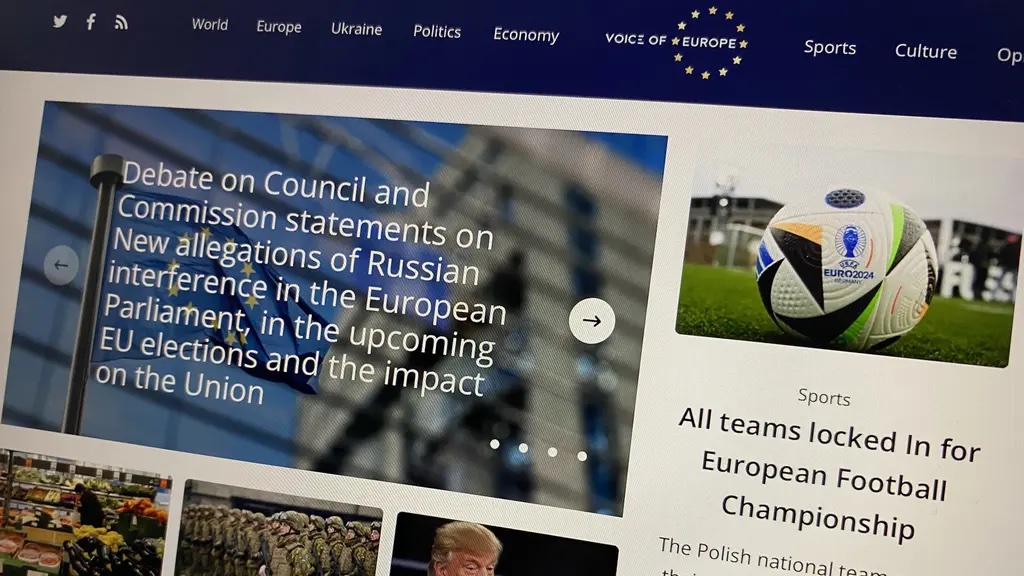
Czech media, citing intelligence sources, reported the exposure of a pro-Russian propaganda network intended to influence EU elections and support for Ukraine. According to the reports, politicians from several European countries received money from Voice of Europe to spread Kremlin narratives. Czech authorities believe the operation was backed by pro-Russian oligarch Viktor Medvedchuk, close to Putin. Following this revelation, Belgium’s прокуратура launched an investigation into possible interference in the upcoming European Parliament elections. On April 17, EU leaders decided to establish a temporary crisis task force to monitor and exchange information on potential Russian interference in European elections.
The APT28 group was also accused of cyberattacks against EU countries and European parties, including attempts to hack the email accounts of Germany’s Social Democratic Party leadership ahead of the European Parliament elections.
Given this background, a series of large-scale fires that occurred in Poland in May, as well as fires in Germany and the United States, appeared particularly suspicious. On May 20, Polish Prime Minister Donald Tusk stated that nine suspects had been arrested and charged with direct involvement in sabotage activities in Poland at the request of Russian services.
In Germany, authorities are investigating a dangerous fire at Diehl Metal Applications, part of the Diehl corporation. Its subsidiary Diehl Defence is a well-known weapons manufacturer, including IRIS-T systems supplied to strengthen Ukraine’s air defense. Earlier, in April, a fire broke out at the Scranton Army Ammunition Plant in the United States, which also produces ammunition supplied to Ukraine.
This activity is alarming, as 2024 is a year of major elections both in the EU and the United States. Moreover, regardless of differing political positions on the war in Ukraine, events on Europe’s largest battlefield will affect global security. Given Russia’s history of assassination attempts and interference in Western political processes, it is likely that Moscow will once again employ hybrid warfare tools to influence elections and public opinion. Russia has sufficient experience, resources, and lobbying power through pro-Russian organizations and politicians. Therefore, it is necessary not only to monitor Russian activity in the information space but also to scrutinize the operations of Russian organizations and businesses in EU countries. In particular, several Russian institutions, such as Rossotrudnichestvo’s “Russian House,” which has previously been suspected of spreading Kremlin propaganda and disinformation, continue to operate in some European countries despite restrictions. On May 21, the head of Rossotrudnichestvo stated that the EU had begun blocking the organization’s bank accounts. Work in this direction is ongoing.
The article was published on Euromaidan Press
18.05.2026
When Russia launched its full-scale invasion of Ukraine in 2022, Mariupol quickly became the site of…

05.05.2026
Russia pressed every Donbas sector in April, with assault tempo at a two-month high. The territorial…

16.03.2026
It is in the war against Ukraine that Russia is trying to adhere to this non-linear…


