


Mariupol is Putin’s blueprint for occupation, and the world is barely paying attention
18.05.2026
When Russia launched its full-scale invasion of Ukraine in 2022, Mariupol quickly became the site of…
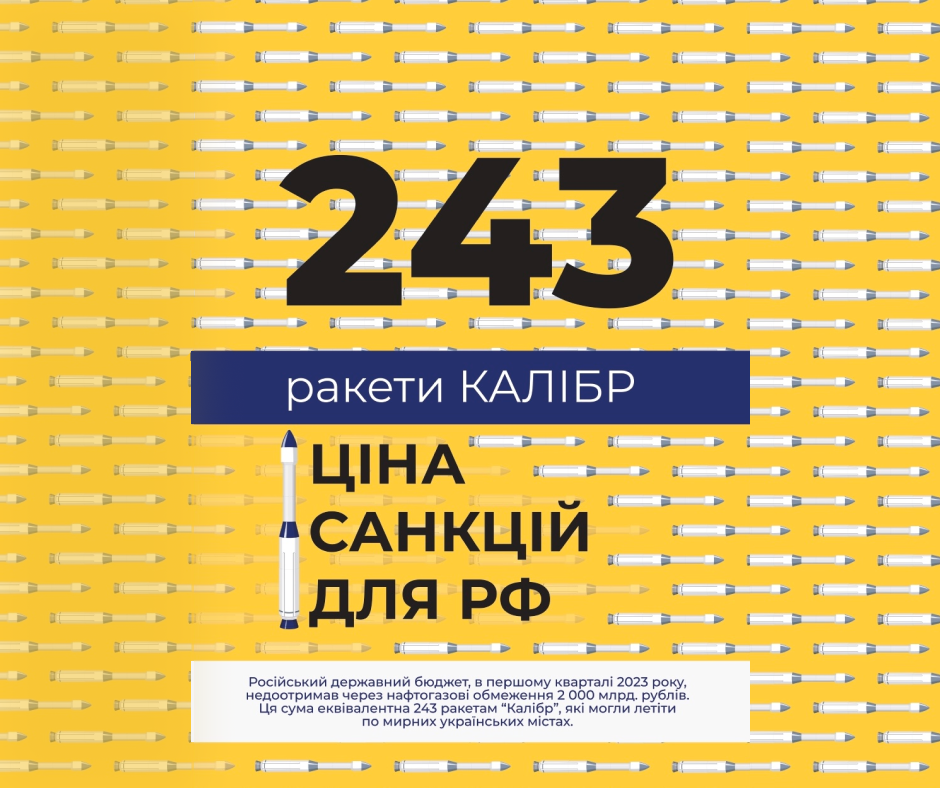
For a long time, Russian propaganda has been promoting the narrative that sanctions have no effect on its economy. This claim is voiced especially loudly for Western audiences. We analyze how sanctions have actually affected the Russian Federation after more than a year of full-scale war.
In 2022, the Russian Federation was recognized as the most sanctioned country in the world, significantly surpassing Iran and North Korea. The sanctions were intended to weaken Russia’s economy to the extent that it would no longer have the resources or capacity to wage war against Ukraine.
It should be noted that such consequences represent the maximum objective of a long-term process such as the imposition and impact of sanctions. More than a year has passed since the large-scale invasion began on February 24, yet a global collapse has not occurred. Russia’s economy remains “afloat,” and the war in Ukraine continues. These facts have become the foundation for Russian propaganda claims about the inefficiency of sanctions. However, in reality, sanctions have significantly clipped the wings of Russia’s two-headed eagle.
What consequences does sanctions policy have for Russia? We examine this in an analytical report by experts from the Ukrainian Center for Security and Cooperation.
MANIPULATION “WITH NUMBERS”
The most influential sanctions against Russia were imposed by the United States, Canada, the United Kingdom, and the European Union. In total, more than 40 countries worldwide joined the sanctions regime. The restrictions affect the energy and banking sectors, the military-industrial complex, machine building, and other industries. Western countries have also sanctioned more than 1,000 Russian individuals and companies, including oligarchs close to the Kremlin.
Despite this, Russia’s economy did not collapse catastrophically in 2022: GDP declined by at least 2.2% in the best-case scenario and up to 3.9% in the worst-case scenario. Although many international experts and financial research institutions predicted a 10–15% decline, Russia managed to avoid such a fall.
Russian propagandists and Russia’s supporters in the West use these figures to argue that the economy is resilient to sanctions. In her article “Don’t Believe Russia’s Numbers,” American economist and head of global economic forecasting at The Economist, Agathe Demarais, argues: “The number has become the subject of political debate. For some, the low figure is proof that Russia’s economy is resilient and sanctions are not working. Others use the same number to argue that sanctions are beginning to bite and Western countries should double down. These opposing arguments share one thing in common: they rely on largely meaningless numbers.”
Indeed, this figure alone does not provide real insight. Economic experts state that the limited GDP decline was driven by emergency measures taken by the Central Bank, domestic financial restrictions, the use of the National Wealth Fund, growth in the military-industrial complex fully redirected to the war against Ukraine, and oil and gas revenues boosted by the spike in energy prices in early 2022.
European sanctions take effect gradually. There are many reasons for this: key sanctions that strongly affect certain sectors of Russia’s economy may take a long time to adopt, or they may enter into force only after a delay. For example, oil sanctions with a six-month delay came into effect on December 5, 2022, while fuel sanctions followed on February 5, 2023. This time was granted to EU countries to find alternative energy supply routes and reduce economic pressure.
International experts assert that Russia’s economic problems will significantly worsen and become partially critical in 2023–2024, as the most painful sanctions begin to have a tangible impact one to two years after their introduction.
GOLDEN OIL WILL STAY IN RUSSIA
One of the main reasons for Russia’s economic decline will be oil and gas-related sanctions, as these commodities make up the largest share of Russia’s revenues. In pre-war years, 60–70% of export income came from oil and gas trade. About 40% of the federal budget was formed from oil and gas export revenues, and half of oil product exports went to the European Union.
EU restrictions on Russian oil and gas were adopted only at the end of 2022. The embargo on maritime transportation and imports of Russian oil and petroleum products, as well as the oil price cap, will significantly reduce oil revenues that Russia had long received steadily from the EU.
In its March report, the Kyiv School of Economics forecasts that the EU embargo on Russian oil and petroleum products will reduce energy export revenues, while G7 price caps have lowered market prices. Further sanctions—such as lowering the oil price cap and banning transportation of Russian LNG and pipeline gas outside Ukrainian territory—could increase pressure and lead to further reductions in oil production.
As a result, it is expected that these sanctions will reduce Russia’s revenues by an additional $56 billion in 2023 and $66 billion in 2024.
18.05.2026
When Russia launched its full-scale invasion of Ukraine in 2022, Mariupol quickly became the site of…

05.05.2026
Russia pressed every Donbas sector in April, with assault tempo at a two-month high. The territorial…

16.03.2026
It is in the war against Ukraine that Russia is trying to adhere to this non-linear…


