


Mariupol is Putin’s blueprint for occupation, and the world is barely paying attention
18.05.2026
When Russia launched its full-scale invasion of Ukraine in 2022, Mariupol quickly became the site of…
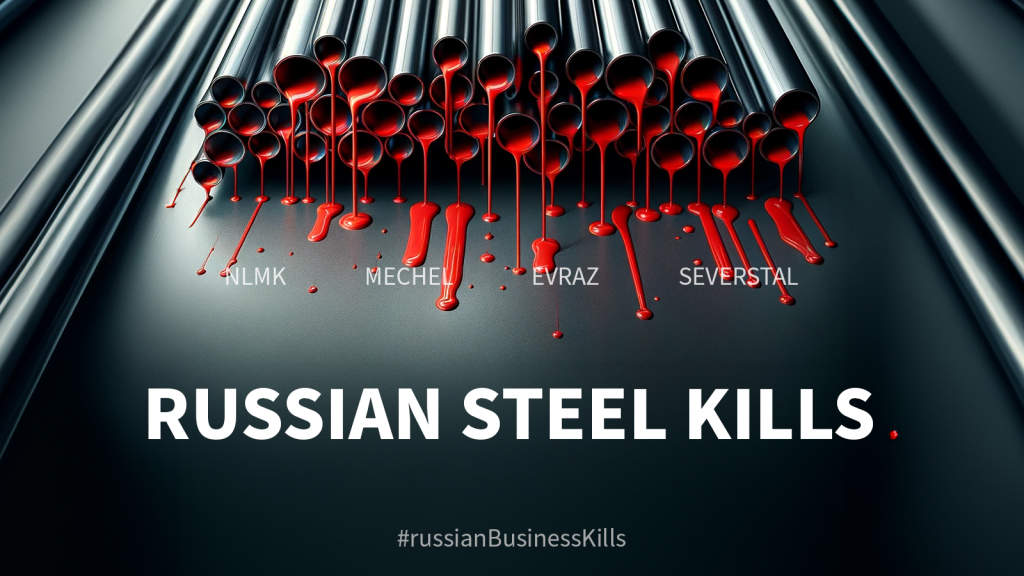
Since Russia’s full-scale invasion of Ukraine, all 27 EU member states have introduced 13 sanctions packages against Russia. These measures include restrictions on trade in oil, coal, timber, and many other resources.
However, a serious loophole in the sanctions regime remains: European industry continues to purchase large volumes of raw materials classified as “critical” or “strategic” — namely metals. Sales through just four companies owned by Russian oligarchs — RUSAL (Sweden and Ireland), Nornickel (Finland), NLMK (Belgium, Denmark, Italy, France), and VSMPO-AVISMA (Germany) — generated more than $20 billion for the Russian budget in 2022 alone. This amount is equivalent to more than 6,500 Iskander-M ballistic missiles or 400 Su-34 bombers, which Russia uses daily to bomb frontline and border Ukrainian cities.
The EU’s sanctions policy is also being undermined by information about state-level lobbying to bypass sanctions. In particular, media recently reported that French President Emmanuel Macron made “significant efforts” to persuade Canada to exempt Airbus and other aerospace companies from sanctions on Russian titanium. This situation creates dangerous precedents.
What is wrong with Russian titanium
The Russian corporation VSMPO-AVISMA is the main producer and exporter of titanium to Europe. While receiving revenue from Western sales, the corporation is also strategically important to Russia’s military-industrial complex. In particular, it supplies titanium for the production of Su and Tu bombers, patrol ships and submarines from which Russia launches Kalibr cruise missiles, as well as for the manufacture of ballistic and intercontinental ballistic missiles such as Bulava and Topol-M, with which the Kremlin threatens the world. Titanium products from VSMPO-AVISMA are also purchased by the Kalashnikov weapons концерn.
One of the co-owners of this titanium corporation (25% of shares plus a controlling share) is the Russian state company Rostec, which is under EU and US sanctions for its role in Russia’s defense industry and is, among other things, a manufacturer of T-90 “Proryv” tanks and Lancet UAVs. Another owner is Russian oligarch Mikhail Shelkov (66.42% of shares).
In 2022, Russian titanium was removed from proposed sanctions lists at the last moment. France and several other EU member states blocked the decision due to the dependence of the world’s largest commercial aircraft manufacturer, Airbus. As a result, in the absence of sanctions, AVISMA has been able to conduct direct trade with European companies, purchasing equipment and resources necessary for its operations. It cannot be ruled out that this equipment is also used by Russia’s military-industrial complex.
AVISMA’s operations in the EU
AVISMA conducts its main operations in the EU through its German subsidiary VSMPO-Tirus GmbH, headquartered in Frankfurt. In 2022 alone, it sold 15,000 tonnes of Russian titanium to the EU worth $370 million. In 2023, sales amounted to at least $345 million (exact figures are not publicly available).
According to the Washington Post, the largest buyers were companies from Germany, France, the US, and the UK. Major clients prior to 2022 included Boeing and Airbus. In March 2022, Boeing announced it would stop purchasing Russian titanium.
In December 2022, Airbus also pledged to stop using Russian titanium. However, according to customs data analyzed by Disclose and Investigate Europe, between February 24, 2022, and March 14, 2023, Airbus purchased $22.8 million worth of Russian titanium — four times more than in the previous 13 months.
In addition, companies can purchase metal through intermediaries or buy finished products made from Russian titanium. For example, the French engine and landing gear manufacturer Safran and the British company Rolls-Royce, which produces engines for Airbus and Boeing, announced in 2022 that they would stop buying Russian titanium, yet imports continued throughout 2022 and 2023.
In April 2024, Reuters also reported that despite sanctions on AVISMA, the Canadian government allowed Airbus to use Russian titanium in aircraft production. This could set a bad precedent for European countries and weaken the sanctions regime.
Russian lobbying in the EU
Moscow exploits the EU’s dependence on Russian raw materials to influence sanctions policy. In particular, in November 2023, companies linked to Russia from the NLMK group (with plants in Belgium, Denmark, France, and Italy) and the Czech steel company Vítkovice Steel lobbied for easing sanctions on Russian steel imports.
As a result, in the 12th sanctions package adopted in December 2023, the EU extended quotas on Russian steel slabs for another four years. Extending the quotas does not force European manufacturers to diversify their sources of raw materials; instead, it allows them to remain within Russia’s “metallurgical pool” and continue their dependence on Moscow.
Notably, the Czech Republic and Belgium — countries that lobbied these decisions at the EU level — are connected through the presence or business ties of the aforementioned Russian steelmaker NLMK, owned by Russian oligarch Vladimir Lisin. In April 2024, NLMK reported a 25.8% increase in net profit for 2023, reaching 209.37 billion rubles ($3.22 billion).
In addition, Czech steelworkers also influenced the extension of quotas by pressuring the authorities. In November 2023, the OS KOVO metalworkers’ union organized a mass strike involving around one million workers. Coincidentally, the union’s head, Roman Durčo, is a member of the Supervisory Board of Vítkovice Steel — the largest lobbyist for the quotas. Vítkovice Steel was previously owned by Evraz, a holding company of Russian oligarch Roman Abramovich. In 2014, it was acquired by a group of Cyprus-registered companies. According to an investigation, the actual owner is Russia’s state development bank Vnesheconombank (VEB), which was sanctioned by the EU following Russia’s full-scale invasion of Ukraine.
In 2022, the Czech Financial Analytical Office (FAÚ) froze Vítkovice Steel’s assets. However, company management denies ties to Moscow and, as of May 2024, continues operations.
Of course, the revenue Moscow receives from selling titanium and steel is not comparable to the billions Russia earns from liquefied natural gas or other metals. However, it represents another potential lever for the Kremlin to exert political pressure on entire sectors of the global economy. As in the case of the bribery of European politicians from Germany, France, Poland, Belgium, the Netherlands, and Hungary to influence EU elections and promote Kremlin narratives, Russia uses affiliated corporations to influence European governments. This creates a paradox: European partners provide Ukraine with financial and other assistance to resist Russian aggression, often amounting to millions of euros, while at the same time, by purchasing Russian raw materials and extending quotas, they effectively support Russia’s ability to continue waging this aggressive war. This not only undermines the assistance provided but also does nothing to help end the war.
The material was published on Ukrainska Pravda
18.05.2026
When Russia launched its full-scale invasion of Ukraine in 2022, Mariupol quickly became the site of…

05.05.2026
Russia pressed every Donbas sector in April, with assault tempo at a two-month high. The territorial…

16.03.2026
It is in the war against Ukraine that Russia is trying to adhere to this non-linear…


