


Mariupol is Putin’s blueprint for occupation, and the world is barely paying attention
18.05.2026
When Russia launched its full-scale invasion of Ukraine in 2022, Mariupol quickly became the site of…
The “migration crisis” on the eastern borders of the EU, which has been ongoing for several months, has significantly escalated in recent weeks, leading to the introduction of a state of emergency in the border regions of Poland and Lithuania adjacent to Belarus. The possibility of introducing a state of emergency is also being considered in Ukraine.
The latest escalation has resulted in the deaths of migrants, serious clashes at the border, and raised the question of imposing new sanctions against the Belarusian regime.
Against the backdrop of the crisis escalation, the EU political leadership took an unprecedented step and entered into direct talks with the illegitimate president Alyaksandr Lukashenko. This is the first such case since the 2020 elections that a representative of Western political leadership has engaged in direct contact with him.
The very fact of these negotiations was perceived by Belarusian and Russian propaganda as another victory, proof of Lukashenko’s influence over European processes and a full recognition of the Belarusian dictator by the EU.
At the same time, the migrant situation itself was actively amplified from the very beginning in the Russian and Belarusian information space as indisputable evidence of the inhumane nature of Western democracies.
In recent days, the situation at the border has stabilized, and a significant portion of migrants has been relocated from spontaneous camps near the border to special detention centers organized by the Belarusian authorities. This happened almost immediately after Lukashenko’s talks with German Chancellor Angela Merkel, who held two phone conversations with him. This fact gives rise to reasonable suspicions that one of the main goals of the crisis organizers was to obtain recognition of the Belarusian authorities by the EU leadership and the lifting of sanctions imposed after the events of 2020.
Although official communiqués do not disclose the content of the talks, Estonian Foreign Minister Eva-Maria Liimets stated that Lukashenko presented two demands to the EU in exchange for ending the migration crisis: recognition of him as the legitimate leader of Belarus and the lifting of sanctions.
However, this blackmail did not work. On November 29, Estonia’s foreign minister announced that the fifth sanctions package against Belarus was to be adopted on December 2.
In addition, many Western and Ukrainian experts believe that the “migration crisis,” essentially a hybrid attack on the EU’s eastern borders, may be only part of a broader plan and serve as a diversion from Russia’s intentions toward Ukraine.
Considering the completion of the Nord Stream 2 gas pipeline, Russia’s overtly disruptive actions on the energy market, Belarus’s sabotage of Ukraine’s energy system, intensified anti-Ukrainian propaganda in Russia, and the active build-up of Russian armed forces along Ukraine’s borders, this version appears highly plausible.
An increasing number of authoritative international outlets and experts warn that the risk of a Russian invasion is extremely high and that the Russian army is preparing to repeat the Georgian scenario of 2008. At the same time, this activity can also be interpreted as blackmail of the West related to the certification and launch of Nord Stream 2, which would undoubtedly strengthen Moscow’s influence over the EU.
Integration with Russia
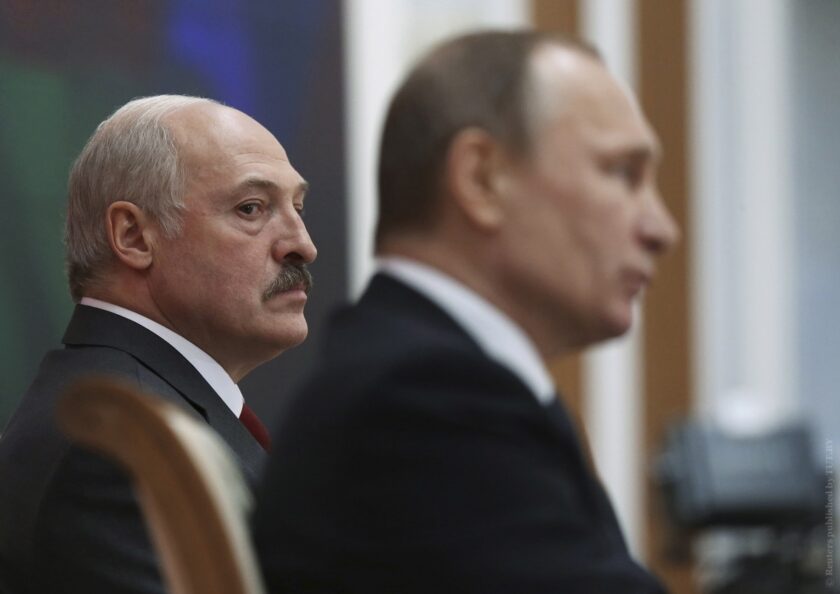
On November 4, another online meeting of the Supreme State Council of the Union State took place. Russian President Vladimir Putin and Belarusian self-proclaimed president Alyaksandr Lukashenko approved 28 union integration programs.
The documents agreed upon in September frequently use the word “harmonization.” This includes harmonization of monetary systems, creation of a common payment space, new taxation principles, unification of legislation, development of a single energy market, industrial and agricultural policy, among others. Details of all 28 programs remain undisclosed, and it is unclear how they will be implemented.
Despite the intensified construction of the Union State, it appears that only Putin is genuinely interested in it, while for the illegitimate Lukashenko this entire project serves merely as a tool to prolong his political survival (see also Belarus–Russia: Integration or Imitation).
This is evidenced by both the absence of real steps toward integration and certain actions by the Belarusian leader that provoke irritation even in Russia itself.
For example, Lukashenko recently stated that in the event of sanctions against his country, he could stop gas supplies to Europe.
These statements caused outrage not only in the EU but also in Russia, since both the gas and the pipelines belong to Gazprom, not the Belarusian government. Therefore, Lukashenko has no legal ability to halt gas supplies to the EU (although legality has never been a concern for the Belarusian regime).
The unexpected nature of these remarks for the Russian government is evidenced by the fact that Putin had to comment publicly, expressing hope that no actual interruption of supplies would occur.
Thus, as of today, real political integration between Belarus and Russia appears impossible, as it is neither beneficial nor safe for Alyaksandr Lukashenko.
However, this does not guarantee that Russia will not use Belarus as a staging ground for aggression against Ukraine. In matters of deploying Russian troops on Belarusian territory, Lukashenko shows no resistance—quite the opposite. Among the documents approved on November 4 was also an updated military doctrine.
Military Doctrine
The military doctrine was first adopted 20 years ago, but in 2018 it was updated and approved by government leaders. The new version takes into account the “realities of the geopolitical and military-strategic situation in Europe and military threats,” including NATO expansion, the buildup of military potential, “color revolution” technologies, and provocation of internal conflicts.
Union State Secretary Dmitry Mezentsev noted that the new document would improve coordination of defense policy in light of changes in the regional military-political situation and “unprecedented pressure” on Moscow and Minsk.
The primary objectives include developing a unified regional grouping of forces and integrated military systems.
A military cooperation plan between Russia and Belarus until 2024 was also developed. As a result:
Belarusian authorities explain this activity as a “hybrid war” against Belarus conducted “in virtually all directions.”
“We don’t know what they might throw at us. Could we have imagined a migration crisis? Yet it happened, and it is constantly fueled,” Lukashenko said on November 29.
At the same time, the regime accuses neighboring countries—Poland, the Baltic states, and Ukraine—of militarizing borders and conducting special operations, hinting that Belarus would support Russia in the event of a new escalation.
Ultimately, events in Belarus benefit only Moscow, while millions of Belarusians and neighboring states—especially Ukraine—become hostages to the situation.
Today, relations between Russia and Belarus resemble a handler and a bear in an iron cage. The Kremlin seeks to demonstrate its control over Lukashenko, while using him to appease domestic audiences.
However, whether Lukashenko will actually intervene militarily in the Russian–Ukrainian war remains an open question.
Photo: Reuters
Authors: Borys Hrachov, Oksana Kuzan
18.05.2026
When Russia launched its full-scale invasion of Ukraine in 2022, Mariupol quickly became the site of…

05.05.2026
Russia pressed every Donbas sector in April, with assault tempo at a two-month high. The territorial…

16.03.2026
It is in the war against Ukraine that Russia is trying to adhere to this non-linear…


