


Mariupol is Putin’s blueprint for occupation, and the world is barely paying attention
18.05.2026
When Russia launched its full-scale invasion of Ukraine in 2022, Mariupol quickly became the site of…
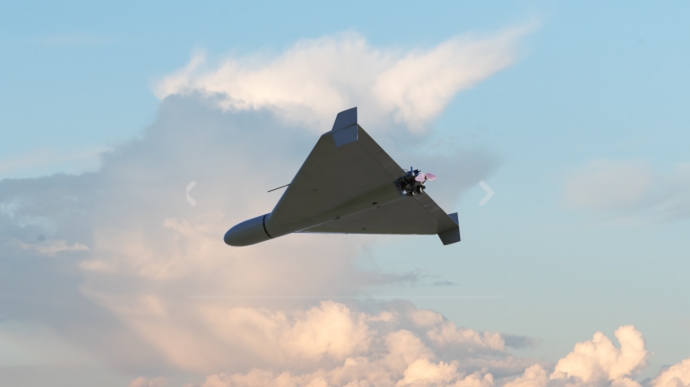
In the third ten-day period of May, Russia significantly increased the number of drones launched toward Ukraine. According to the Ukrainian Air Force, on the night of May 26 the enemy launched 355 Shahed-type attack UAVs and various decoy drones, marking a record single drone attack by Russia at that time.
In its article dated May 25, 2025, The Economist reported that Russia is preparing to launch more than 1,000 Shahed drones against Ukraine simultaneously, also claiming that these drones are being equipped with artificial intelligence. Citing Ukraine’s Main Intelligence Directorate (HUR), the publication asserted that Russia’s military-industrial complex has the capacity to produce 500 drones per day.
At present, there is no official confirmation from Ukrainian intelligence regarding a sharp increase in Russia’s production capabilities. At the same time, on March 3, 2025, Deputy Head of the HUR Vadym Skibitskyi stated that Russia is planning simultaneous attacks on Ukraine involving around 500 Shahed drones and other UAVs. In this context, the HUR representative was referring not to production, but to operational use. In addition, claims about Shaheds being used with artificial intelligence were publicly refuted by the head of Ukraine’s Center for Countering Disinformation and by Ukrainian military officials.
Judging by the night attack of May 26 and other available information, there are indeed signs that Moscow’s capacity to manufacture Shahed-type drones and their imitators (Geran-1, Geran-2, Harpia, Herbera, Parodiya, etc.) has increased. This is evidenced, in particular, by the scaling up of production at the plant in Alabuga (Republic of Tatarstan). When the facility began operations in 2023, its production area was around 80,000 square meters. However, satellite imagery from April 2025 shows that the site has since doubled in size, with at least five new buildings added, including a covered passageway and protective anti-drone netting. In parallel, drone production is also taking place at other facilities, including in Izhevsk at the Kalashnikov Concern. As of August 2024, the HUR estimated Russia’s drone production capacity at around 500 units per month.
An increase in the number of Russian drones may also be indicated by the Kremlin’s efforts to minimize reliance on components from countries that have imposed sanctions, replacing them with Chinese analogues. In particular, the electronic warfare protection of Shahed drones has almost entirely eliminated dependence on U.S. components. In this case, switching to Chinese alternatives allows Russia to obtain components in the required quantities without obstruction, which in turn reduces production time and facilitates faster deployment.
It is also worth noting that Moscow has increased the number of launch sites for drones. Previously, there were around five such locations, but over the past eight months their number has doubled to 11, including sites in Russia’s border regions and in temporarily occupied territories of Ukraine.
Despite all these factors, it is still too early to claim that Russia will soon be able to produce more than 500 drones per day, let alone launch more than 1,000 simultaneously.
The only scenario in which Russia could carry out an attack involving a thousand drones would be through their prior accumulation over a certain period. In fact, Russia has had — and still has — the ability to stockpile such numbers, especially if decoy drones and lures are used in parallel. However, deploying such a large number of drones simultaneously remains difficult at present.
For example, during the aforementioned largest attack on the night of May 25–26, Russia simultaneously launched 355 Shahed-type drones and various decoys, using seven of the 11 known launch sites. It is worth noting that three airfields — Seshcha, Yeysk, and Berdiansk — have not been used for drone launches since last year. The Ukrainian Air Force report after the attack also did not mention the Hvardiiske airfield in temporarily occupied Crimea, suggesting it was likely not used either.
Currently, Russia’s drone launch infrastructure can support between 20 and 60 launches per site. During this operation, Russia effectively used the maximum capacity of its existing launch sites to conduct the simultaneous launch of 355 drones.
To achieve a simultaneous launch of 1,000 drones, each site would need to launch between 90 and 142 UAVs — a level that has not yet been observed. To reach such scale, Russia would need either to significantly expand capacity at existing sites or to build several new ones.
This underscores the significant logistical and operational challenges Russia faces in attempting to scale up its drone strikes.
In addition to infrastructure, a sufficient number of trained and prepared operators is required to launch these drones, which is also a time-intensive process. Therefore, it can be cautiously assumed that Russia currently lacks both the capacity and the capability to launch 1,000 drones, especially on a regular basis.
At the same time, the Defense Forces of Ukraine are doing everything possible to prevent such capabilities from emerging. This is precisely why Ukraine has carried out long-range strikes against Russian military-industrial facilities in various regions of Russia, including attacks on Yelabuga, where the aforementioned Shahed or Geran-2 drones are produced.
The West can also play a role in preventing Russia from scaling up its drone launch capabilities against Ukraine. In particular, the most effective means of countering Russian drone strikes is the destruction of storage, production, and launch facilities directly on Russian territory. On May 26, reports emerged that Germany, as well as France, the United Kingdom, and the United States, no longer impose restrictions on the range of weapons supplied to Ukraine or their use on Russian territory. Had such restrictions been lifted earlier, the balance of power in the air and on the battlefield could have changed significantly.
At present, even if the reports about lifting restrictions are accurate, Ukraine has a very limited stock of long-range weapons (Storm Shadow/SCALP, ATACMS, etc.), and a significant increase in supplies is unlikely due to U.S. policy. One effective way to strengthen Kyiv’s long-range capabilities is to support the Ukrainian defense industry through investment under the “Danish model,” leading to increased production of cruise and ballistic missiles, strike drones, and more. Supporting and developing Ukraine’s defense industry is not only an investment in Ukraine’s defense capabilities, but also a contribution to Europe’s overall security system.
The article was published as a column on Censor.NET
Photo: Getty Images
Author: Dmytro Zhmailo
18.05.2026
When Russia launched its full-scale invasion of Ukraine in 2022, Mariupol quickly became the site of…

05.05.2026
Russia pressed every Donbas sector in April, with assault tempo at a two-month high. The territorial…

16.03.2026
It is in the war against Ukraine that Russia is trying to adhere to this non-linear…


