


Mariupol is Putin’s blueprint for occupation, and the world is barely paying attention
18.05.2026
When Russia launched its full-scale invasion of Ukraine in 2022, Mariupol quickly became the site of…
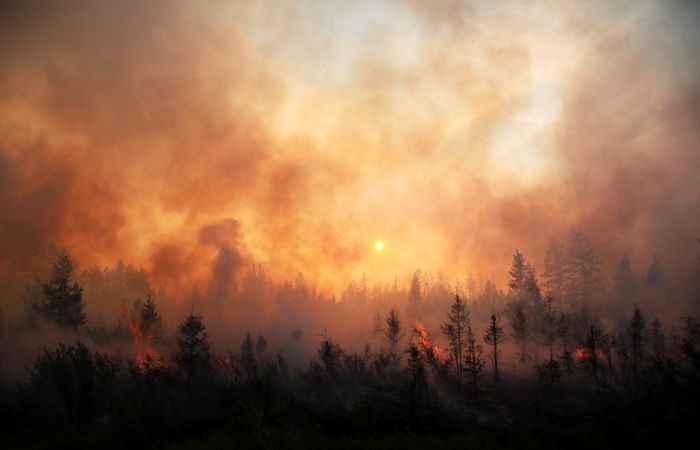
While Russian President V. Putin was writing an article about being “one people” with Ukraine and sending special equipment to fight wildfires in Turkey, thousands of hectares of forest were burning inside Russia itself — in Yakutia and Karelia.
The Situation in Yakutia
Yakutia (the Sakha Republic), located in northeastern Siberia and the largest administrative-territorial unit in the world, is suffering from massive wildfires. Local residents suspect that Yakut officials may be involved, allegedly attempting to conceal illegal logging and profit from firefighting funds allocated by the state.
The fires are approaching populated areas, and smoke is now felt far beyond neighboring Krasnoyarsk Krai. Smog covers almost all of Siberia, has reached Tatarstan and Kazakhstan, and even the southwestern part of the Sea of Okhotsk. In addition, six fires were detected in specially protected natural areas — the Lena Pillars Nature Park and the Olyokminsky Nature Reserve. According to the republic’s Ministry of Ecology, the fire currently poses a potential threat to the Svetlinskaya Hydroelectric Power Plant, despite the presence of a natural barrier — the Vilyuy River.
On July 11, a popular Russian blogger spoke about the massive wildfire in Yakutia. He noted that Russian media were deliberately avoiding the topic.
Firefighters attempted to induce rain over critical areas, but most of the time the fight against the fire was reduced to spraying water from special backpacks with a capacity of 15–18 liters. This is how local firefighters, together with activists — including women and children (although local authorities deny children’s involvement despite photo and video evidence) — tried to contain the fire, as there was simply no other equipment or machinery available.
In addition, in 2015 the Russian Ministry of Natural Resources designated so-called “control zones,” where extinguishing forest fires is considered “economically impractical.” These zones cover nearly half of all forests in Russia. Looking at the map of Yakutia, most of the region falls precisely within these “control zones.”
Realizing the severity of the situation, local residents asked Moscow to pay attention — for example, to purchase or deploy Be-200 amphibious aircraft, which collect water from rivers or lakes and drop it onto fires. However, Russians had to wait a long time for help due to the Kremlin’s geopolitical games. By Putin’s order, Russian Defense Minister Shoigu sent the Be-200 aircraft to Turkey, where wildfires were also raging. Russia came to the aid of Erdoğan — but not its own citizens.
Having lost hope of receiving help from the authorities, activists tried to draw the attention of global celebrities, including American actor Leonardo DiCaprio. This step proved to be the most effective. However, instead of fighting the fire, local authorities began persecuting journalists and activists who spoke about the disaster.
In particular, activist Roza D’yachkovskaya, who was born in Yakutia, faced a wave of criticism and harassment after appealing to DiCaprio for help. She was forced to post a statement on social media, tearfully saying that she “wants to live a normal life and will delete all her posts about the fires.”
Eventually, even Moscow realized that the situation in Yakutia was spiraling out of control. Russia’s Minister of Natural Resources and Ecology sent a letter to the Prosecutor General’s Office demanding action against the Yakut authorities for concealing the real scale of the fires and taking insufficient measures. According to reports, for some fires the discrepancy between satellite monitoring data and official reports reached a factor of 40.
In response, the Yakut Ministry of Ecology, Nature Management, and Environmental Protection issued a statement claiming the data were inaccurate and that the real area affected by fire requires monitoring — “but there is no money for that.”
At the same time, Yakutia received 1.7 billion rubles from Russia’s federal budget this year alone to fight forest fires. Despite this, 15–18-liter backpacks remained the main firefighting tool against blazes that engulfed more than one million hectares of forest. The situation changed only after public exposure: as of July 27, two helicopters and three Be-200 aircraft were deployed for monitoring and firefighting.
The entire story raises serious questions about local authorities. Residents are convinced that officials are behind the fires, allegedly trying to conceal illegal logging and profit from funds allocated by Moscow to combat the blazes.
Numerous media reports from recent years support this version:
1. Sturgeon dying in the Lena River in Yakutia
2. Logging in Yakutia will lead to permafrost thaw — scientists
3. Illegal logging uncovered in ten districts of Yakutia
4. Yakutia suffocates in smoke — “Nikolaev, resign!”
5. “They burn what is profitable to cut”: how ‘commercial’ arson works
In addition, local authorities closely monitor social media comments about deliberate arson and personally respond, denying such claims. This clearly indicates that officials have something to hide and do not want this version to gain traction.
As of July 28, more than 1.3 million hectares of forest are burning in Yakutia. Since the beginning of the fire season, 1,191 fires have been recorded. Russian authorities currently report 126 registered fires, 48 of which are being extinguished. According to Avialesookhrana, 55% of fires are not being fought at all — again citing “lack of funding,” which prevents the purchase of necessary equipment and hiring personnel. Local volunteers continue helping firefighters battle the flames.
Republic of Karelia (Russian Federation)
Meanwhile, wildfires have also engulfed Karelia, located in northern Europe and bordering Finland. As of July 27, forest fires covered nearly 11,300 hectares in the republic.
Local residents are fighting the fires day and night on their own, without any special equipment. Fire engines and helicopters are sorely lacking, while local officials report receiving assistance from other regions.
Residents of the village of Naistenjärvi were forced to hold back the fire on their own for five days. Instead of extinguishing the fire while it was still small, local authorities suggested evacuation. People chose to save their homes themselves: they formed volunteer squads and coordinated actions via social media. Without specialized equipment, extinguishing the fire was nearly impossible. Residents found themselves encircled by fire.
Help arrived only after the fire spread to houses. The wildfire around the village continues to this day and is considered one of the largest in Karelia.
Author: Oksana Kuzan
18.05.2026
When Russia launched its full-scale invasion of Ukraine in 2022, Mariupol quickly became the site of…

05.05.2026
Russia pressed every Donbas sector in April, with assault tempo at a two-month high. The territorial…

16.03.2026
It is in the war against Ukraine that Russia is trying to adhere to this non-linear…


