


Mariupol is Putin’s blueprint for occupation, and the world is barely paying attention
18.05.2026
When Russia launched its full-scale invasion of Ukraine in 2022, Mariupol quickly became the site of…
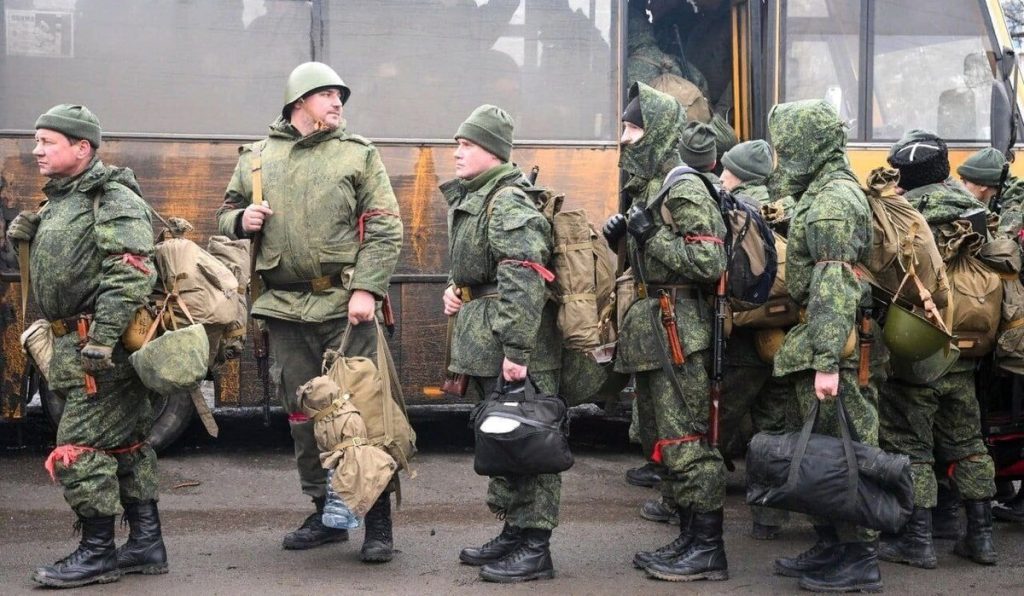
Against the backdrop of the adoption of a new draft law on mobilization in Ukraine, information about conscription into compulsory military service and active (albeit hidden) mobilization measures into the Russian army in the temporarily occupied territories of Ukraine remains in the shadows. This constitutes an international crime. Kyiv urges citizens who still remain in the TOT to leave as soon as possible, as there is a high risk of forced mobilization, especially for men who have been registered for military service.
On March 31, 2024, Russian dictator Putin signed a decree on the spring conscription of men aged 18–30 for military service. The Kremlin promises that conscripts will not serve in the temporarily occupied territories of Ukraine and will not take part in the so-called “special military operation.”
However, representatives of the Russian authorities have repeatedly failed to keep their promises, especially when it comes to the war in Ukraine. In particular, in the autumn of 2022, the so-called governor of Zaporizhzhia region, collaborator Ye. Balitsky, assured that there would be no conscription into the Russian army in the occupied part of Zaporizhzhia in the coming years due to “agreements with the leadership of the Russian Federation.” However, already in the spring of 2024, the occupiers began conscripting Ukrainian youth in the territories seized in 2022. Public discontent is being suppressed by the so-called “authorities” with new promises that conscripts will not be sent to the front.
At the same time, Ukrainian intelligence has recorded numerous cases in which conscripts from the TOT did end up on the front line, and some of them were lucky enough to be captured by the Armed Forces of Ukraine.
“As an example: at the beginning of the Russian invasion in 2022, a group of Donetsk students was captured. In February, they were summoned to their university dean’s offices and formally registered there as recruits. Literally a week later, without any training or equipment, they found themselves on the front line in Zaporizhzhia region.”
UCSS was told by a representative of the Main Intelligence Directorate of the Ministry of Defense of Ukraine, Andrii Yusov.
Overall, mobilization measures in the temporarily occupied parts of Luhansk and Donetsk regions have been ongoing almost continuously since 2014. At that time, Russia created the “1st Army Corps of the DPR” and the “2nd Army Corps of the LPR” in Donbas, fully subordinated to the Russian army. Their combined strength amounted to approximately 35,000 servicemen.
On February 19, 2022, just days before the full-scale invasion, full mobilization was announced there, and penalties were introduced for evasion (ranging from fines to imprisonment). In 2023, these “corps” were incorporated into the Armed Forces of the Russian Federation. According to Ukrainian intelligence, their staffing has lost its regional character, as forced mobilization has effectively “swept up” all “conditionally fit” men of conscription age. At present, only a small number of “reserved” specialists from strategic enterprises remain, as they could not be replaced, but even they are planned to be replaced by specialists from Russia, while Ukrainians will be mobilized.
“Overall, the mobilization potential of the temporarily occupied territories is insignificant. For comparison: this year Russia plans to recruit up to 385,000 ‘newcomers’ for contract service. Up to 65,000 are planned for the ‘Southern Military District,’ which includes the 1st and 2nd Army Corps. Of these, up to 9,000 may come from the occupied territories. However, with a high degree of probability, even these plans will not be fully implemented.”
Andrii Yusov noted.
Nevertheless, the occupation authorities prepared for conscription in advance. According to the head of the Luhansk Regional Military Administration, Artem Lysohor, the so-called “Ministry of Internal Affairs” has been working for the past two years to establish the actual whereabouts of citizens. Ukrainians who do not report to military enlistment offices are forcibly taken there. The absence of a Russian passport or citizenship is no longer an obstacle to mobilization. According to information from April 30, occupiers are handing out summonses to all men at the entrance to the city of Sievierodonetsk (Luhansk region).
The lack of Russian citizenship is also not an obstacle to mobilization under the guise of “conscription” in the temporarily occupied city of Mariupol. This was reported to UCSS by Petro Andriushchenko, advisor to the Mariupol mayor. According to him, men are immediately offered to sign contracts with the Russian Ministry of Defense with promised payments starting from 200,000 rubles, along with assurances they will not be sent to the front. At the same time, the so-called authorities are conducting data reconciliation of private and public sector employees with military enlistment offices. From May 10, after verification, enterprises will receive so-called “mobilization tasks.”
“The essence is that enterprises are given quotas for how many people must sign contracts with the Russian Ministry of Defense. Failure to meet these quotas leads to arrests of enterprises or their officials on fabricated charges, ranging from tax evasion to embezzlement.”
Andriushchenko explained.
In addition to mobilization, the occupation authorities are accelerating the forced passportization of the population. This was stated by the head of Zaporizhzhia region, Ivan Fedorov. Citizens are required to re-register real estate and land plots, which is impossible without a Russian passport and personal presence in the TOT. At the same time, property registration does not guarantee that the occupiers will not seize it to house the Russian army.
Mobilization measures are also ongoing in Crimea. During the period of temporary occupation, Russia has mobilized at least 48,000 conscripts from the peninsula. According to the Ukrainian resistance, in early April 2024 occupiers carried out a raid on the local population in Simferopol district during one of the major Muslim holidays. The goal is obvious — to draft the most problematic group for Russia: Crimean Tatars who refuse to accept the occupation.
Despite this, Russia is actively pressuring men in the TOT to sign contracts with the Russian army, especially targeting vulnerable groups — those with debts, loans, legal problems, or difficult living conditions.
Mobilization in the TOT is also an element of psychological pressure
Moscow will continue to intensify mobilization measures in the temporarily occupied territories of Ukraine. This issue is particularly acute against the backdrop of Kremlin statements about preparations for an offensive in May–June 2024, daily personnel losses, and desertion.
According to information from the Main Intelligence Directorate, more than 18,000 servicemen have deserted from armed formations of the Southern Military District. In addition to the temporarily occupied territories of Ukraine, this district includes problematic regions for Russia such as Dagestan, Ingushetia, Kabardino-Balkaria, Chechnya, and others. Most deserters are servicemen of the 8th Combined Arms Army — about 10,000 mobilized soldiers and 2,000 contract soldiers. Russia constantly deploys these forces in battles in eastern Ukraine. During offensives, which usually result in higher losses for the attacking side, desertion trends may increase. As long as the war continues, the need for personnel replenishment will remain acute.
However, conscription and mobilization in the TOT are needed by Russia not only to replenish its army. They also serve as tools of psychological pressure: to break people living under occupation, impose propaganda, and take active segments of society under control — effectively holding them hostage. This applies not only to the mobilized themselves but also to their families. Even here, however, Ukrainian resistance finds ways to exploit the situation in Ukraine’s favor: by transmitting information to the Armed Forces of Ukraine from within the Russian army and recruiting Russian officers. Another option is surrendering to the Armed Forces of Ukraine through the “I Want to Live” project. According to March 2024 data, the website recorded 1.5 million visits from Crimea alone.
One way or another, as Russia captures more Ukrainian villages and cities, it will expand its mobilization potential. Despite resistance, Moscow will continue turning the local population into an army it has no qualms about throwing into “meat assaults” by the thousands for the sake of another patch of land.
The full version of the article was published in The Telegraph
18.05.2026
When Russia launched its full-scale invasion of Ukraine in 2022, Mariupol quickly became the site of…

05.05.2026
Russia pressed every Donbas sector in April, with assault tempo at a two-month high. The territorial…

16.03.2026
It is in the war against Ukraine that Russia is trying to adhere to this non-linear…


