


Mariupol is Putin’s blueprint for occupation, and the world is barely paying attention
18.05.2026
When Russia launched its full-scale invasion of Ukraine in 2022, Mariupol quickly became the site of…
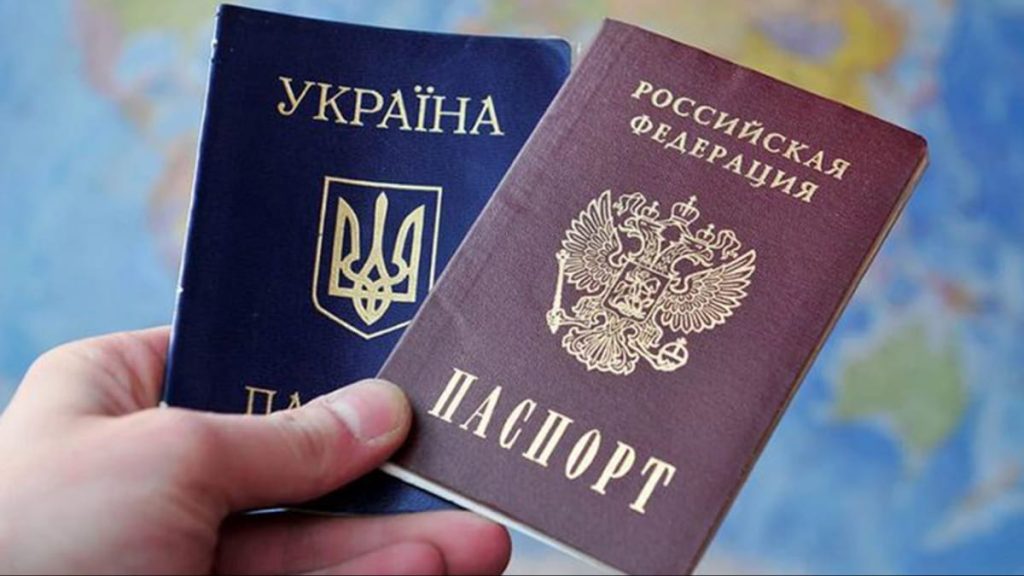
Residents of the occupied parts of the Donetsk and Luhansk regions who, in violation of international law, have obtained Russian passports under a simplified procedure are being promised the opportunity to take part in Russia’s parliamentary elections in the fall of 2021. At the same time, passportization in the temporarily occupied areas of Donetsk and Luhansk regions (ORDLO) is proceeding at a rapid pace and often in a coercive manner.
According to information provided to us by Ukrainian security services, in order to accelerate passportization, the leadership of the Russian occupation administration in the Donetsk region has set a minimum daily quota for document issuance in each district sector of the so-called “migration service” of the so-called DPR—40 “DPR” passports and Russian Federation passports per day. As of April 24, 2021, 242,850 people in the occupied part of the Donetsk region had received Russian passports, compared to 231,000 at the beginning of April—an increase of 11,000. As of early April, 683,000 residents held “DPR passports,” without which (or without an “LPR passport”) it is impossible to obtain Russian citizenship. There is also information that passportization of servicemen of the 2nd Army Corps of the Russian Federation, which includes armed formations of the so-called LPR, is actively underway. Certain units within it have passportized between 64% and 89% of their personnel.
According to information provided to us, the principal of Secondary School No. 55 in the city of Horlivka issued a verbal order requiring all school employees to obtain a Russian passport. Refusal is threatened with dismissal. According to school staff, the mandatory acquisition of Russian passports is explained by the requirement that those who receive them must take part in elections to the State Duma of the Russian Federation.
According to Oleg Agarkov, head of the Main Directorate of the Ministry of Internal Affairs of the Russian Federation in the Rostov region, as of February 18, 2021, 639,000 people from ORDLO had obtained Russian citizenship under a simplified procedure, whereas in January 2021 the number was only 400,000.
Alongside the accelerated passportization, residents of ORDLO are being encouraged to support the Russian party “United Russia.” On May 10, 2021, the Secretary of the General Council of President Vladimir Putin’s party “United Russia,” Andrey Turchak, signed a cooperation agreement with the “Union of Donbas Volunteers” (UDV)—a public organization created largely by natives of the so-called “DPR” and headed by its former “prime minister” Alexander Borodai and former “head of the Ministry of State Security” Andrey Pinchuk. In addition to its formal role of declaring support, the agreement also provides for the participation of ORDLO residents holding Russian passports in voting at the primaries of the “United Russia” party.
Alexander Borodai has also submitted his own candidacy to participate in the party’s preliminary voting. In addition to him, two other members of the “Union”—Maksim Chikin and Maksim Khlopin—have also applied.
“There should be no situation in which a citizen of the Russian Federation, regardless of territory or place of residence, is restricted in their rights,” said Andrey Turchak, a representative of “United Russia,” during a visit to the occupied Ukrainian territories.
In reality, the “restriction of the rights of Russian citizens” in the case of the passportization of ORDLO residents was built in from the very beginning. Since the so-called republics are not part of the Russian Federation, people who received passports did not receive Russian residence registration along with them. The absence of such registration under Russia’s existing residence permit system means that a person cannot, in particular, receive social benefits from the Russian Federation or vote in Russian elections. At the same time, residents of the occupied parts of the Donetsk and Luhansk regions represent an electoral resource for the Russian authorities.
“For the preservation of the republics […] we are grateful first and foremost to the President of Russia. Therefore, we have a special debt and special obligations to him. Of course, we are ready to support Putin’s party,” said Alexander Borodai, head of the so-called UDV.
According to a sociological survey by the Russian analytical center Levada, the electoral rating of the pro-government party “United Russia” continues to decline—while in August 2020, 31% of Russians were ready to vote for the party, that figure has now dropped to 27%.
It is currently unknown whether a procedure will be organized to enable residents of ORDLO with Russian passports to vote, and if so, how exactly it will be carried out. One option under discussion is the opening of special polling stations in the Rostov region or directly in the occupied territory.
At the same time, in the 2016 parliamentary elections, United Russia received the largest share of votes—54.2%—and thus retained a majority over the past five years.
However, during the 2020 referendum in Russia, residents of ORDLO were already granted the right to vote in the Rostov region.
We recall that under the formal pretext of “protecting the Russian-speaking population,” the Russian Federation deployed its troops to the territories of the Luhansk and Donetsk regions in 2014 (a justification later used by Vladimir Putin to explain the occupation of Crimea). After the launch of the passportization of residents of the occupied territories in 2019, Russian officials repeatedly stated their intention to “protect” ORDLO on the grounds that “Russian citizens” now live there.
Author: Olesia Horiaiynova
18.05.2026
When Russia launched its full-scale invasion of Ukraine in 2022, Mariupol quickly became the site of…

05.05.2026
Russia pressed every Donbas sector in April, with assault tempo at a two-month high. The territorial…

16.03.2026
It is in the war against Ukraine that Russia is trying to adhere to this non-linear…


