


Ukraine Is a Key Pillar of Europe’s Defense
13.06.2025
At the summit of the Bucharest Nine (B9) and Nordic countries held on June 2, 2025,…
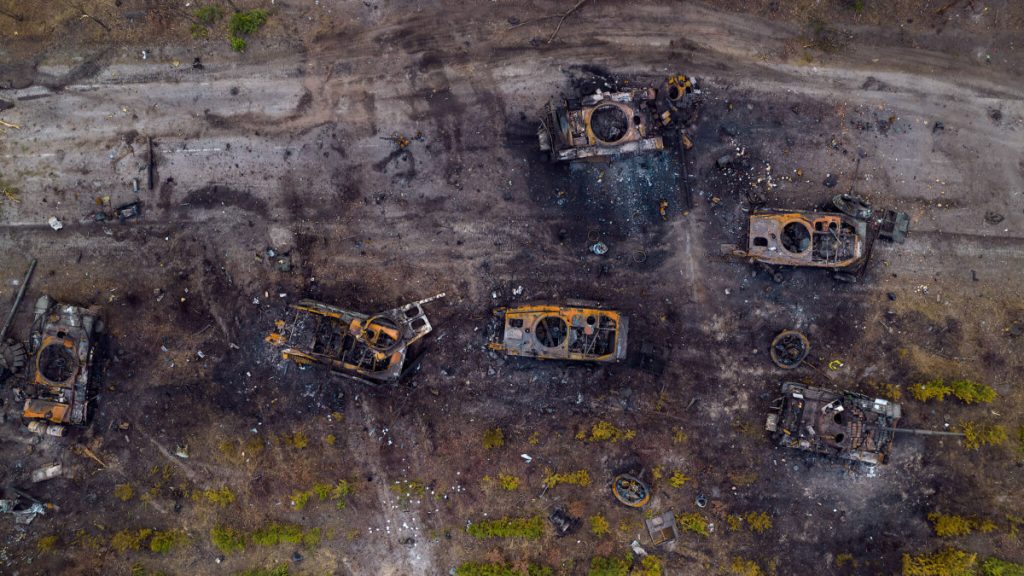
Since the start of the full-scale invasion, Russia has been suffering heavy losses both in personnel and in mechanized military equipment. Over more than two years of war, thousands of Russian tanks and armored personnel carriers have been “written off,” and these loss statistics continue to grow. For the enemy, many of these losses are irrecoverable; as a result, an increasing number of units are now equipped with lightly armored or unarmored vehicles and motorcycles. In particular, a new phenomenon has appeared in the Russian army — the so-called “turtle tank,” a tank welded with metal plates to protect the troops riding on it.
According to data from the Oryx project, as of May 1, 2024, Russia has lost 1,969 armored personnel carriers and armored fighting vehicles (AFVs) destroyed, abandoned, or captured, based on confirmed data alone. These include Soviet-era MT-LBs and BRMs, as well as modern Russian vehicles such as the BMPT “Terminator” and BTR-80/82.
The situation with infantry fighting vehicles (IFVs) is even worse. According to Oryx, since the start of the war Ukraine’s Defense Forces have eliminated 3,886 such vehicles, of which 2,805 were completely destroyed.
Thus, in total, Russia may have lost 5,855 units of armored vehicles. For example, during the battles for Avdiivka alone, on just one section of the front between October 2023 and February 2024, the Russian army left behind 404 armored vehicles (AFVs and IFVs) destroyed, abandoned, or captured.
Such losses could not but affect the supply of combat vehicles to the Russian army. According to the annual report of the analytical center IISS, as of 2022 Russia had 14,193 AFVs and IFVs in service. As of May 1, 2024, verified losses recorded by Oryx amount to 41.25% of the equipment Russia had at the start of the war. If one takes into account the figures reported by the General Staff of the Armed Forces of Ukraine, losses reach 14,067 units, or 99.11%.
No European army could withstand comparable losses in armored vehicles simply because none possesses such quantities of equipment. No European defense industry could replenish such losses in the short or medium term by producing new vehicles. The Russian military-industrial complex is likewise incapable of doing so.
Losses and replenishment
To compensate for battlefield losses, the Kremlin has resorted to restoring and replacing destroyed equipment by drawing from large stockpiles of mothballed Soviet-era hardware inherited after the collapse of the USSR. According to open-source researchers analyzing satellite imagery of Russian storage bases, Russia had about 14,865 armored vehicles in storage before the full-scale invasion.
As of May 2024, researchers estimate that 10,043 armored vehicles of various types remain in Russian storage. Thus, over nearly two and a half years of fighting, Russia has removed at least 4,813 vehicles — 32.4% of its reserves — though the actual figure is likely much higher. On average, Russia refurbishes around 185 armored vehicles per month and produces a limited additional number.
Even with additional production, such refurbishment volumes are insufficient to offset monthly battlefield losses. Based on Oryx’s confirmed data alone, Russian forces lose around 180 armored vehicles per month. In reality, actual losses are almost certainly higher.
“Turtle tank” as a litmus test
As a result, the reduction in armored vehicles on the front line has become increasingly noticeable. Russian command is forced to concentrate remaining equipment on priority axes in an attempt to break through, creating shortages on secondary fronts and leading to imbalances in equipment availability and use.
Accordingly, attacks without armored support are becoming more frequent. Ukrainian forces report an increase in enemy assault groups using motorcycles, buggies, golf carts, or unarmored Ural trucks fitted with metal mesh against FPV drones. Such tactics have been observed, for example, on the southern axis near the village of Robotyne. At the same time, Russia continues mechanized assaults near Avdiivka — its main axis of effort — losing dozens of IFVs and APCs daily.
A telling sign of the shortage of armored troop carriers is the emergence of the so-called “tsar tank” or “turtle tank.” This vehicle is distinguished by additional welded metal plates forming a shell-like structure. The first such tank was spotted during assaults near Krasnohorivka in Donetsk region; it was later destroyed by Ukrainian artillery. Other similar “innovations” have since appeared on the battlefield.
Notably, this improvised armor is designed not to protect the tank itself but the troops riding on top from shrapnel and kamikaze drones. Instead of using APCs or IFVs — whose primary function is to transport infantry to the battlefield — Russian units are forced to carry troops on tanks. In effect, the troops themselves become armor for the tank. A uniquely Russian workaround for replacing lost equipment.
Given current loss rates, Russia may soon exhaust its Soviet-era armored reserves. If Ukraine’s Defense Forces maintain the current pace of destruction, certain Russian IFV and APC models could become rare on the battlefield within 1.5–2 years. Equipment losses may significantly affect the Kremlin’s future operational planning.
For instance, when Russian forces first attempted to encircle Kharkiv in 2022, they committed around 11,000–13,000 professional troops equipped with modern weapons and vehicles. Today, Russia’s force composition has changed: many professional soldiers have been replaced by mobilized personnel, while the quality of equipment has declined. Under such conditions, any renewed offensives against Kyiv or Kharkiv — often touted by Russian propaganda — remain largely imaginary.
Ukraine is systematically reducing Russia’s military capabilities that could otherwise be used against other European countries. It is in the interest of Ukraine’s partners to continue providing military and financial support so that Ukraine can further weaken the aggressor on the battlefield and reduce the risk of war escalation on the continent.
*AFV (armored fighting vehicle) refers to a wheeled or tracked armored vehicle designed to transport infantry as part of mechanized units, provide fire support, and enable combat both mounted and dismounted.
IFV (infantry fighting vehicle) is a tracked or wheeled armored combat vehicle, often amphibious, designed to transport infantry and provide direct fire support. The main difference between an IFV and an AFV lies in its heavier armament and greater firepower.
The material was published in The Moscow Times
13.06.2025
At the summit of the Bucharest Nine (B9) and Nordic countries held on June 2, 2025,…

13.06.2025
The full-scale war against Ukraine is setting new rules and military doctrines that must be taken…

09.06.2025
In the fall of 2024, the Kremlin took another step toward renewed nuclear blackmail. On September…


