


Mariupol is Putin’s blueprint for occupation, and the world is barely paying attention
18.05.2026
When Russia launched its full-scale invasion of Ukraine in 2022, Mariupol quickly became the site of…
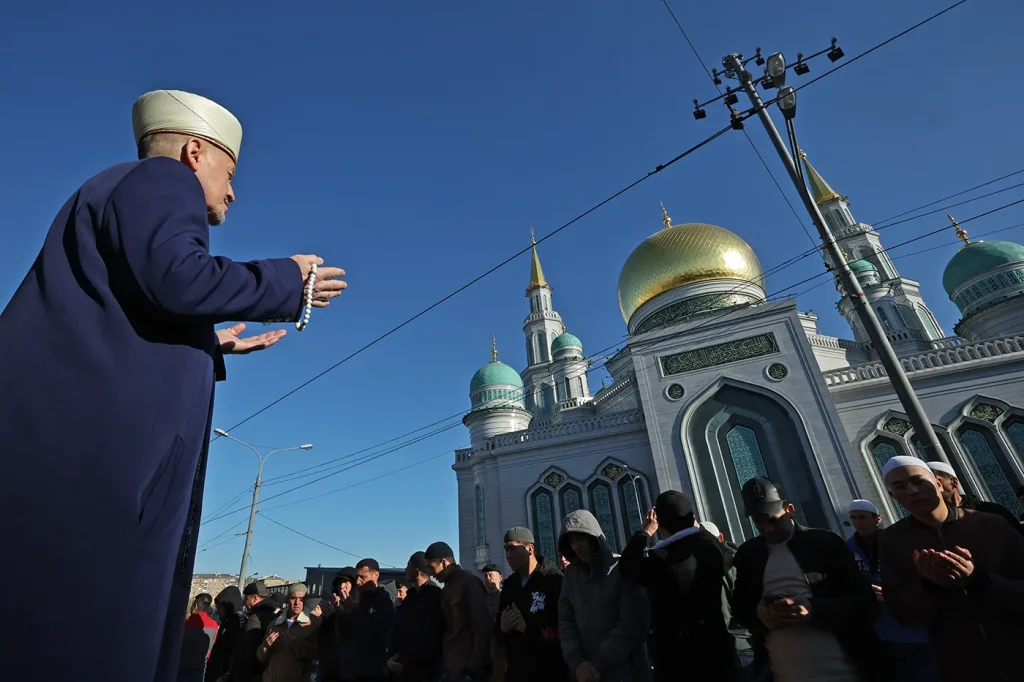
On April 21, Ramadan—the most important ritual period for Muslims—came to an end. This year, the month of Ramadan further exacerbated the already tense relations between Muslims and Russians. While using followers of Islam as cannon fodder in the so-called “special military operation,” the Russian authorities simultaneously suppress the voices of Muslims inside the country and deliberately provoke religious conflicts, “seasoning” them with persecution and arrests.
Background of the Conflict
Back in 2022, the Kremlin decided to build the largest mosque in Europe in Moscow—a temple and sacred site for Muslims. Such an idea seems logical, considering that around two million Muslims currently live in Moscow alone and more than 15 million across the Russian Federation. As representatives of territories colonized by Russia, Muslims could become a driving force against the Kremlin’s actions—something the Russian authorities already fear.
However, as early as February 2023, discussions about building the mosque near Holy Lake were put on hold, and later the decision was abandoned altogether. In April, Moscow’s city authorities announced that the mosque would instead be built on the outskirts of the city. The supposed reason for refusing construction at the originally chosen site was protests by Orthodox believers.
These events angered Muslims, especially those fighting in the Russian military. During Ramadan, the situation only worsened—becoming one of the preconditions for the outbreak of protests.
Escalation of Religious Hostility
In April, so-called “actions” by representatives of the pro-government Russian Orthodox Church against the construction of the promised mosque began gaining momentum in Russia. Thousands of Orthodox Russians and participants in the so-called “special military operation” gathered at these events. The staged nature of these protests is suggested by the Kremlin’s immediate reaction—canceling construction and launching mass arrests of Muslims.
Protest by Russian Orthodox Church parishioners against the construction of a mosque.
Protest participants claimed that the mosque was allegedly planned to be built on “sacred Orthodox land,” which would “defile this holy place.” Offensive chants and songs targeting Chechens were often heard at rallies, along with xenophobic rhetoric describing the Russian capital as overcrowded with migrants—mockingly calling it “Moscowabad.” Videos also appeared online showing two unidentified individuals burying a pig’s head (an animal considered unclean in Islam) near Holy Lake to prevent construction. Such actions naturally outraged hundreds of Muslims.
Protesters labeled the Muslim complex project “a religious center for migrants, refugees, and terrorists.”
Reaction of the Chechens
The loudest reaction to the situation came from Kadyrov’s forces. In a video address from the front line, they stated that they “would not tolerate such religious oppression and humiliating statements” and that they would “turn a blind eye to this only once.”
“We believe that the Russian authorities must respond. Criminal cases must be opened against these people. The guilty must be imprisoned or eliminated. We are not threatening—we are warning: if you go against the will of the Almighty, we will fight you as well. It makes no difference to us whom we fight,” Kadyrov’s forces commented in their video statements, openly published online.
Many representatives of Islamic public organizations with influence in their communities began speaking about “jihad”—a sacred struggle to defend Islam. This is exactly what the Kremlin used as a pretext to initiate public arrests and persecution.
Chechen leader Ramzan Kadyrov, who is considered Russia’s main “protector” of Muslims, also reacted by calling on the “defenders of Orthodoxy” to go to war: “If all these rally participants claim they are defending Russian land, then go to the trenches with a rifle! Take a weapon, push aside the Muslim who is fighting in your place today in Russian-occupied Donbas, and show your patriotism in action—not in words or provocations.” The weak response to the oppression of Muslims was expected—Kadyrov chose loyalty to Putin over defending believers.
Later, Moscow authorities decided to move the mosque construction site to the city outskirts, to the Kosino-Ukhtomsky district. “The mosque will not be built near Holy Lake next to an Orthodox church,” Moscow Mayor Sergey Sobyanin announced. The first mosque was planned to be completed by Q4 2024; there is currently no timeline for the new construction.
Escalation of Oppression and Repression
During Ramadan, detentions of Muslims who openly expressed protest intensified significantly. Each week, pressure on representatives of Islam continues to grow.
A notable “coincidence” is the number of detentions and verdicts issued specifically in April 2023. In Chechnya, an individual involved in a 2000 attack on a Perm riot police unit was sentenced to life imprisonment, while three residents of Dagestan will stand trial for alleged terrorist activity committed between 2018 and 2021. Repression of opponents of Russia’s aggression against Ukraine has increased in southern Russia and the North Caucasus.
At the same time, following Kadyrov’s reaction to the burning of the Quran near Beloye Lake in Moscow’s Kosino-Ukhtomsky district, authorities opened a criminal case. This was a clear protest against mosque construction at the site, although Chechnya labeled it a “Ukrainian provocation.”
Today, Muslims worldwide celebrate Uraza Bayram, marking the end of the holy month of Ramadan. However, interfaith hostility in Russian society is only beginning to intensify.
“Russia for Russians”
Russian chauvinism is reaching new heights. Even during the holy month for Muslims, the desire to incite hatred, dominate, and humiliate others does not fade.
On April 21, the day Ramadan ended and Uraza Bayram was celebrated, Russian authorities restricted traffic in Moscow and “strengthened security” around mosques. Entry was only possible through metal detectors and in small groups. The Kremlin attempted to turn security measures into surveillance to prevent any coordination among worshippers. Nevertheless, Muslims united on this holy day and launched an action after the final Ramadan prayer: “Shout your takbir against Islamophobia in Russia.” Mass chants echoed across Russian cities, and many Muslims supported the action.
It is worth noting that the Kremlin refused even to exchange Muslim prisoners of war with Ukraine, despite Ukraine’s voluntary humanitarian gesture during Ramadan. This was reported several weeks ago in an interview with Voice of America by Daria Zarivna, adviser to the Head of the Office of the President of Ukraine.
Anastasiia Pikhor
18.05.2026
When Russia launched its full-scale invasion of Ukraine in 2022, Mariupol quickly became the site of…

05.05.2026
Russia pressed every Donbas sector in April, with assault tempo at a two-month high. The territorial…

16.03.2026
It is in the war against Ukraine that Russia is trying to adhere to this non-linear…


