


Mariupol is Putin’s blueprint for occupation, and the world is barely paying attention
18.05.2026
When Russia launched its full-scale invasion of Ukraine in 2022, Mariupol quickly became the site of…
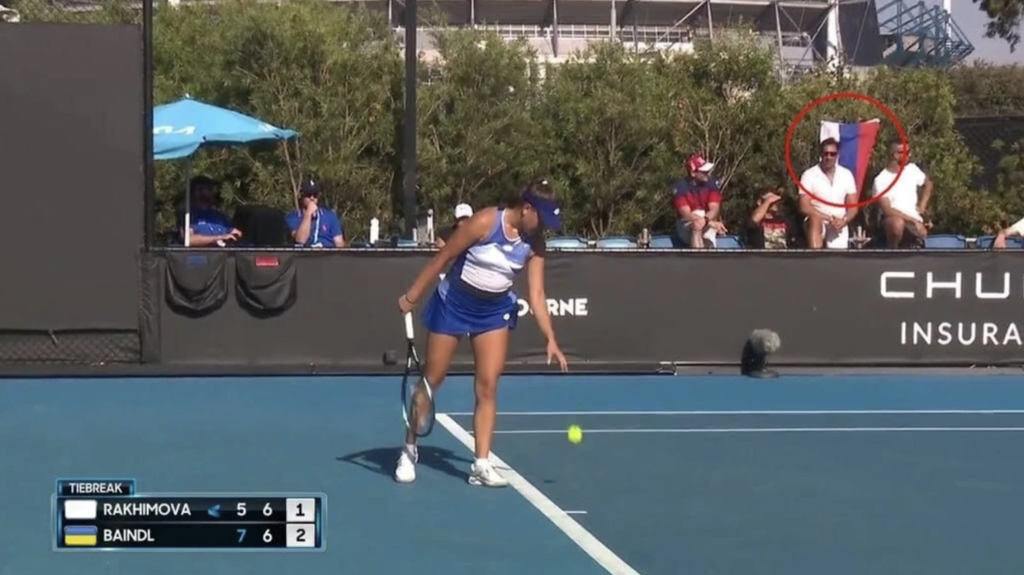
Spectators display a Russian flag and a Putin T-shirt during a first-round Australian Open match. Photo: Pete Shmigel
At the Australian Open, tokenism was put on display — and it costs Ukrainians their lives.
By Pete Shmigel
Read also: Patterns Emerge – Pete Shmigel on Russia at the UN
Australia is about as far from the war in Ukraine as it is possible to be. Yet this week it showed how the West as a whole risks drifting even further away from Ukraine.
In particular, the Australian Open — one of tennis’s four Grand Slam tournaments, held from January 8–29 and traditionally opening the international tennis season — failed to properly respond to the consequences of Russia’s full-scale invasion.
At the tournament:
– Russian players were allowed to compete, while Wimbledon and other major sporting events did not allow this;
– ahead of the tournament, a carefully produced and televised PR event was held to demonstrate the tournament’s supposed commitment to “peace in Ukraine”;
– Russian players were told they could not compete under the Russian flag — yet fans were later allowed to bring Russian flags to a match involving Ukrainian player Kateryna Kozlova-Byndle;
– only after statements by the Ukrainian Ambassador, diaspora organizations, and media outrage was a forced decision made to ban spectators from bringing Russian flags.
Throughout this entire absurd episode, Tennis Australia — the body that runs the tournament — did nothing to condemn the causes or drivers of the war.
Nor did it demand or request that Russian players state their position on the war.
Even after the 2014 Sochi Olympics and the mass disqualification of Russian athletes for doping, Tennis Australia shows no sign of recognizing that sport is part of Putin’s hybrid war.
At the core of Tennis Australia’s mishandling of the situation lie broader, troubling trends in Western liberal democracies that pose risks to Ukraine’s future prospects of victory, including the flow of military aid.
The first trend can be described as “business as usual.”
Under this trend, many politicians, business figures, and media outlets view and present Russia’s invasion of Ukraine as something inevitable — “just another war in a brutal world” — and something to be addressed primarily in terms of minimizing their own risks (rather than risks to Ukrainians). While the human consequences of the war are tragic in their minds, and Ukraine is clearly the wronged party, the war somehow becomes “normal” within their broader worldview. These things happen.
Look at Tennis Australia’s statement on banning Russian and Belarusian spectator flags:
“Flags of Russia and Belarus are banned at the Australian Open. Our initial policy was that fans could bring them but not use them to disrupt the event. Yesterday we had an incident where a flag was displayed courtside. The ban takes effect immediately.
We will continue to work with players and fans to create the best environment to enjoy tennis.”
This is purely reputational risk management, with no recognition whatsoever of the stakes or the potential impact on the Ukrainian player who was targeted — a player from Mykolaiv, where there was no water for months and where homes and hospitals were deliberately bombed.
At this moment, after dozens of war crimes and the killing of more than 40 people in an apartment building in Dnipro just this week, it is genuinely inhumane not to see the horror and harm represented by the Russian flag and the Russian regime.
Whether it is Tennis Australia or others, such approaches reflect either a foolish or malicious refusal to acknowledge that Ukraine’s situation is unprecedented in modern history; that genocide and colonization are Russia’s goals; that the very values of the West are at stake; and that extremely difficult choices must be made — otherwise many people will die for nothing.
Instead, part of the Western elite — including wealthy actors with highly polished and loyal interests who continue to run and profit from events like the Australian Open — prefer the softer option.
In the case of the Australian Open, this means evasion and symbolic gestures. It is as if saying “peace” in every speech absolves you from taking a real stance on the war. It does not — and it certainly does not grant moral superiority to Russian players who claim to stand for “peace.”
As Marta Kostyuk, one of Ukraine’s young stars at the Open, wisely said: “When people say they ‘don’t want war,’ we (Ukraine) sound like we do want war. Obviously, we don’t want war either.”
Indeed, at this point, Russian calls for “peace” are a sinister cover for the continuation of destruction and violence.
Kostyuk further rightly called on the Women’s Tennis Association to suspend Russian and Belarusian players until those players publicly condemn Russia and its actions.
The second trend relates to “mediocre managerialism.”
In this paradigm, Ukraine is something to be “managed” — whether in politics, business, or the media. This means doing the minimum required to meet the expectations of stakeholders.
Some weapons here, some statements there, visits, isolated bans on flags.
Once again, the driver is not Ukraine’s interests, the protection of Ukrainians, or the survival of Western values, but doing just enough to say and show that you are “doing something.” Tokenism that costs Ukrainian lives. A trend clearly visible in Germany’s “lost Leopard tanks.”
This kind of “managerialism” is, in fact, the polar opposite of leadership.
In this situation, leadership requires: a) knowing the end goal to strive for; b) genuine partnership and listening to the affected party — Ukraine; c) reference to the democratic values on which the West is founded; and d) an understanding of the sacrifice required for victory.
Unfortunately, some in the West are so accustomed to “managing” rather than leading that they cannot even wear a T-shirt saying “Be Brave Like Ukraine.” Boris Johnson was a leader.
Which Western leaders govern as he did? Or as the President of Ukraine, military commanders, train drivers, nurses, and energy workers do?
Hannah Arendt spoke of the “banality of evil” in relation to Nazi Germany.
In Putin’s Russia, in light of cases such as a tennis tournament on the other side of the planet, there are today strategists who are pleased that their war is becoming normal.
They are even more pleased by yet another example of how some in the West lack clarity of vision and moral courage to do what is required: to recognize the abnormality of war and then truly support Ukrainians in eradicating the enemy for the benefit of the West.
Read also: Campaign #unrussiaUN to expel Russia from the UN Security Council
18.05.2026
When Russia launched its full-scale invasion of Ukraine in 2022, Mariupol quickly became the site of…

05.05.2026
Russia pressed every Donbas sector in April, with assault tempo at a two-month high. The territorial…

16.03.2026
It is in the war against Ukraine that Russia is trying to adhere to this non-linear…


