


Ukraine Is a Key Pillar of Europe’s Defense
13.06.2025
At the summit of the Bucharest Nine (B9) and Nordic countries held on June 2, 2025,…
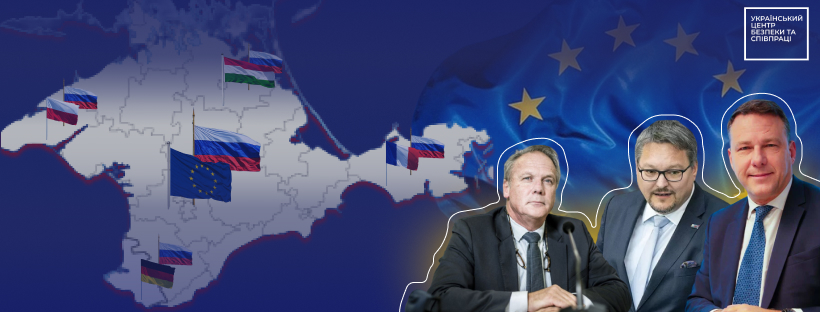
Since 2014, Russia has sought to create an illusion of legality for its actions on Ukrainian territory: the occupation of Crimea, the creation of new “republics” later incorporated into the Russian Federation, and ultimately the full-scale invasion. A key role in this system is played by “independent international experts” who are in fact Kremlin-paid European citizens and individuals who also bear responsibility for Russia’s aggression against Ukraine.
WHY DOES RUSSIA NEED THIS?
All criminal actions have consequences. Of course, the Russian authorities understand this as well, which is why they seek to convince a world that is not fully immersed in the context of Russia’s relations with its neighbors (Ukraine, Georgia, Kazakhstan) of the “legality” of their open terrorism and aggression. This policy is recognized as the “legitimation of occupation” and has many instruments of implementation that Russia constantly uses.
The Kremlin attempted to legitimize its presence in Crimea, and later in Donetsk and Luhansk regions, through the alleged free expression of the people—under the barrels of guns and “little green men”—via so-called referendums and local elections. In this way, the occupiers sought to gain international recognition of the occupied territories’ belonging to Russia, which would grant numerous privileges: lifting sanctions, new partnerships, and, of course, freedom for further crimes.
Spreading propaganda about the “fair return of historical lands” among the domestic population ensures broad internal support for the occupation, facilitating the mobilization of citizens, including for participation in the so-called “special military operation.”
A crucial criterion for recognition in this case is “broad international support” — that is, the participation of citizens of other countries who are formally not parties to the conflict.
So-called “foreign observers” have played a special role in the shameful “legitimization” of pseudo-referendums throughout nearly ten years of war in Ukraine. By referring to their participation in elections, the Kremlin claims that occupation “plebiscites” (votes on the state affiliation of a particular territory) comply with international norms and standards. This maneuver brings Russia two immediate benefits: convincing the West and Russians that Russia has support abroad among politicians and journalists, and persuading European societies of the legality of Russia’s actions—after all, your own compatriots allegedly prove the legality and fairness of these processes.
The Russian myth of the legality of acts of “popular will,” promoted by Kremlin propaganda, rests precisely on these “international observers.” Therefore, responsibility for the occupation of Ukrainian territories lies with them just as much as with the Russian authorities. Every one of Putin’s “international friends” who visited the occupied territories in violation of Ukrainian law helped annex Ukrainian lands and became accomplices to Russian aggression.
EUROPEAN “FRIENDS OF PUTIN”
Since 2014, Russia has regularly invited European politicians to elections, building ties with those unafraid of Russia’s “political toxicity.” Even members of the European Parliament visited the occupied territories—among them French politician Thierry Mariani—despite the PACE ban on visiting these regions without the consent of the Ukrainian authorities.
Below is a list compiled by USCC analysts of information about “international experts” who visited the temporarily occupied territories of Ukraine to observe elections since 2014:
FRANCE
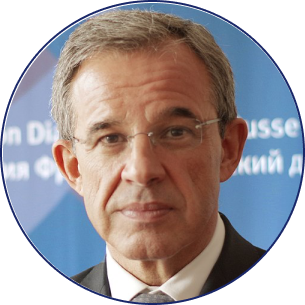
Thierry Mariani — a French far-right politician, Member of the European Parliament.
He openly promotes pro-Russian narratives, recognized Russia’s annexation of Crimea (calling it a “restoration of historical justice”), advocates lifting sanctions against Russia, and supports providing humanitarian aid to the so-called DPR and LPR. Mariani is co-chair of the “Franco-Russian Dialogue” association. He is among the most frequent foreign political visitors to occupied Crimea, including leading a large French delegation in summer 2015, spring 2018–2019, and summer 2020. Ukraine imposed sanctions on Mariani and restricted his entry. After his first visit to Crimea, the French Foreign Ministry condemned the trip but noted it was a “personal initiative of parliamentarians.” In 2022, it became known that French prosecutors opened two investigations into the “Franco-Russian Dialogue” association and Mariani personally—one for suspected corruption and influence peddling, and another for breach of trust and money laundering. In autumn 2022, reports emerged of his possible participation as an observer in occupied Ukrainian territories, but due to pressure from the Ukrainian community the visit was canceled, and Mariani denied the information.
13.06.2025
At the summit of the Bucharest Nine (B9) and Nordic countries held on June 2, 2025,…

13.06.2025
The full-scale war against Ukraine is setting new rules and military doctrines that must be taken…

09.06.2025
In the fall of 2024, the Kremlin took another step toward renewed nuclear blackmail. On September…


