


“Free Ukraine Fund” encourages investments
25.02.2026
The Ukrainian Security and Cooperation Center, which celebrates its 3rd anniversary on April 2, is implementing…
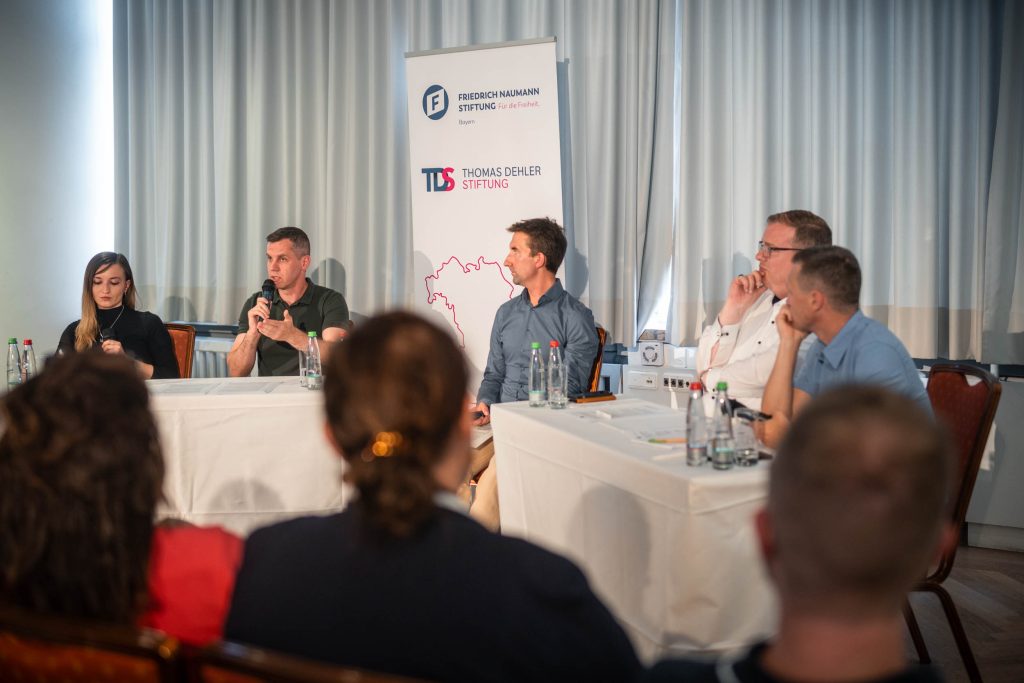
The discussion addressed the effectiveness of compliance by Western countries with sanctions packages against the Russian Federation, as well as their impact on Russia’s economy and military capabilities. The event took place on July 20 in Munich in cooperation with UCSS partners in Germany – the foundations Friedrich Naumann Foundation for Freedom, Thomas Dehler Foundation and Ukrainischer Verein Augsburg e.V.
The speakers of the discussion were:
Sergii Kuzan – Head of the Ukrainian Center for Security and Cooperation.
Ulrich Lechte – Member of the Bundestag, Chair of the Bundestag Committee on Foreign Affairs, Foreign Policy Spokesperson of the FDP parliamentary group.
The discussion was moderated by Jean-Marie Magro, a journalist for the German television company Bayerischer Rundfunk.
In the deadly missiles that killed 15 Ukrainian civilians over the past five days, up to 50 components are microelectronics, mostly manufactured in other countries, according to an analysis by the Yermak–McFaul International Expert Group. This list includes the German company Infineon Technologies and its subsidiary Cypress Semiconductor.
The sanctions imposed on the Russian Federation are intended to stop the ruleless war against the territory and citizens of a free Ukraine. However, without strict control over third countries and “shell companies,” Russia continues to find ways to circumvent restrictions and acquire the necessary components to strengthen its weaponry. One recent example is the intention to import 20,000 base stations for mobile communications into Russia from Sweden, manufactured by the Swedish company Ericsson. It is unlikely that the Swedish company does not understand to whom it plans to sell goods worth tens of millions of dollars.
Societies of the sanctions coalition countries must understand that restrictions are imposed on Russia not to worsen the socio-economic situation of its citizens, who in the majority consciously support the war against Ukraine. Sanctions are designed to stop Russia’s ability to arm itself and wage a war without rules against Ukraine.
“Today Russia is forced to cope with the broadest range of sanctions ever imposed on a state. However, this economic attack has insufficient results, and we see the consequences after each new missile strike,” commented UCSS Head Sergii Kuzan during the discussion.
Global companies continue to deliberately circumvent sanctions and finance Russian terrorism, while Russia keeps blackmailing the world with nuclear catastrophes, famine, and threats to freeze Europe if its demands are not met.
“Russia has used its partnership relations with Europe, exploiting a network of connections to bypass restrictions. Given that Russia is 64 times larger than Germany, collective involvement is necessary to control compliance with sanctions,” noted Ulrich Lechte, Foreign Policy Spokesperson and Chair of the Foreign Affairs Committee of the FDP parliamentary group in the Bundestag.
The final solution to the issue of sanctions circumvention can only be achieved by strengthening control over the enforcement of previously imposed sanctions by the European Union — without such control, no restrictions will work, as evidenced by repeated analyses of components found in Russia’s deadly missiles.
“Germany, as a leader of the European Union, thanks to its consistent policy toward Ukraine, is gradually shedding its dependence on Russia. However, this dependence might never have existed if European leaders had recognized the threat of such relations with Moscow earlier and had enforced compliance with sanctions from the very beginning,” commented Kateryna Matei, UCSS Representative in Germany.
Sanctions must work comprehensively and be imposed not only on companies but also on oligarchs and businessmen who build their lives in European countries on dirty money.
All of the deadliest missile attacks on peaceful Ukrainian cities were carried out using cruise missiles produced by the Russian corporation Tactical Missiles Corporation – Kh-22 and Kh-101. The director of this corporation is Boris Obnosov. His family owns two luxury apartment buildings in the center of Prague, where his daughter and her husband still live. There is a high probability that the Obnosov family’s real estate was purchased with money earned from the sale of missiles that have taken the lives of hundreds of Ukrainians.
“The sooner we stop financing the war, the sooner stability will return across Europe. While Ukraine pays the highest price — the lives of its citizens — by using weapons to deter Russian interference in the affairs of democratic states, the task of our partners is to continue exerting constant and prompt pressure on Russia’s economy in the fight for a free future of Europe,” summarized Sergii Kuzan.
We express our gratitude to the partners of the Ukrainian Center for Security and Cooperation — the Friedrich Naumann Foundation for Freedom, the Thomas Dehler Foundation, and Ukrainischer Verein Augsburg e.V. — for their support in organizing the event and for their participation in Ukraine’s struggle.
25.02.2026
The Ukrainian Security and Cooperation Center, which celebrates its 3rd anniversary on April 2, is implementing…
24.06.2024
An advocacy summit, Nordic Ukraine, took place in Helsinki, the capital of Finland. Participants included the…

24.04.2024
In Germany, with the support of the Ukrainian Center for Security and Cooperation, a discussion was…


