


Mariupol is Putin’s blueprint for occupation, and the world is barely paying attention
18.05.2026
When Russia launched its full-scale invasion of Ukraine in 2022, Mariupol quickly became the site of…
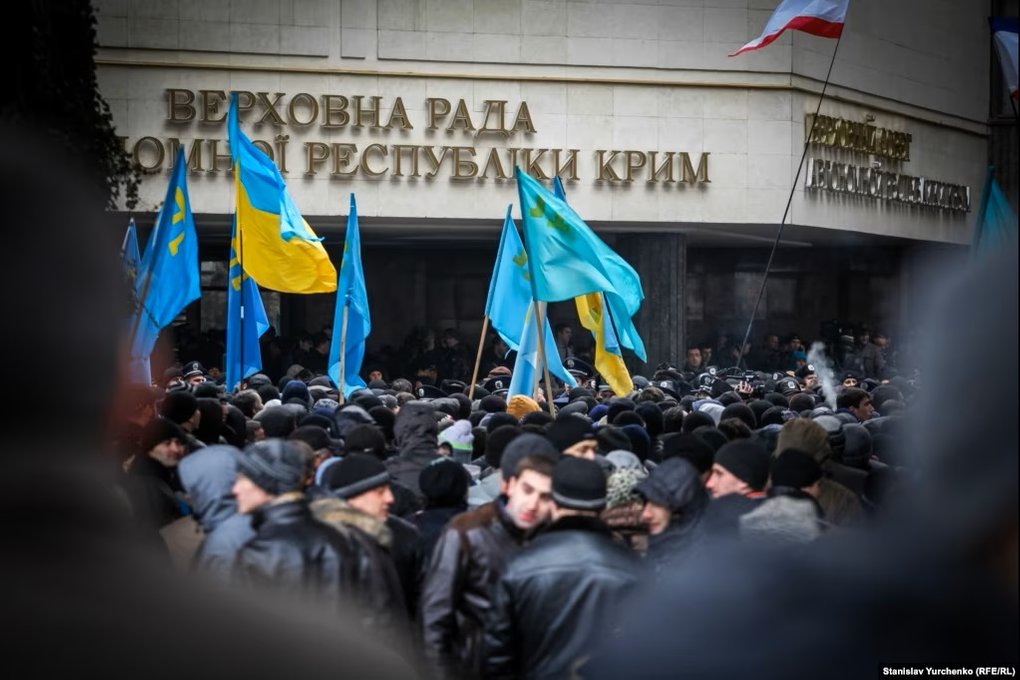
April 15 marks ten years since the Verkhovna Rada of Ukraine adopted the law defining the Autonomous Republic of Crimea and the city of Sevastopol as “territories under temporary occupation.” During this time, Russia has turned the peninsula into a land of fear, repression, and a military stronghold. Yet despite all its efforts, the aggressor has failed to break the people of Crimea or to gain international recognition of its annexation. Crimea is waiting for Ukraine, and the numerous successes of the Armed Forces of Ukraine as well as the growing resistance movement on the peninsula prove this—none of which would be possible without a strong pro-Ukrainian population in Crimea.
When Russians seized Crimea in blatant violation of international law, no one doubted that the Kremlin’s promises of a “paradise life” and “millions of tourists” for the peninsula’s residents would prove empty. However, the way the occupiers have actually treated Crimeans once again demonstrates that the world is dealing with a criminal state.
Patriots turned into political prisoners
This is particularly evident to the Crimean Tatars, who had already endured the tragic experience of deportation from their homeland and once again faced persecution after 2014. Following the occupation, many indigenous residents were reminded of the Stalinist era: mass repression, abductions by security forces, imprisonment, and mysterious killings became the new norm in Crimea. On March 15, 2014, the body of 39-year-old Crimean Tatar activist Reshat Ametov was found bearing numerous signs of torture. On March 3, 2014, Ametov had staged a solitary protest against the occupation of the peninsula on Simferopol’s main square. CCTV footage captured three men in the uniform of the illegal armed group “Crimean Self-Defense” detaining him and forcing him into a car. He was never seen alive again.
Reshat Ametov is considered one of the first victims of the occupation of Crimea. In 2017, he was posthumously awarded the title Hero of Ukraine.
According to Crimean activists, the killing of Ametov was the first demonstrative act of intimidation aimed at the pro-Ukrainian population of Crimea. In the first months of occupation, such disappearances were frequent. In particular, the civic organization CrimeaSOS has information about at least 59 people who have gone missing over the past ten years.
Despite this, many people in Crimea did not give in to fear. Some openly declared their pro-Ukrainian stance, while others joined the underground resistance. Since the beginning of the occupation, human rights organizations have documented 307 political prisoners and individuals persecuted on politically motivated criminal charges, including 206 Crimean Tatars.
“Those who openly opposed the occupation—Reshat Ametov, Oleh Sentsov, Oleksandr Kolchenko, Akhtem Chiygoz, Ilmi Umerov, Ervin Umerov, Timur Shaymardanov, Seiran Zinedinov, Nariman Dzhelyal, and many others—were quickly imprisoned, abducted and killed, or banned from entering Crimea and later sentenced in absentia to years in prison. Now, the hunt is mainly for those who ‘think incorrectly.’”
said Mustafa Dzhemilev, leader of the Crimean Tatar people, human rights defender, and former dissident.
According to Dzhemilev, Russia’s FSB closely monitors the moods of Crimean residents, tracking which websites they visit and which posts they “like,” which is why arrests and searches continue to escalate.
Crimeans forced into the Russian army, children militarized
Russia continues to violate international law through the illegal mobilization of local residents and the mass militarization of children.
According to Tamila Tasheva, the Representative of the President of Ukraine in the Autonomous Republic of Crimea, as of the end of 2023 the occupation authorities had conscripted 44,500 Crimeans into the Russian army as part of partial mobilization. At least 525 of them have already been killed and were likely Ukrainian citizens. The exact number is difficult to determine, as Russia conceals its losses.
Russia has also involved more than 30,000 Crimean children in the “Yunarmiya” movement created by Russia’s Ministry of Defense, opened cadet classes in schools, and staged military demonstrations even for preschoolers.
The resistance movement in Crimea is gaining momentum
Despite the repressive actions of the occupation authorities, a large number of pro-Ukrainian residents remain on the peninsula, resisting the occupiers in various ways. Importantly, their numbers and influence on the de-occupation process continue to grow.
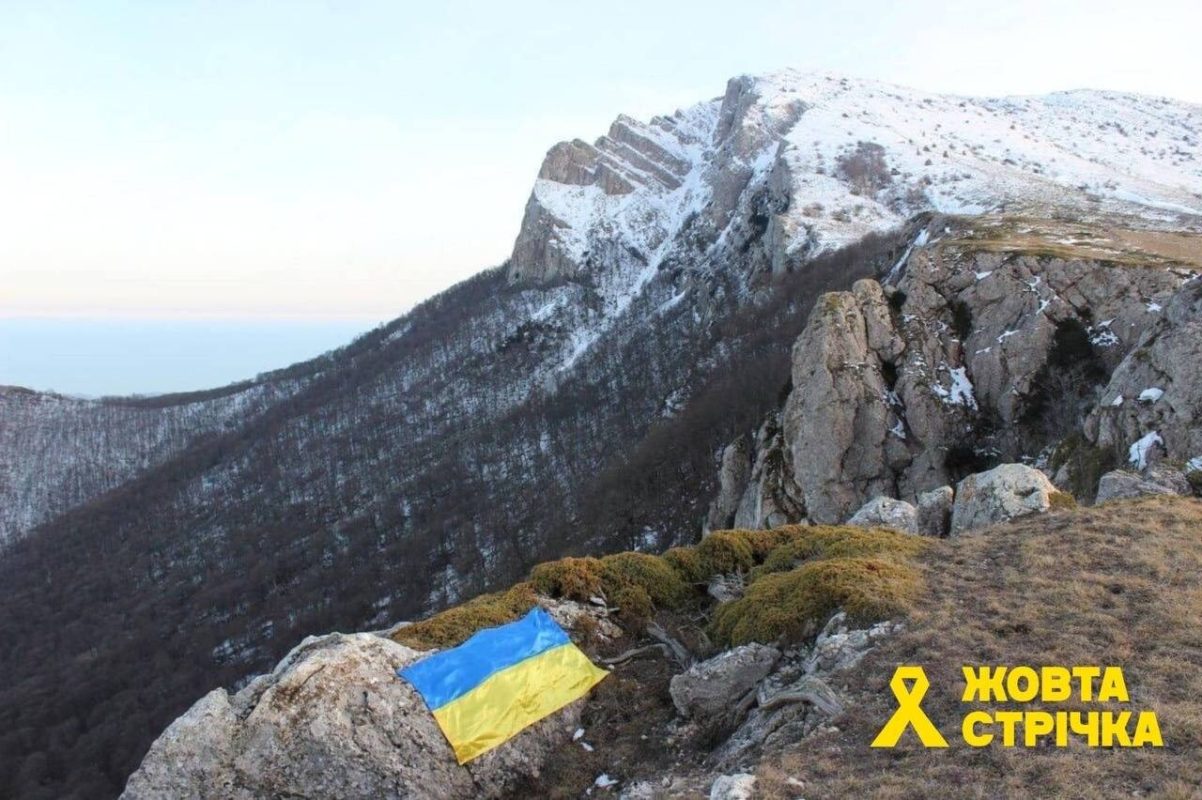
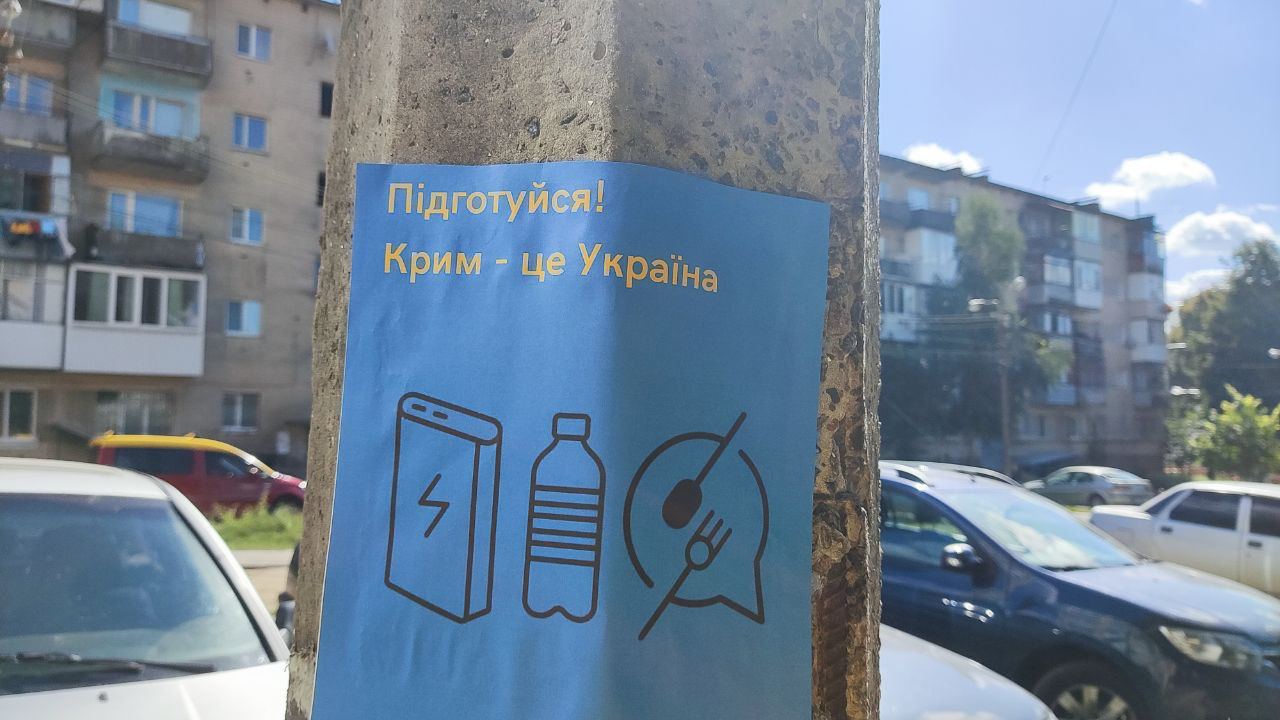
In particular, around 6,000 Crimeans are members of the Yellow Ribbon civic resistance movement, which operates in the temporarily occupied territories of Ukraine and constantly reminds the occupiers that they are only temporary.
The military partisan movement “Atesh,” formed by Ukrainians and Crimean Tatars, has also made itself known. Its members conduct reconnaissance and collect data on enemy personnel, equipment, and weapons. The monitoring group “Crimean Wind” tracks the movement of Russian military equipment as well.
Recently, reports have also emerged about the appearance of another resistance movement in Crimea—National Resistance. Its activists began with decisive actions, setting fire to a car bearing Russian symbols in Feodosia.
Rejection of Russia is also evident on an everyday level. The derogatory term “ponaekhi” is often used in local social media and in daily life to refer to Russians who moved to the peninsula.
The Crimean Bridge under pressure
Perhaps the strongest signal to Crimeans that they have not been forgotten—and that the ground beneath the occupiers must burn—comes from the Security and Defense Forces of Ukraine.
Over ten years of occupation, Ukraine has inflicted significant losses on the aggressor in both manpower and equipment. A number of sophisticated strikes and operations have been carried out, setting examples that special services and military units of other countries could study. These include the destruction of the flagship of Russia’s Black Sea Fleet, the missile cruiser Moskva; the restoration of control over the so-called Boyko towers; strikes on the headquarters of the Black Sea Fleet; and repeated attacks on the Crimean Bridge—one of the key transport arteries supplying Russian military logistics between mainland Russia and the occupied Ukrainian peninsula.
Thanks to the efforts of the Security Service of Ukraine, the Main Intelligence Directorate, and other defense units, the balance of power in the Black Sea has effectively changed. Ukraine, which lost much of its fleet after 2014 and again after the full-scale invasion in 2022, managed to seriously undermine Russia’s main naval force and pride in Crimea—the Black Sea Fleet and the city of Sevastopol.
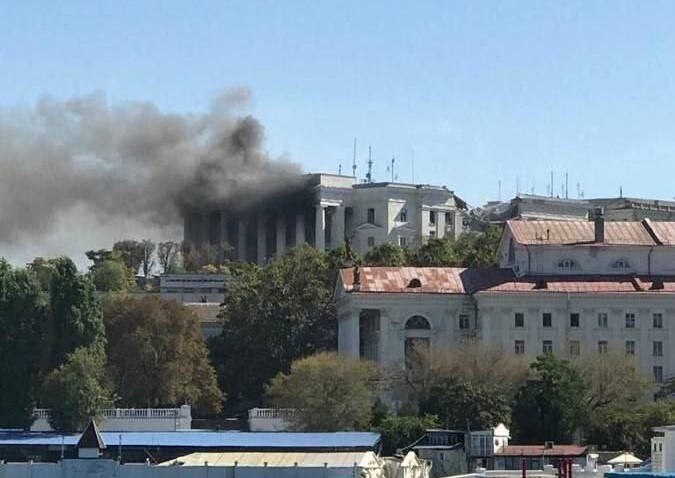
Overall, Ukrainian forces have destroyed roughly one third of the Black Sea Fleet’s 80 vessels, while 15 more remain damaged and under repair.
“As for the number of units hit, we are talking about 27 vessels, including a submarine. Fourteen of them were significant, high-profile targets of various classes—large landing ships, missile boats, a submarine, and a patrol ship,”
reported Dmytro Pletenchuk, spokesperson for the Ukrainian Navy.
Despite the fact that the Black Sea Fleet still retains considerable capabilities, most of its remaining assets have been redeployed from Crimea due to the Ukrainian threat. Notably, only one cruise missile carrier remains in Crimea, and it has not launched a single missile.
We can conclude that the strategic importance of Crimea for Russia is changing as a result of Ukraine’s defensive actions. This is evident both in propagandists’ rhetoric and in Russia’s failure to respond to the so-called “red lines” it declared in 2022. The relocation of part of the Black Sea Fleet to Russia’s Krasnodar region is also a blow to Russian propaganda, which has mythologized Sevastopol for years. No matter how hard Russia tries to turn the peninsula into an impregnable fortress, Ukraine’s Defense Forces and the people of Crimea themselves are proving that such plans are unattainable.
In August 2021, Ukraine announced the creation of the Crimean Platform—an international forum aimed at discussing ways to de-occupy Crimea and strengthen European and global security. The initiative has been supported by many countries and international organizations.
Speaking of Crimea’s occupation, it is important to remember its impact on international security. As long as Crimea remains under Russian control, no country in the Black Sea region can feel safe. Moscow has repeatedly demonstrated that international agreements and rules do not apply to it. The return of Crimea to Ukraine, international support for this process, and holding Russia accountable for the annexation would send a clear signal to all authoritarian regimes that in the 21st century, international law—not the whims of tyrants—must prevail.
Finally, February 24, 2022, made it clear that Russia will not stop unless it is stopped by force. Whether the temporarily occupied territories of Moldova, Georgia, and Ukraine shrink or expand—possibly even at the expense of EU and NATO member states—is a matter of responsibility not only for Ukraine, but for the entire world.
No matter how events unfold, Ukraine, Ukrainians, and Crimean Tatars—who have no other homeland—will never stop fighting for the liberation and return of Crimea. They have no right to stop. And just as Russian ships disappeared from Crimean ports, the rest of the occupiers and their equipment will follow the same course once defined by Ukrainian border guards on Snake Island. And for them, that would not even be the worst possible outcome. The sailors of the cruiser Moskva—if they were alive—would confirm it.
18.05.2026
When Russia launched its full-scale invasion of Ukraine in 2022, Mariupol quickly became the site of…

05.05.2026
Russia pressed every Donbas sector in April, with assault tempo at a two-month high. The territorial…

16.03.2026
It is in the war against Ukraine that Russia is trying to adhere to this non-linear…


