


Ukraine Is a Key Pillar of Europe’s Defense
13.06.2025
At the summit of the Bucharest Nine (B9) and Nordic countries held on June 2, 2025,…
In the fall of 2024, the Kremlin took another step toward renewed nuclear blackmail. On September 25, Vladimir Putin publicly hinted at the possibility of expanding the conditions for the use of nuclear weapons, emphasizing the need to “anticipate the development of the situation” and adapt strategic documents to new realities. Then, on November 19, 2024, Putin signed an updated nuclear doctrine, formalizing new “rules of the nuclear game” intended to serve as a pressure tool not only against Ukraine but also against the West, particularly in terms of further military support for Kyiv.
The updated doctrine stipulated the condition for a Russian nuclear response in the event of a “critical threat” to sovereignty even in the case of the use of conventional weapons. One of its clauses states the following: “in the event of reliable information about a massive launch of aerospace attack assets (strategic and tactical aircraft, cruise missiles, unmanned, hypersonic, and other aerial vehicles) and their crossing of the Russian border.” To “reinforce the effect” of the document, Russian authorities demonstratively struck the Ukrainian million-plus city of Dnipro with an experimental ballistic missile from the “Kedr” system.
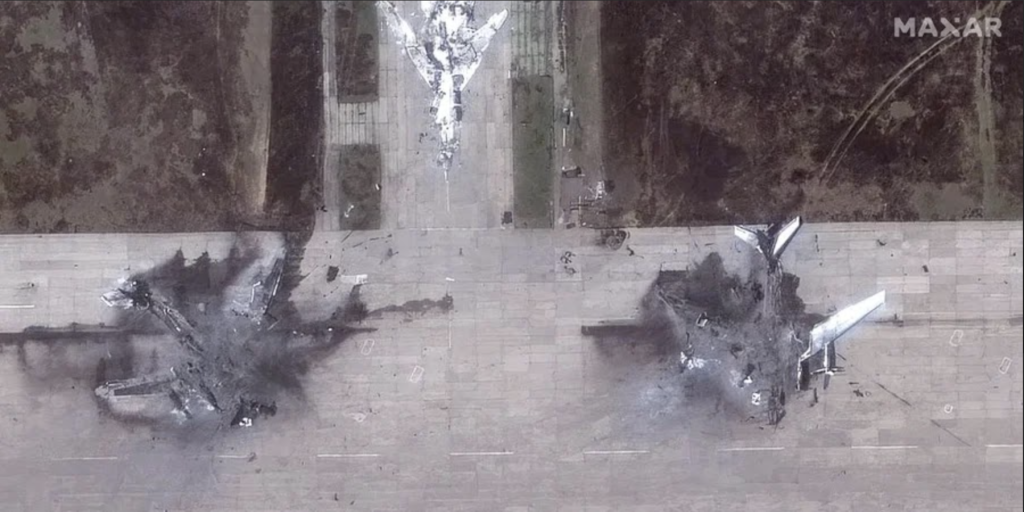
Almost seven months after Moscow updated its nuclear doctrine, Kyiv delivered an unprecedented blow. On June 1, 2025, Ukraine carried out the historic “Spiderweb” operation — an attack on four Russian military airfields deep in the rear: “Belaya” (Irkutsk Oblast), “Dyagilevo” (Ryazan Oblast), “Olenya” (Murmansk Oblast), and “Ivanovo” (Ivanovo Oblast). According to preliminary information, the strikes destroyed or damaged more than 41 Russian strategic aircraft, including Tu-95, Tu-22M3, Tu-160 bombers, and A-50 reconnaissance aircraft.
Notably, around one hundred Ukrainian drones, without crossing the Russian border, took off directly near Russian air bases from specially equipped trucks, raising questions not only about the security of strategic facilities deep in the rear, but also about the effectiveness of all Russian security agencies. In fact, Russia has not suffered such a humiliating defeat since its very founding.
The damage and destruction of Russian strategic bombers is not only a direct reduction in Russia’s ability to carry out missile strikes against Ukrainian civilian cities. On a strategic level, Operation “Spiderweb” inflicted serious damage on precisely that component of Russia’s nuclear arsenal whose restoration would be an extremely difficult task for Moscow. In particular, recovery would require decades and billions of dollars — and only on the condition that Russia’s military-industrial complex is even capable of producing such aircraft.
Russia does not have an established serial production of new strategic bombers and is currently only modernizing and assembling aircraft using airframes preserved since the 1980s. This process is referred to in Russia as “reproduction,” but it is not full-scale production from scratch. For example, in recent years not a single new aircraft has been manufactured, and only a handful of modernized Tu-160M bombers have been assembled from Soviet-era airframes.
Moreover, such successes by the Defense Forces of Ukraine may have another consequence: a vivid demonstration of Kyiv’s capabilities and the very trump card whose absence Trump has repeatedly mentioned when speaking about the war.
The full article was published on Euromaidan Press
Photo: Maxar Technologies/Handout via REUTERS
Author: Anton Zemlianyi
13.06.2025
At the summit of the Bucharest Nine (B9) and Nordic countries held on June 2, 2025,…

13.06.2025
The full-scale war against Ukraine is setting new rules and military doctrines that must be taken…

22.07.2024
Full version of the article is published on Dagens Nyheter Despite the introduction of 14 packages…


