

Even in the absence of U.S. assistance, Ukraine will offer desperate resistance to the aggressor — Head of the USCC
24.02.2024
Another attempt by U.S. President Joe Biden during a meeting with congressional leaders on February 27…
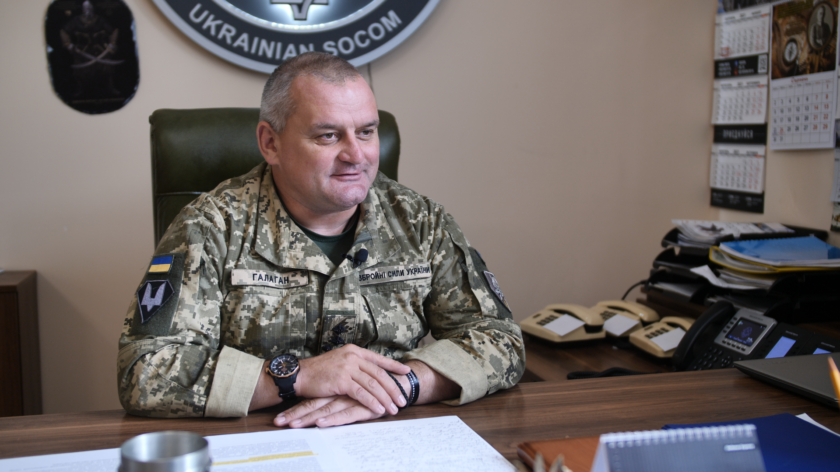
Commander of the Special Operations Forces Hryhorii Halahan is a vivid example of a new generation of Ukrainian commanders who took the oath during Ukraine’s independence and possess a fundamentally different mindset.
From 2002 to 2014, Hryhorii Anatoliiovych served at the “Alpha” Special Operations Center of the Security Service of Ukraine (SBU) in Simferopol and was among the 10% of Crimean SBU officers who did not betray their oath after the occupation of the peninsula began. He took part in the Russian–Ukrainian war and was awarded the Order “For Courage” (3rd Class) and the Order of Bohdan Khmelnytskyi (3rd Class).
In August 2020, Hryhorii Halahan was appointed Commander of the Special Operations Forces. More than a year has passed since then, and both Major General Halahan and the SOF themselves have much to be proud of.
Why have the Special Operations Forces become a model to follow?
How are reforms being implemented and how does the SOF cooperate with NATO countries?
What is the role of the Special Operations Forces in organizing national resistance? Read about this and much more in an exclusive interview by the Ukrainian Center for Security and Cooperation (UCSC) with the Commander of the Special Operations Forces of the Armed Forces of Ukraine, Major General Hryhorii Halahan.
— After the first rotations to the combat zone in eastern Ukraine, I was offered to take part in forming a special volunteer unit of the Security Service of Ukraine—one of the combat directorates of the Special Operations Center. Later, I commanded this unit. Over four years of the Anti-Terrorist Operation and subsequently the Joint Forces Operation until 2019, I held positions as head of a directorate, deputy head of the center, and deputy head of the Special Operations Center of the SBU.
— In 2015, I was wounded while performing combat tasks. There wasn’t much time for rehabilitation because the war continued, and I had to carry on fulfilling my duties as deputy head of the center.
In 2019, the then Commander-in-Chief offered me to return to the Special Operations Forces, which I accepted. I became Chief of Staff, and a year later I was appointed Commander of the Special Operations Forces.
— First of all, we changed the selection approach at our Training Center—the Q-course, or qualification course, which has the same name in partner countries. Only service members with proper prior training can join. The requirements for a SOF operator are very high: they must be able to make quick decisions, be highly qualified, and provide medical aid to comrades. For us, the best warrior is the one who can respond rapidly to rapidly changing situations.
— The Special Operations Forces are the youngest but also the most modern branch of forces. They were formed under wartime conditions. Since 2014, our service members have gained extensive combat experience, which is highly valued by our partners.
— In 2014–2016, partners provided assistance even at the tactical level, including material and technical support. Without them, we simply could not have managed. Now, with accumulated experience, we have reached a level where we can also provide advisory support. In some aspects, we are even ahead, because we are constantly engaged in combat operations.
Not all countries participate in active combat, so I believe we have reached a “peer-to-peer” level. Ukraine is becoming an equal partner. One SOF unit of the Armed Forces of Ukraine is already on combat duty within NATO’s Rapid Response Forces, meaning it fully meets NATO standards—from planning procedures to equipment and interoperability.
By 2024–2025, I plan for each unit from every center to be able to take part in NATO Rapid Response Force rotations.
24.02.2024
Another attempt by U.S. President Joe Biden during a meeting with congressional leaders on February 27…
05.12.2023
The Chairman of the Verkhovna Rada of Ukraine Committee on National Security, Defense, and Intelligence, Oleksandr…
17.11.2023
Georgia—a country that for a long time had been moving toward European integration—has recently witnessed a…


