


Mariupol is Putin’s blueprint for occupation, and the world is barely paying attention
18.05.2026
When Russia launched its full-scale invasion of Ukraine in 2022, Mariupol quickly became the site of…
This summer was extremely eventful, and one of its key moments was the meeting between the Presidents of the United States and Russia on June 16.
The meeting was followed particularly closely in Minsk. According to sources of the Ukrainian Center for Security and Cooperation (UCSC) within Ukrainian intelligence services, the illegitimate president of Belarus, Alyaksandr Lukashenka, feared that he might become a bargaining chip during negotiations between Joe Biden and Vladimir Putin, and allegedly even demanded guarantees from the Russian president that this would not happen.
At the same time, intelligence circles expressed the view that if no changes occurred at the top of Belarusian power by autumn, Lukashenka could remain in office for quite some time. As we can see, no changes took place; however, the illegitimate president of Belarus did make certain concessions to the Kremlin.
“Union State”
On September 9, another meeting between Alyaksandr Lukashenka and Vladimir Putin took place.
As a result of this meeting, 28 integration roadmaps were agreed upon. On September 10, they were approved by the governments, and their signing is scheduled for November 4 at a meeting of the Supreme State Council of the “Union State.”
Over the past year, this was already the fifth meeting between Putin and Lukashenka. Each of them was hyped by both propaganda machines to the level of being “extraordinary”, “historic,” “decisive”, etc. Yet in reality, virtually nothing happened. The number of integration roadmaps constantly changes, while their full content remains unknown to the public.
The main actors of the “integration” also avoid clarifying their substance, limiting themselves to vague phrases such as “strengthen,” “deepen,” “improve,” and “harmonize.”
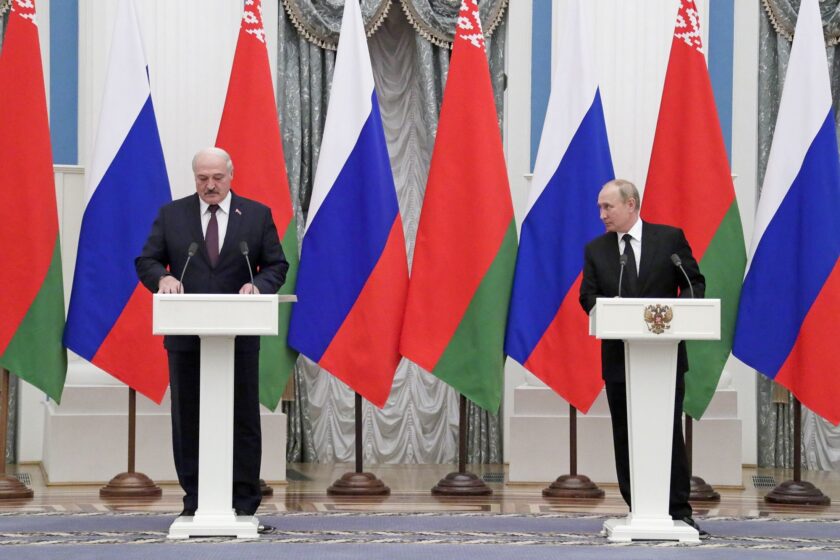
At the press conference on September 9, Lukashenka appeared rather confident, thanked Putin and Russia, and criticized the West, which he claimed was “on the verge of collapse.” The Russian leader looked somewhat unwell, coughing frequently, but overall also appeared confident in the success and timeliness of creating the “Union State.” Notably, on September 14 it became known that Putin went into forced self-isolation “due to detected cases of coronavirus in his close circle.”
At the same time, the rostrum from which Lukashenka spoke did not bear the Belarusian coat of arms, unlike Putin’s podium, which displayed the Russian emblem.
At the end of the press conference, answering a journalist’s question about the current stage of the “rapprochement” process that has lasted more than 20 years, Putin stated that it should have started with what they have agreed upon now—creating an economic base as the foundation of relations, while everything else would be a political superstructure. He added that only after these agreements are implemented could further steps be discussed, but that would be a matter for the future, “since the situation is changing rapidly.”
The economic agreements, although initially envisaging the creation of a single currency for the “Union State,” abandoned this idea. The Kremlin also rejected the issue of creating a single parliament, while a unified electricity, oil, and gas market is planned to be created by the end of 2023.
Lukashenka’s latest statements, made on the same day, further reinforce suspicions that integration between Belarus and Russia under the Union State treaty, in its originally planned form, has no real prospects.
“Two generations have grown up since then, and today it is no longer possible to implement that integration,” Lukashenka himself stated.
Of course, it is difficult to make political forecasts where politics depends solely on the decisions of two autocrats. However, it increasingly appears that real integration is primarily uninteresting to Alyaksandr Lukashenka, who uses it exclusively as a bargaining tool—to extract financial support from Moscow and secure backing for his extremely unstable position after losing the 2020 presidential election. The Kremlin, in turn, uses Lukashenka for its own electoral purposes, selling a new geopolitical “victory” to its citizens in the form of Belarus’s de facto annexation.
Domestic situation
UN Special Rapporteur Anaïs Marin described repression in Belarus as worse than catastrophic. Lukashenka’s regime directs “horrific repression” against the human rights group Viasna, whose volunteers collect information on human rights violations in Belarus. As a result, this undermines Geneva’s ability to monitor the situation and properly report on repressive policies.
Belarusian human rights defenders share this view: during the summer of 2021 alone, another 236 people were arrested for political reasons.
The general trend suggests that from mass repression against politically active citizens, the illegitimate Belarusian authorities have moved toward terror against society as a whole. Many recent cases concern ordinary citizens who merely attempted to express disagreement with the regime. People are arrested even for likes and comments on social media, while kindergartens and schools are declared sources of a so-called “color revolution.”
Military integration
Earlier this year, within the framework of Russia–Belarus integration, so-called “military integration roadmaps” were agreed upon. According to officials from both states, these included a joint air defense system, joint military training centers, joint troop command, and more.
However, here too Lukashenka, apparently bargaining for better terms, was in no hurry to surrender his positions.
At the end of summer, he stated that there was no need to deploy Russian troops on Belarusian territory.
According to Russian media, despite Moscow’s attempts to agree on operational subordination of forces and the creation of a single military decision-making center, no agreement with Minsk was reached. This was clearly reflected in the command of the “Zapad-2021” exercises, which was carried out by the Chiefs of the General Staffs of Russia and Belarus rather than a unified center.
However, just ahead of the Putin–Lukashenka meeting, the situation began to change.
On September 8, the Belarusian Ministry of Defense published information about the deployment of at least three Russian Aerospace Forces Su-30SM fighter jets, which would carry out joint combat duty to protect the air borders of the “Union State.”
On September 12, while visiting a training ground near Baranovichi, Lukashenka hinted at an alleged “threat” from the West and recalled the experience of 1941, when Belarus was occupied by Nazi forces.
He also announced plans to deploy Russian S-400 air defense systems on the border with Ukraine, stating that this issue was discussed with Putin. According to him, Belarus plans to purchase weapons from Russia totaling more than USD 1 billion.
“Zapad-2021.” Military aspects
From September 10 to 16, Russia and Belarus officially conducted joint strategic military exercises “Zapad-2021”. In addition to the organizers, military contingents from Armenia, India, Kazakhstan, Kyrgyzstan, Mongolia, and a representative of Sri Lanka’s military delegation took part. According to official data, about 200,000 personnel, more than 700 units of military equipment, and over 80 aircraft and helicopters were involved.
The true number of participants remains unknown. NATO had previously accused Moscow of understating participant numbers during the 2017 exercises. This year, Ukraine’s Defense Intelligence also stated at the outset that more combat aviation and artillery systems would be used than officially declared.
Thus, it cannot be said that integration between Russia and Belarus exists only on paper; however, rapid progress—at least in political matters—should not be expected.
Photo: TASS
Authors: Oksana Kuzan, Borys Hrachov
18.05.2026
When Russia launched its full-scale invasion of Ukraine in 2022, Mariupol quickly became the site of…

05.05.2026
Russia pressed every Donbas sector in April, with assault tempo at a two-month high. The territorial…

16.03.2026
It is in the war against Ukraine that Russia is trying to adhere to this non-linear…


