


Mariupol is Putin’s blueprint for occupation, and the world is barely paying attention
18.05.2026
When Russia launched its full-scale invasion of Ukraine in 2022, Mariupol quickly became the site of…
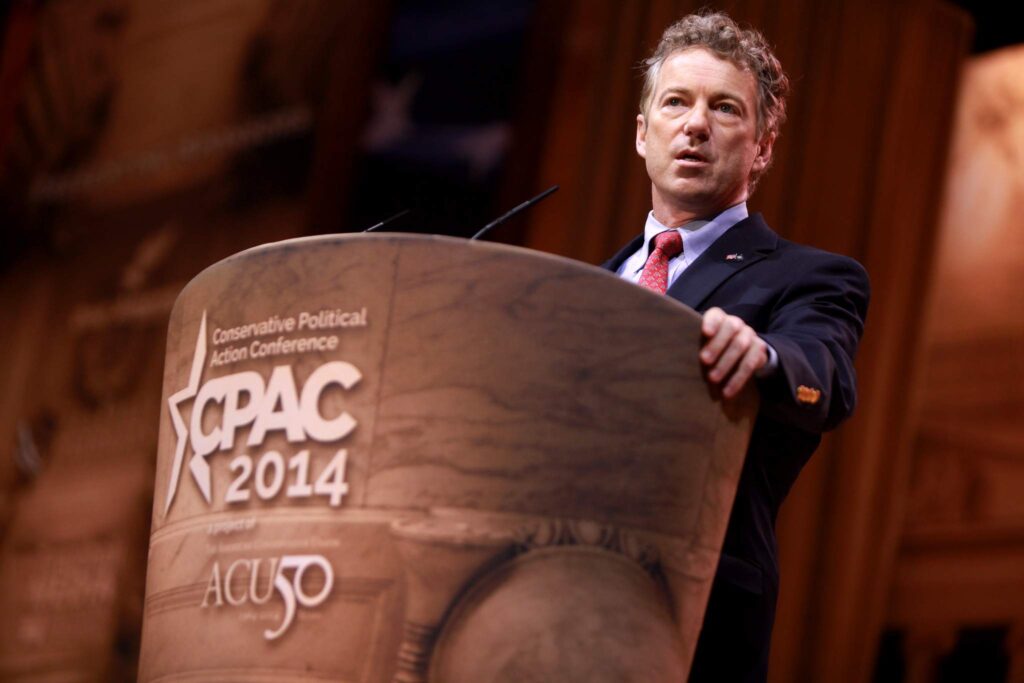
Days before the public learned about Trump’s 28-point “peace plan” for Ukraine, a cluster of American conservative publications began pushing the narratives that would justify it.
The plan—which would require Ukraine to surrender the entire Donbas region, cap its military at 600,000 troops, enshrine non-NATO status in its constitution, and give up long-range weapons capable of striking Russia—drew immediate criticism from Republicans and Democrats alike. Ukraine called it what it was: a roadmap to capitulation. The Institute for the Study of War noted that the plan contains “no provisions in which Russia makes any concessions.”
But the rhetorical ground had already been prepared—by outlets with ties to Senator Rand Paul of Kentucky.
On 18 November—the same day the plan surfaced—The American Conservative published a lengthy piece by John Mearsheimer, the political scientist whose arguments about NATO “provoking” Russia have become fixtures of Kremlin messaging.
Mearsheimer’s article, “Europe’s Bleak Future,” recycled familiar claims: that Russia never intended to destroy Ukraine, only to “defend its interests” against NATO expansion; that Ukraine’s defeat is now obvious; that Europe brought economic suffering on itself by confronting Moscow.
These are not analytical conclusions. They are Kremlin talking points—the same arguments Vladimir Putin uses to justify invasion, echoed by Russian state media the same day.
A day earlier, on 17 November, Responsible Statecraft published “A Trump offer that Putin cannot refuse” by Jennifer Kavanagh of Defense Priorities. Kavanagh’s piece reinforced the same core narrative: Russia is winning, Ukraine is losing, and Washington should stop pressuring Moscow and start offering incentives instead. She explicitly recommended that the administration pursue “bilateral political or economic agreements between the US and Russia”—precisely what the 28-point plan delivers.
What links these outlets? All three—The American Conservative, Responsible Statecraft, and the Defense Priorities think tank—have ties to Senator Rand Paul.
Defense Priorities was created in 2016 with backing from Paul and several conservative donors. The outlets regularly amplify his foreign policy views: minimal US involvement abroad, skepticism of NATO, and—most relevantly—reducing American support for Ukraine.
This isn’t the first time Paul’s name has appeared alongside Kremlin-favorable positions:
That last point matters. Paul is not simply a Trump loyalist. He operates from consistent libertarian principles that happen to align with Russian strategic interests on Ukraine: reduce American military commitments, avoid confrontation with nuclear powers, prioritize domestic spending.
None of this proves coordination between Paul’s media orbit and the Kremlin. What it demonstrates is something arguably more concerning: an ideological ecosystem within American conservatism that consistently produces messaging favorable to Russian interests—whether by design or alignment.
When the 28-point plan emerged, the arguments defending it were already circulating. Readers of The American Conservative and Responsible Statecraft had already absorbed the framing: Ukraine is losing, resistance is futile, the real problem is NATO expansion, and Washington should offer Moscow incentives rather than pressure.
This is how information environments are shaped. Not through crude propaganda, but through a steady accumulation of respectable-seeming analysis that makes capitulation seem reasonable—even inevitable.
American debate about Ukraine policy is legitimate and necessary. But when the same network of outlets consistently amplifies positions that serve Russian strategic goals—and does so with suspicious timing—readers deserve to know whose interests are being served.
18.05.2026
When Russia launched its full-scale invasion of Ukraine in 2022, Mariupol quickly became the site of…

05.05.2026
Russia pressed every Donbas sector in April, with assault tempo at a two-month high. The territorial…

16.03.2026
It is in the war against Ukraine that Russia is trying to adhere to this non-linear…


