


Mariupol is Putin’s blueprint for occupation, and the world is barely paying attention
18.05.2026
When Russia launched its full-scale invasion of Ukraine in 2022, Mariupol quickly became the site of…
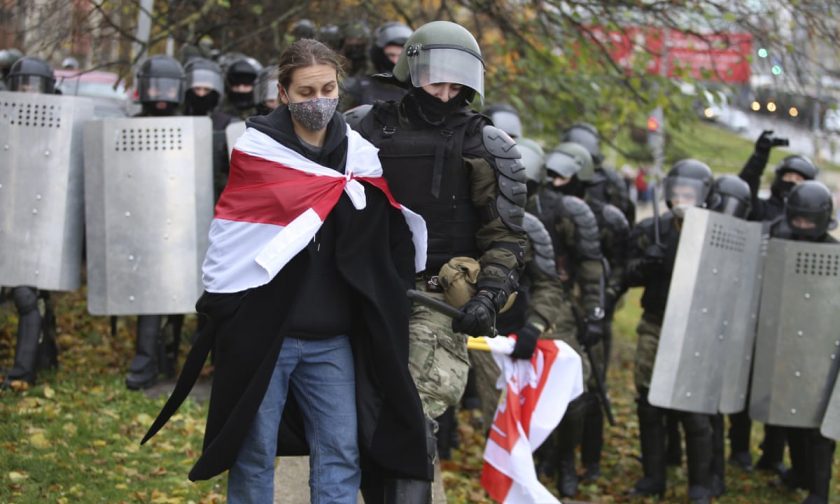
In Belarus, a wave of mass repression against the opposition, activists, and the media continues. The vast majority of cases end with real and lengthy prison sentences for those involved. In addition, according to information from our sources in Ukrainian special services, the process of Belarus’s gradual “absorption” by Russia continues: many representatives of Russia’s FSB are currently working within the KGB of the republic.
The judicial system has completely degraded, leaving virtually no— even the smallest—means of defending one’s rights. People have been driven to despair, and some have committed public suicide.
In particular, on May 25, 17-year-old Dmitry Stakhovsky, who was a suspect in the “mass riots” case of August 9–11, 2020, took his own life, leaving a suicide note on social media. In it, the teenager blamed the Investigative Committee for his death and complained about pressure from security forces.
On June 1, political prisoner Stepan Latypov attempted to take his own life directly during a court hearing. Prior to this, he stated that GUBOP (the Main Directorate for Combating Organized Crime and Corruption — ed.) had threatened him with criminal cases against his relatives and neighbors if he did not plead guilty. According to Stepan’s father, since April 11 his son had been held in a punishment cell together with people suffering from mental disorders.
At times, the actions of law enforcement reach the point of absurdity. For example, on May 31, 78-year-old pensioner Galina Ivanova was fined $1,717 for a flower she placed at the site of the death of Aliaksandr Taraikouski—the first Belarusian activist killed during mass protests. The elderly woman was accused of picketing “by raising her hand and placing one tulip.”
Persecution of journalists and media
Over the past few weeks, most independent media outlets that attempted to continue operating inside the country have been effectively destroyed.
The largest Belarusian portal TUT.BY (essentially an analogue of Russia’s Yandex) was blocked; the website is currently inaccessible, and the vast majority of its staff were arrested. In late May–early June, some employees were released from detention. Those who were freed describe inhumane conditions, torture, threats, and more.
The same fate befell employees of the BELSAT TV channel: some staff were detained, while others were evacuated to Kyiv. The channel continues operating, but without a studio in Belarus.
On May 18, journalist Artyom Mayorov of the outlet “Belarusians and the Market” was detained while covering a search at TUT.BY’s main office. He was convicted of “minor hooliganism” and released on June 2 after 15 days of administrative arrest.
On January 29, searches were conducted at Hrodna.life—one of the few outlets that continued to operate and honestly cover events in Belarus.
An administrative case was opened following the searches. The editorial office faces a fine of up to 14,500 Belarusian rubles (about $5,500). After the search, security forces seized flash drives, a laptop, four cameras, a drone, and printed materials from Hrodna.life.
According to security officials, the search was conducted because one article on the site contained an image with a watermark from a Telegram channel that had been designated as extremist (presumably Nexta Live).
On May 30, Hrodna.life editor-in-chief Aliaksei Shota was detained. He was later released, but charged under Article 19.11 of the Administrative Code for “distribution, production, storage, or transportation of information products containing calls for extremist activity or promoting such activity.”
On June 1, journalist Dmitry Ruto of the sports portal Tribuna was detained for a white-red-white scarf in his car and found guilty of “illegal picketing.”
Journalist Denis Ivanov was sentenced to 15 days of arrest for disobedience. He was detained at his workplace on June 1 and spent the night in a detention facility.
On June 2, Tribuna journalist and footballer Aliaksandr Ivulin, as well as editor Yaroslav Pisarenko of the “Chestnokov” project, were detained. They were taken from an apartment by men in civilian clothes and driven away in two cars to an unknown location.
This is only the information available from open sources. Most likely, the scale of detentions is much larger.
Ideological work with youth
It is evident that the current Belarusian authorities have drawn conclusions from last year’s protests. Alongside the detention of opposition leaders and the suppression of journalists’ activities, the authorities are closely monitoring youth, who were the driving force of the protest movement. To suppress opposition sentiments, the authorities resort to expelling young activists from universities, detentions, and convictions.
Belarus is also closely monitoring the “proper” ideological training of military personnel, especially young people conscripted in 2021. According to several of our sources in Ukrainian special services, the command of the Belarusian Armed Forces developed recommendations for military commissariats and unit commanders regarding ideological work with conscripts who participated in protests in 2020–2021.
In particular, it is recommended to assign them to units with a high level of combat readiness and minimize contact with their former social circles. The Belarusian Armed Forces hope to completely “re-educate” youth from the “risk group” in this way.
In addition, at the assessment stage, military commissariats are advised to work with the families of opposition-minded conscripts, educational institutions’ administrations, and former employers.
Protasevich’s “confession”
Detained on May 23, former editor-in-chief of the opposition Belarusian Telegram channel “Nexta,” Roman Protasevich, confessed to organizing mass riots and expressed respect for the self-proclaimed president Lukashenko.
The “confession” took place in the format of an “interview” with the pro-government Belarusian TV channel ONT. Marks from handcuffs were visible on the opposition figure’s wrists, and his hands appeared swollen.
Videos of Protasevich were actively disseminated by state media and even broadcast on advertising screens in some major cities, including the capital. The authorities are likely attempting to intimidate and demoralize participants of opposition rallies and citizens dissatisfied with the current political situation.
Exit ban
The last legal and relatively easy way to leave Belarus was air travel. However, after the introduction of a flight ban over the country and sanctions against Belavia, leaving Belarus has become extremely difficult.
Since December 2020, exit from Belarus through land border checkpoints has been temporarily restricted for Belarusian citizens and foreigners with residence permits. Only transit through Russia remains possible.
Legislative changes
In practice, the law in Belarus no longer functions. To legitimize repression, the authorities have adopted even harsher laws that make any disobedience impossible.
The changes include bans on rallies, restrictions on journalists’ work during protests, altered procedures for authorizing demonstrations, a complete ban on fundraising to pay fines or support detainees, and legal authority to shut down the internet, television, and public transport.
Amendments also affected the Labor Code, introducing new grounds for dismissal. From June 30, Belarusians may lose their jobs due to absence caused by administrative arrest, and striking workers can be dismissed without prior notice or union consent.
Meanwhile, the self-proclaimed president Lukashenko signed Security Council Resolution No. 1 “On Measures to Ensure National Security of the Republic of Belarus,” instructing the government to prepare draft laws amending the laws “On the State of Emergency” and “On Martial Law.”
An artificial “Iron Curtain”
Repression and persecution, as well as the practical neutralization of opposition media, have had a severe impact on Belarusian civil society. The Belarusian language and even clothing in the colors of the historic national flag (white-red-white) can result in fines or detention. Soon, the white-red-white flag and the slogan “Long Live Belarus” may be classified as “Nazi symbols.”
Arrests and their true scale remain unknown. According to our sources, many FSB representatives are currently working within the Belarusian KGB.
Their tasks include:
An example of such “cooperation” is the demonstrative operation to detain former NEXTA editor-in-chief Roman Protasevich.
Thus, it is already clear that the Belarusian authorities have decided to clamp down tightly on all protest activity:
On the one hand, these measures contribute to establishing an “Iron Curtain” between Belarus and the West, turning the country into an international outcast. On the other hand, they create a strong impression that there is no alternative to closer integration with Russia. Information about the presence of FSB representatives within the Belarusian KGB only confirms that the current situation is not only beneficial to the Kremlin but is coordinated directly from there.
Photo: AP
Authors: Oksana Kuzan
18.05.2026
When Russia launched its full-scale invasion of Ukraine in 2022, Mariupol quickly became the site of…

05.05.2026
Russia pressed every Donbas sector in April, with assault tempo at a two-month high. The territorial…

16.03.2026
It is in the war against Ukraine that Russia is trying to adhere to this non-linear…


