


Ukraine Is a Key Pillar of Europe’s Defense
13.06.2025
At the summit of the Bucharest Nine (B9) and Nordic countries held on June 2, 2025,…
“The Russians built three lines of defense on the right bank of the Dnipro, but it didn’t save them. They fled, abandoning all those fortifications and Kherson itself, which they had promised to defend to their very last mobilized soldier,” — Serhii Kuzan, Head of the USCC, in an interview with BBC News Ukraine.
Since the beginning of Russia’s full-scale invasion of Ukraine, the Russian army managed—after heavy fighting—to capture only one regional center in the south of the country: Kherson.
During the occupation, the city experienced the full essence of the so-called “Russian world.” Kherson was kept inside a total Russian information bubble filled with concentrated propaganda. War crimes committed by the invaders numbered in the hundreds: murders, abductions, rapes, torture, and deportations. Kherson residents were forcibly relocated, while occupiers settled into abandoned homes. By deporting Ukrainians to various regions of Russia, the Kremlin is attempting to solve the problem of record natural population decline (1.4 million people in 2021) and the resulting labor shortages—an issue Putin himself complained about in late 2021. In Kherson alone, investigators discovered four torture chambers and seven additional illegal detention sites where detainees could not be publicly charged due to lack of evidence.
To liberate the city, the Ukrainian command—unlike the Russian one—refused a direct assault in order to avoid heavy losses. Instead, Ukrainian forces spent nearly nine months methodically striking Russian logistics routes, bridges, and crossings, slowly advancing forward. Eventually, to avoid the catastrophe that had befallen Russian troops in the Kharkiv region, Russian units were forced to flee to the left bank of the Dnipro.
However, while retreating, they managed to completely destroy the city’s energy infrastructure and looted everything of any value from state institutions, private businesses, and households. The occupiers mined buildings, household objects, and even bodies. Since the city’s liberation, approximately 2,500 explosive devices have already been neutralized.
Investigators have already documented more than 400 war crimes, for which Russia will have to answer before international courts.
How is liberated Kherson living today? What is the mood of local residents? And was the city’s liberation unexpected? The team of the Ukrainian Security and Cooperation Center visited Kherson immediately after it was liberated by the Ukrainian army.

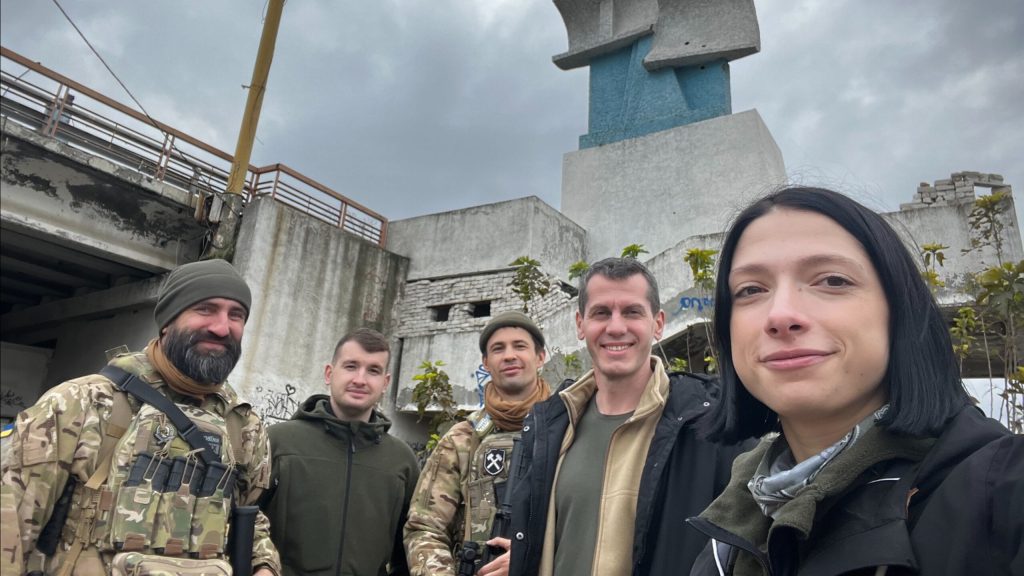
Representatives of the Ukrainian Security and Cooperation Center at the entrance to newly liberated Kherson. Source: USCC
“We knew we had not been forgotten”
Despite the large number of unexploded mines and rockets from multiple-launch rocket systems along the road to the city, life in Kherson itself is gradually being restored. The first thing that catches the eye is the huge number of residents wrapped in Ukrainian national flags against the backdrop of half-torn billboards reading “Russia is here forever,” left behind by the occupiers.
Units of the Ukrainian Defense Forces continue to enter the city, conducting stabilization measures and restoring the work of authorities and social infrastructure. Major state-owned companies such as PrivatBank and Oschadbank, as well as Ukrposhta, have returned. Private companies are resuming operations as well. The first major retail chain to return was ATB. Nova Poshta has already opened two stationary branches.
Thousands of residents constantly gather at Freedom Square in front of the Kherson Regional Military Administration. Here, Kherson residents continue to welcome soldiers, receive humanitarian aid, reconnect to Ukrainian mobile networks—immediately discarding Russian SIM cards (Ukrainian mobile operators restored service in Kherson within just two days). Many are searching for relatives who disappeared during the occupation or were evacuated before the city was captured.
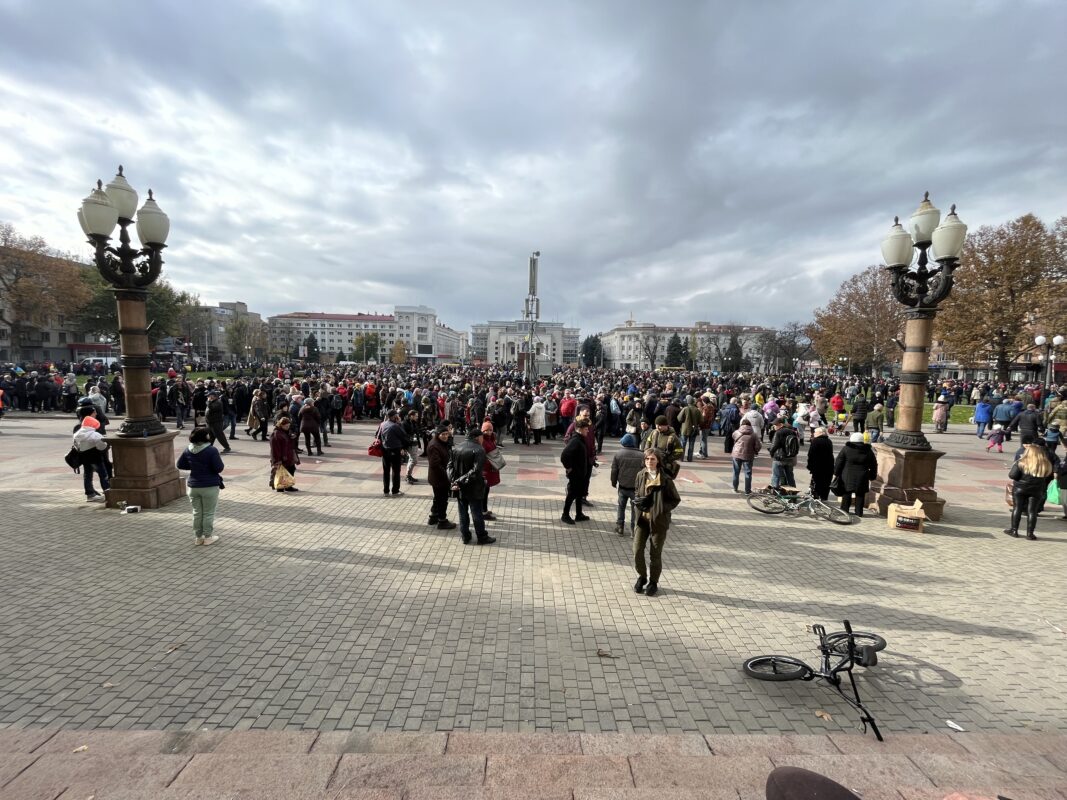
Kherson residents at Freedom Square in front of the military administration. Source: USCC
“We knew we had not been forgotten,” says local resident Viktoriia (name changed), who, together with her daughter, was having a Ukrainian flag signed by a soldier—a flag her family had hidden throughout the occupation. “The Russians completely blocked Ukrainian communications, so we were forced to buy Russian SIM cards. However, they failed to fully block the satellite signal of Ukrainian television. We followed the news closely, although we couldn’t fully believe Kherson would be liberated. You can’t imagine our joy when Ukrainian units entered the city.”
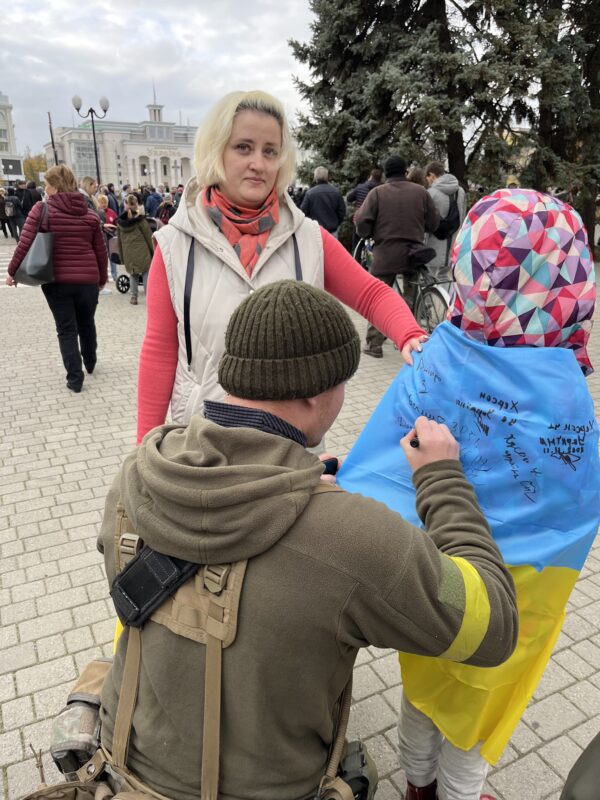
Local resident “Viktoriia” with her daughter
“Kherson never surrendered during the occupation”
“Detentions, torture, and killings of civilians by the Russians became the norm,” says 17-year-old Kherson resident Liubov, dressed in a traditional Ukrainian embroidered blouse. “All of Ukraine saw how Kherson residents stopped Russian military vehicles with their bare hands at Freedom Square—many paid a brutal price for that. Police detention facilities turned into torture chambers; women suffered the most, subjected to gang rape. Yet Kherson never surrendered throughout the occupation: refusing Russian documents and payments, boycotting the so-called ‘referendum,’ sabotaging occupation authorities, and even conducting reconnaissance for the Defense Forces—this was the daily resistance of Kherson residents.”
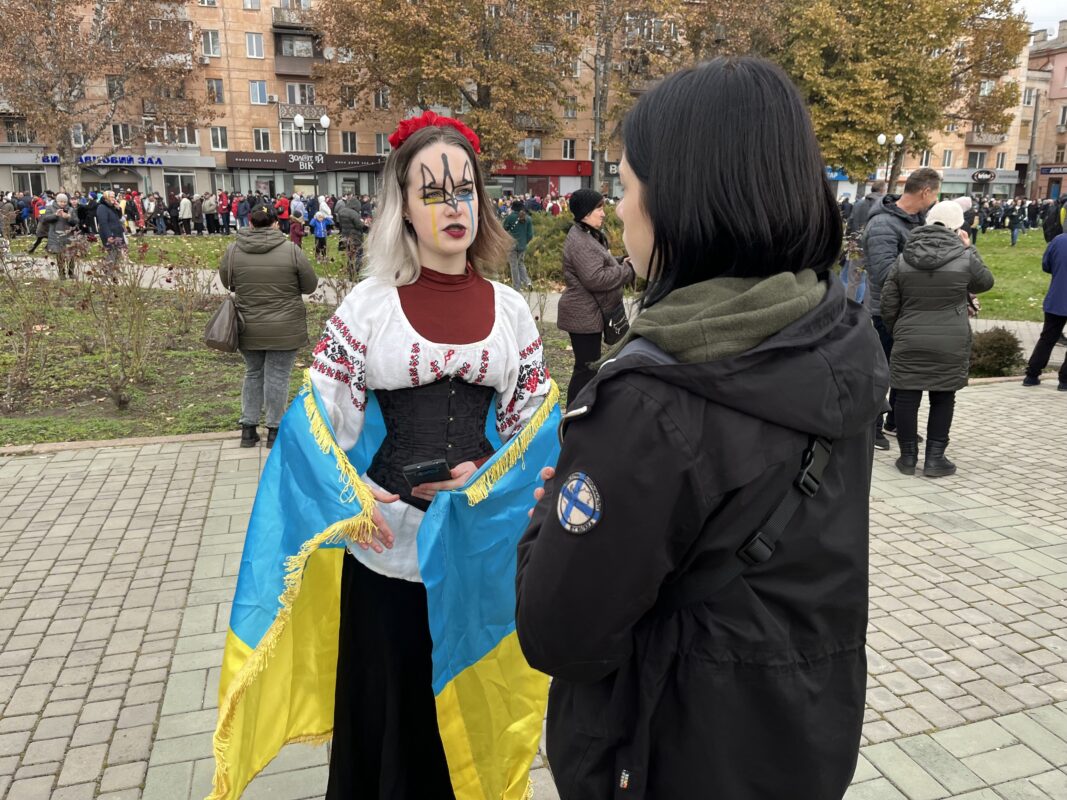
Seventeen-year-old Kherson resident Liubov recounts crimes committed by Russian occupiers
The resistance movement in the Kherson region became truly legendary. Partisans painted graffiti, posted leaflets, tied yellow ribbons, and passed information to the Ukrainian Defense Forces. To honor those resisting the occupiers, Ukraine even launched the “Yellow Ribbon” flash mob.
A City on the Line of Fire
In addition to civilians, the USCC team also spoke with soldiers who liberated the city. Ukrainian defenders emphasize that the war is not over for Kherson, as the city remains on the front line. To avoid the defeat they suffered in the Kharkiv region, Russian forces carefully prepared their retreat:
First. The Russian command forced the local population to relocate to the left bank of the Dnipro. Under this “human shield,” the occupiers evacuated equipment, weapons, and documents over three weeks before the city’s liberation. The Ukrainian army still carried out precision strikes on retreating Russian forces but could not launch a larger offensive in order to protect civilians.
Second. The enemy continuously prepared positions on the left bank of the Kherson region, building deeply echeloned defenses with concrete fortifications, trenches, and anti-tank obstacles.
Third. Kherson remains within reach of Russian artillery, which continues to terrorize the city with massive strikes.


The Antonivskyi Bridge, blown up by the Russians during their retreat from Kherson and USCC representatives with Ukrainian soldiers.
Sources: USCC
At the same time, morale in Kherson itself remains high. In every corner of the city, the sound of Ukrainian artillery can be heard, preventing Russian forces from fully deploying on the left bank. Despite disruptions to communications, heating, and water supply, Kherson residents are convinced the worst is already behind them. And the abandoned Russian positions on the approaches to Kherson—positions they had vowed to hold to the last—once again confirm that sooner or later the entire Kherson region, like all of Ukraine, will be liberated from Russian occupation.
13.06.2025
At the summit of the Bucharest Nine (B9) and Nordic countries held on June 2, 2025,…

13.06.2025
The full-scale war against Ukraine is setting new rules and military doctrines that must be taken…

09.06.2025
In the fall of 2024, the Kremlin took another step toward renewed nuclear blackmail. On September…


