


Mariupol is Putin’s blueprint for occupation, and the world is barely paying attention
18.05.2026
When Russia launched its full-scale invasion of Ukraine in 2022, Mariupol quickly became the site of…
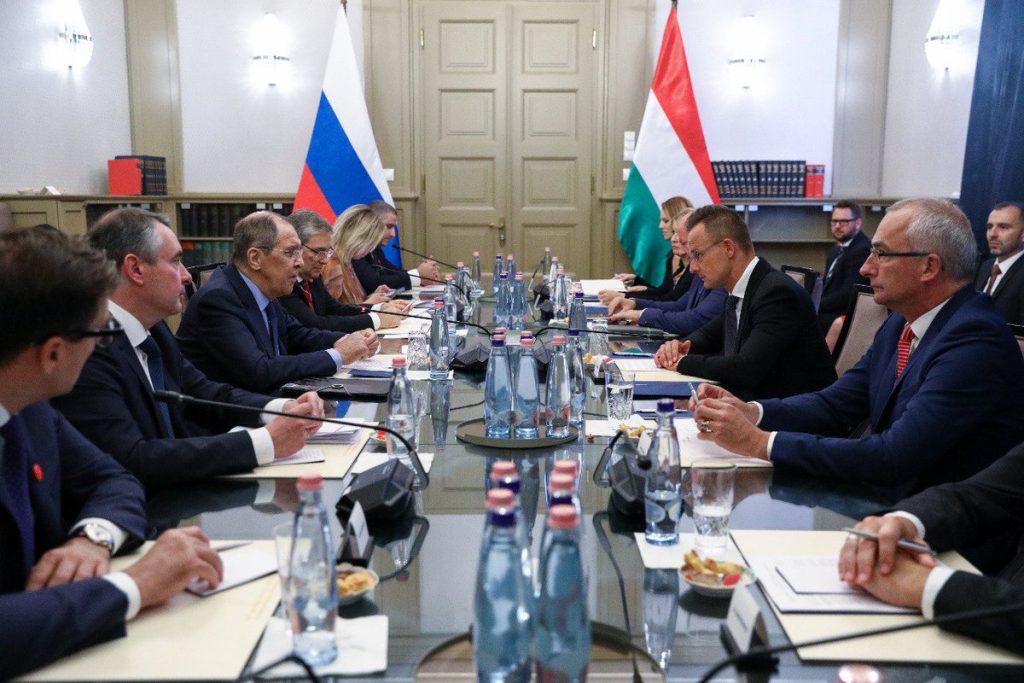
The understanding reached between Berlin and Washington with Moscow on the implementation of the Nord Stream 2 project as early as this autumn has put at risk not only Ukraine’s security, but that of all Europe. And the leaders of the Old World have already begun to feel the first consequences of this step.
The Kremlin has provoked yet another gas crisis on the eve of the heating season, as a result of which prices for “blue fuel” have reached record highs.
Against this backdrop, Hungary’s gas deal with Russia—amid calls in Hungarian media for the country to leave the EU—may appear logical, but once again raises serious questions about the effectiveness of Euro-Atlantic institutions.
The Road to “Huxit”
After returning to power for a second term in 2010, Hungarian Prime Minister Viktor Orbán gradually established an authoritarian regime in the country. Following Russia’s armed aggression against Ukraine in 2014, Orbán issued ultimatums to the Ukrainian authorities demanding dual citizenship and “collective rights” amounting to “autonomy” for Hungarians in Transcarpathia. Since then, Orbán’s government has consistently advocated for the lifting of sanctions imposed on Russia for the occupation of Crimea and parts of Donetsk and Luhansk regions, openly stating that “sanctions against Russia are not a reasonable policy.” Even during the Visegrád Group summit (Czech Republic, Poland, Slovakia, and Hungary) in April this year, Budapest blocked a stronger statement criticizing the Kremlin. With the onset of the pandemic, Orbán’s government was also the first in the EU to approve the use of the Russian Sputnik V vaccine, whose effectiveness has yet to be conclusively proven.
Notably, Orbán has called for the lifting of sanctions not only against Russia, but also against Belarus. The self-proclaimed president of Belarus, Alyaksandr Lukashenka, recently even предложed to Orbán to “jointly fight for family values.”
Moreover, this year Orbán, along with Putin and Lukashenka, was included in the list of “enemies of the press” by the respected organization Reporters Without Borders. The Hungarian prime minister became the only leader of an EU member state on this list. Recently, the pro-government newspaper Magyar Nemzet (“Hungarian Nation”) published a provocative headline, “It’s Time to Talk About ‘Huxit’” (by analogy with “Brexit”), openly calling for Hungary’s exit from the European Union. This outlet has often been used by the Hungarian government to test public sentiment on sensitive issues.
In response to Budapest’s centrifugal tendencies, Luxembourg’s Foreign Minister Jean Asselborn suggested that the EU should hold a referendum on Hungary’s continued membership. Overall, however, the position of the united Europe has remained weak.
A Gas “Victory”
At the end of August, Hungarian Foreign Minister Péter Szijjártó announced the agreement of a long-term gas deal with Russia. The new contract with Gazprom is рассчитан for 15 years, with the possibility of changing supply volumes after 10 years, and is to be signed by the end of September.
Prior to the new contract, Russian gas supplies to Hungary were delivered via two routes—through Berehove on the Ukrainian-Hungarian border (almost the entire main flow) and via Baumgarten on the Slovak-Austrian border. In 2020, Moscow supplied Hungary with 8.637 billion cubic meters of gas, and in 2019 with 10.522 billion cubic meters. In the first half of this year, supplies totaled 3.909 billion cubic meters.
Under the new arrangement, Gazprom will annually pump 4.5 billion cubic meters of natural gas to Hungary via two routes: 3.5 billion cubic meters through Serbia and 1 billion through Austria. In other words, bypassing Ukraine via the TurkStream pipeline and its onshore extensions through Bulgaria, Serbia, and Austria. The new deal effectively covers half of Hungary’s needs. How the remaining share will be delivered, and what role Ukraine will play in this process, remains an open question.
“We have also agreed on a price that is much more favorable than the one we paid under the agreement signed by Hungary in 1995, which is now expiring,” Szijjártó said, without providing details, portraying the Hungarian-Russian deal as a major “victory” for his country.
However, the “favorable price” mentioned by Szijjártó cannot be such a priori. Previously, gas reached Hungary via a direct route—Russia–Ukraine–Hungary. Now it will travel a much longer, and therefore more expensive route: Russia–Turkey–Bulgaria–Serbia–Hungary. Not to mention that transit along the new route increases harmful emissions. In this situation, Gazprom conveniently hides transportation costs in the final gas price.
Why? Because for Russia, the main goal—regardless of economic feasibility—is to finally tighten the gas noose from the north (Nord Stream 2) and the south (TurkStream), not only around Ukraine, but around Europe as a whole.
Does Budapest understand this? Obviously, yes.
Lessons for the Future
For “favorable” deals with Russia, its partners usually pay with their sovereignty. We see this in the case of Belarus; Ukraine faced the same fate when the infamous Kharkiv Accords were signed in 2010. The Kremlin “rake” Hungary is now stepping on is unlikely to be an exception. One can only hope that Hungarian civil society will still have its say, remembering well the 1956 Revolution drowned in blood by Moscow.
As for Ukraine, it has no choice but to focus on its own energy security and demand accountability from its allies, since both Washington and Berlin promised not to allow Moscow to “turn gas into a weapon.” One such demand could be for Gazprom to sell gas at the borders of the Energy Community, of which Ukraine is a member. Under such conditions, European traders would be able to independently choose routes for further transportation of natural gas.
For now, the worst forecasts warned of by Kyiv have begun to come true even before the launch of Nord Stream 2.
Photo: RusEmbassy (Twitter)
18.05.2026
When Russia launched its full-scale invasion of Ukraine in 2022, Mariupol quickly became the site of…

05.05.2026
Russia pressed every Donbas sector in April, with assault tempo at a two-month high. The territorial…

16.03.2026
It is in the war against Ukraine that Russia is trying to adhere to this non-linear…


