


Mariupol is Putin’s blueprint for occupation, and the world is barely paying attention
18.05.2026
When Russia launched its full-scale invasion of Ukraine in 2022, Mariupol quickly became the site of…
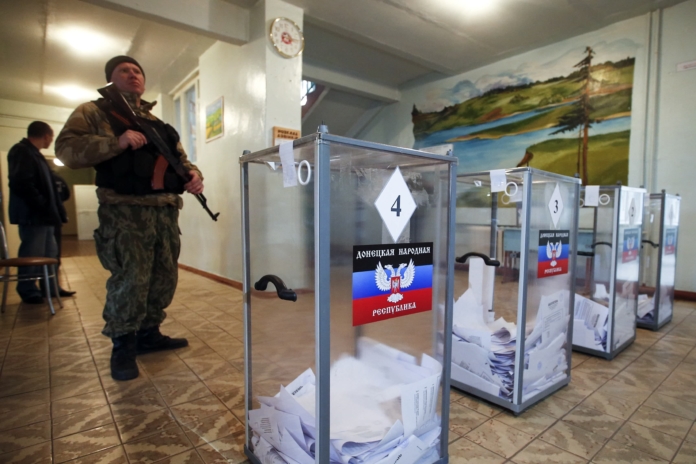
On Sunday, September 19, three-day elections to the State Duma concluded in Russia. In addition to reports of mass fraud and forced voting in favor of the ruling party, United Russia (UR), the Kremlin-orchestrated “expression of will” constitutes a challenge to the civilized world.
Moscow involved not only residents of occupied Crimea in the elections, but also residents of the occupied areas of Luhansk and Donetsk regions, which violates the Constitution of Ukraine and contradicts international law. Although Moscow has already declared an “honest victory” for the ruling party, numerous falsifications amid the near absence of international observers indicate otherwise.
The situation in Russia
This year’s elections are extremely important for the Russian Federation; in effect, they are a general rehearsal ahead of the 2024 Russian presidential elections. Therefore, Moscow spared no tools to ensure a respectable “result” for the presidential party.
The ratings of the ruling party, United Russia (UR), have been declining year after year. In February, UR had only 27% support—an alarming signal for Putin, who still plans to rule Russia. Public sentiment is poor: Russians do not believe the country’s leaders can cope with the situation. Russia is experiencing a severe COVID-19 crisis, with record mortality rates recorded over the summer.
Thus, while the world was watching developments in Belarus, Russia was shutting down opposition media, removing opposition candidates from the ballot en masse, and opening criminal cases against them. In July, the federal media watchdog Roskomnadzor blocked nearly 50 websites and demanded the removal of social media pages linked to imprisoned opposition politician Alexei Navalny and his associates. As a result, there were effectively no genuinely opposition parties participating in these elections in Russia.
Moscow also resorted to outright vote-buying: in August, Putin announced one-time cash payments to pensioners.
The situation was so dire that Russia went all in and, for the first time, decided to hold illegitimate elections in the occupied areas of Luhansk and Donetsk regions.
Russian passportization
In 2019, Russia began the mass issuance of Russian passports in the occupied areas of eastern Ukraine; currently, more than 600,000 people hold them.
In June of this year, ahead of the State Duma elections, this process significantly accelerated. The sole reason for the haste was to ensure the participation of local residents in Russian elections. The issued “passports” contained the code of a non-existent subdivision of the Migration Service of Russia’s Rostov region and lacked residence registration. Such documents do not entitle holders to social benefits and serve only as voting certificates.
Only “United Russia”
To ensure the required turnout—and, above all, the appearance of full support for Putin’s party (and, accordingly, Russia’s occupation of eastern Ukraine)—the Kremlin-controlled authorities of the so-called “republics” were actively involved.
Ahead of the elections, various events were held “with assistance,” and sometimes with the participation of representatives of United Russia. Campaigning and information drives were conducted, including the opening of 396 information centers where people were instructed on how to vote “correctly.”
The actual “voting” took place via two channels: the remote electronic voting system (REV) and in-person voting at polling stations in Russia’s Rostov region. Special transportation was organized for the latter. On September 15, the so-called “head of the DPR,” Denis Pushilin (who in July expressed a desire to join United Russia), announced the organization of 825 bus routes and 12 railway trips for those “wishing” to take part in the Russian elections.
Despite these statements and figures, residents of the so-called “republics” were in no hurry to register for electronic voting and complained that they were being forced to vote for United Russia.
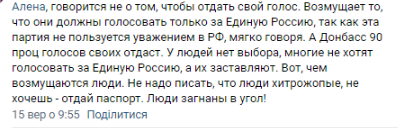
Realizing the impending failure, the Kremlin-controlled “authorities” resorted to intimidation and unprecedented falsifications:
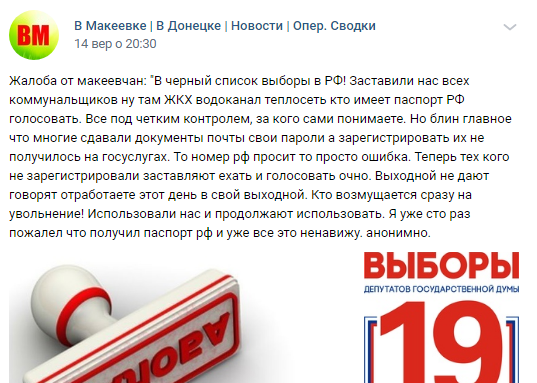
Moreover, as a result of the illegitimate “elections” to the Russian State Duma, notorious militants from the so-called “DPR/LPR” also entered parliament. It is not difficult to guess what activities they will pursue in Russia’s legislature.
However, despite Moscow’s use of mass fraud and the neutralization of opposition candidates, preliminary results indicate a steady decline in support for Putin’s party. Therefore, in addition to the tools tested on September 17–19 to interfere in the electoral process, the Kremlin is likely to seek additional ways to secure Putin’s continued rule.
What these ways will be also depends on the international community, which must not remain silent after the brazen involvement of Ukraine’s occupied territories in Russian elections and the subsequent attempt to legitimize the occupation.
Thus, Turkey and Poland have already officially declared their non-recognition of the elections conducted by Russia in occupied Crimea.
“The State Duma elections held in Crimea on September 17–19, 2021 have no legal force for Turkey,” the Turkish Foreign Ministry stated. The Polish Foreign Ministry, in turn, in addition to not recognizing the elections in Crimea, also condemned the mass issuance of passports and the organization of electronic voting in the occupied parts of Luhansk and Donetsk regions.
Dictators never stop; they are stopped.
Photo by M. Zmeyev — Reuters
18.05.2026
When Russia launched its full-scale invasion of Ukraine in 2022, Mariupol quickly became the site of…

05.05.2026
Russia pressed every Donbas sector in April, with assault tempo at a two-month high. The territorial…

16.03.2026
It is in the war against Ukraine that Russia is trying to adhere to this non-linear…


