


Mariupol is Putin’s blueprint for occupation, and the world is barely paying attention
18.05.2026
When Russia launched its full-scale invasion of Ukraine in 2022, Mariupol quickly became the site of…
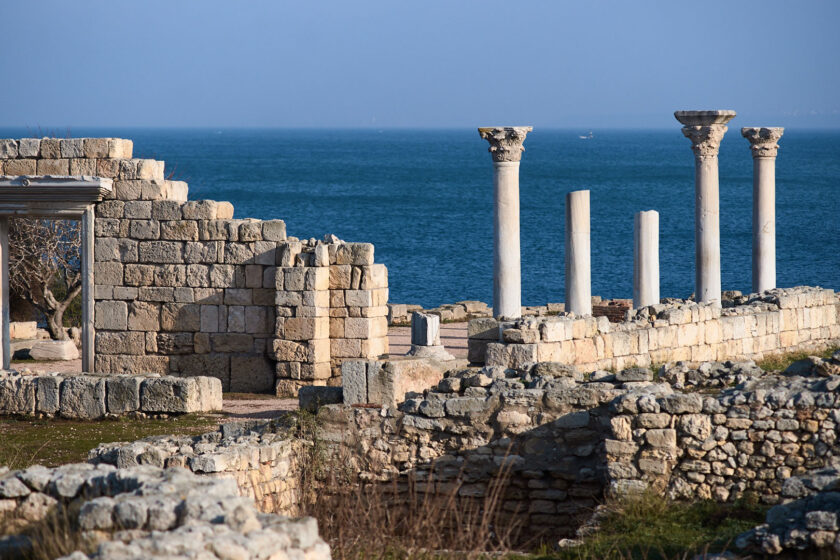
Immediately after the occupation of Crimea, Russia “legitimized” the peninsula’s historical and cultural heritage within its own legal framework and included 21 prominent Crimean sites in a federal target program, which envisaged repair, restoration, and emergency stabilization works. However, if historical monuments are of no value for achieving military objectives, Russia, under the guise of restoration, in fact destroys and ruins them.
Restoration of military facilities under the pretext of museum renovation
Thus, according to our sources in Ukrainian intelligence services, the functioning of “Facility 825” — a museum of the Ministry of Defense of the Russian Federation — has been restored in Crimea. “Facility 825 GTS” reopened in May 2021 in Balaklava. Before the occupation, the Balaklava Submarine Museum operated on its premises.
Between February and May 2021, comprehensive repair works were carried out there, including reinforcement of underground engineering structures, replacement of power supply lines, waterproofing works, and restoration of ventilation in all premises.
According to Ukrainian intelligence services, this may indicate the intention of the leadership of the Armed Forces of the Russian Federation to use this mothballed military facility for its original purpose (repair and replenishment of supplies for Project 636.3 submarines, which are part of the combat units of the Black Sea Fleet of the Southern Military District of the Russian Armed Forces) in the event of full-scale hostilities in the Black Sea basin.
In accordance with the federal target program “Socio-Economic Development of the Republic of Crimea and the City of Sevastopol until 2025,” in 2015 the Russian-controlled Crimean government began selecting contractors. This process was overseen by Moscow-appointed head of the штаб for monitoring and resolving issues related to the implementation of the federal program and former candidate for mayor of the Russian city of Voronezh, Viktor Vitinik.
As a result, Russian companies became contractors, with selection carried out behind closed doors, without the required competitive tenders.
Destruction of Chersonesos
Chersonesos is an ancient city located in the southwestern part of Crimea. Since 2013, it has been included in the UNESCO World Heritage List.
According to amendments introduced on April 30, 2021, to the Federal Law of the Russian Federation “On Cultural Heritage Sites (Historical and Cultural Monuments) of the Peoples of the Russian Federation,” plans were made to create a historical and archaeological park on the territory of the Chersonesos Taurica National Preserve. As of May 2021, construction of observation platforms in the form of metal structures with wooden decking had begun.
Such actions led to the destruction of the upper soil layer — the historical landscape of the preserve.
In addition, in the spring of 2021, the Russian government decided to create a branch of the Artek children’s camp next to the museum-reserve — the Sevastopol Children’s Center “Korsun,” as well as a humanitarian school (capacity up to 800 places). Construction plans for the complex near Chersonesos.
According to our sources in Ukrainian intelligence services, already in May a group of representatives of the Russian Ministry of Defense, the occupation administration of Sevastopol, and the Patriarchal Council began preparing permit documentation for the construction of the children’s camp and proposals for its financing. They are to complete this by October 15, 2021.
Also in May 2021, construction works using heavy machinery began on the territory near the Chersonesos Taurica museum-reserve in the area of the 12th and 13th coastal batteries (southeastern outskirts of the reserve): pits and connecting trenches were dug. In response to repeated appeals from local civil society representatives regarding the purpose of the works, the builders and museum administration have avoided providing answers.
In July 2021, local residents recorded the destruction of the central part of the museum-reserve.
However, the story of the destruction of Chersonesos Taurica began back in 2017. At that time, the occupation authorities, represented by the Russian humanities foundation “My History,” launched a large-scale reconstruction of the museum-reserve. As a result, new wooden walkways were laid, a stage with stands was built, and concert equipment, screens, and projectors were installed. According to a representative of the foundation, the total weight of all structures and equipment amounted to 500 tons. The foundation assured that all installations were temporary, but they remain in the reserve to this day.
In 2020, the “My History” foundation, within the framework of the “Historical Park – Chersonesos Taurica” festival, carried out additional “beautification” of the territory, continuing construction. As a result, metal structures were brought into the reserve, an observation deck and additional wooden walkways were installed, engineering communications were laid, and ancient walls were used as a base for mounting lighting and sound equipment.
Local residents opposed these actions, calling them outright vandalism.
In March 2021, former Chersonesos employee and restorer Anatolii Tumanov filed a lawsuit against the “My History” foundation. He stated that the structures built on the territory of the reserve violate its authenticity, distort the landscape, and block the defensive and viewing walls of Chersonesos. In his opinion, this could lead UNESCO to remove the city from its World Heritage List.
A similar fate has befallen the Bakhchysarai Khan’s Palace, the only preserved monument of Crimean Tatar palace architecture and the most famous museum associated with the history of the indigenous people of the peninsula (in 2013, Ukraine nominated the palace for inclusion in the UNESCO World Heritage List).
In July 2016, after the occupation of the peninsula, the Russian State Committee for the Protection of Cultural Heritage of Crimea decided to begin “restoration” and “emergency works” at the Khan’s Palace in Bakhchysarai.
In November 2017, Ukraine protested against the actions of the Russian authorities at the Bakhchysarai Palace and appealed to UNESCO to monitor Russia’s compliance with international law. According to the Ministry of Culture of Ukraine, instead of restoration works, the occupiers completely replaced the authentic handmade roof tiles with modern materials.
Representatives of the Russian authorities confirmed this.
During the replacement of tiles at the oldest structure of the palace — the Great Khan Mosque — ancient wall paintings were damaged, cracks appeared on the facade, and plaster collapsed due to washing the walls with high-pressure water. As a result, the Alexander Fountain and Catherine’s Mile were also damaged.
In June 2018, the National Police of Ukraine in the Autonomous Republic of Crimea and Sevastopol opened criminal proceedings over the illegal destruction, damage, and vandalism of a historical monument.
In April 2021, witnesses recorded the complete destruction of an ancient bridge at the Khan’s Palace.
On the Day of Deportation of the Crimean Tatars, the Russian-controlled “head” of Crimea, Sergei Aksyonov admitted that the Khan’s Palace in Bakhchysarai is being turned into a replica, just like the Chersonesos museum-reserve: “After reconstruction, the Khan’s Palace will be a replica, since builders cannot afford to use ancient materials in their work.”
During the summer of 2021, part of an 18th-century bridge support leading to the main western gate of the Khan’s Palace was destroyed,
and heavy machinery cleared the riverbed of the Churuk-Su River in front of the palace’s main entrance.
An obvious new construction also appeared on the territory.
Local residents say: “Russia is trying to present the destruction of the Khan’s Palace as a story of corruption. But we see a consistent policy of destroying the culture and history of the indigenous people of Crimea.”
Destruction of the Genoese Fortress
The Genoese Fortress in Sudak is the best-preserved monument of Western European fortification architecture in southern Ukraine. It was included by Ukraine in the UNESCO Tentative World Heritage List in two nominations: as a cultural landscape (2007) and as part of the transnational nomination “Trading Posts and Fortifications on Genoese Trade Routes from the Mediterranean to the Black Sea” (2010).
After the occupation of Crimea, the fortress has been controlled by the Russians as the “State Budgetary Institution of the Republic of Crimea ‘Sudak Fortress Museum-Reserve.’” Hotel facilities and additional toilets began to be built on its territory. As a result, in November 2015, one of the fortress towers collapsed.
After that incident, the “administration” hired builders without restoration experience: the foundation was simply poured with concrete, and a fake version of the authentic tower was built using modern cement and old stones.
Already in 2016, the occupiers began digging a construction pit directly beneath the fortress walls. According to witnesses, “soil was removed by truckloads.” All these actions could lead to the complete destruction of this priceless historical monument.
Since 2018, the notorious Russian company “Meandr” has been engaged in the so-called “restoration” of the Genoese Fortress. At the same time, it is carrying out work on dozens of architectural monuments on the Ukrainian peninsula: the Bakhchysarai Palace, the Mithridates Stairs in Kerch, the Vorontsov Palace Museum in Alupka, the Surb Khach Monastery in Stary Krym, the Pallas Estate in Simferopol, the Chekhov House in Yalta, the Swallow’s Nest, and others.
This constitutes a violation of the Convention for the Protection of Cultural Property in the Event of Armed Conflict. Under this convention, Russia, as the occupying power, is obliged to respect the cultural heritage of the peninsula.
In her 2020 report, UNESCO Director-General Audrey Azoulay noted a significant deterioration of the situation on the peninsula across all areas of the organization’s competence.
In 2020, it also became known that Russia is preparing to submit cultural sites in annexed Crimea to UNESCO bypassing Ukraine, with this work being carried out jointly with Italian scholars. Among these sites is the Genoese Fortress. In this way, the Russian Federation is attempting to use yet another mechanism to legitimize the occupation of Crimea.
Illegal archaeological expeditions
Conducting archaeological excavations in occupied territories is prohibited by international law. However, this does not prevent Russians from organizing such illegal expeditions. In July 2021 alone, there were two such cases in Kerch:
The destruction of historical heritage sites has a far deeper meaning in the context of Ukraine and the world. These are not just buildings and architecture — they are remnants of a culture that existed in Crimea long before the Russian occupation.
Thus, all these destructions and reconstructions of millennia-old historical and cultural heritage are needed by Russia not only to assert its position on the peninsula and present itself as its lawful “owner.” In this way, the Kremlin seeks to rewrite history and turn a multinational and multicultural Crimea into an exclusively Russian peninsula. This is precisely why the indigenous people of Crimea — the Crimean Tatars — were deported, and why their persecution continues to this day.
Such actions only prove that the imperial nature of Russia has a destructive impact on everything it touches.
Author: Solomiia Khoma
18.05.2026
When Russia launched its full-scale invasion of Ukraine in 2022, Mariupol quickly became the site of…

05.05.2026
Russia pressed every Donbas sector in April, with assault tempo at a two-month high. The territorial…

16.03.2026
It is in the war against Ukraine that Russia is trying to adhere to this non-linear…


