


Mariupol is Putin’s blueprint for occupation, and the world is barely paying attention
18.05.2026
When Russia launched its full-scale invasion of Ukraine in 2022, Mariupol quickly became the site of…
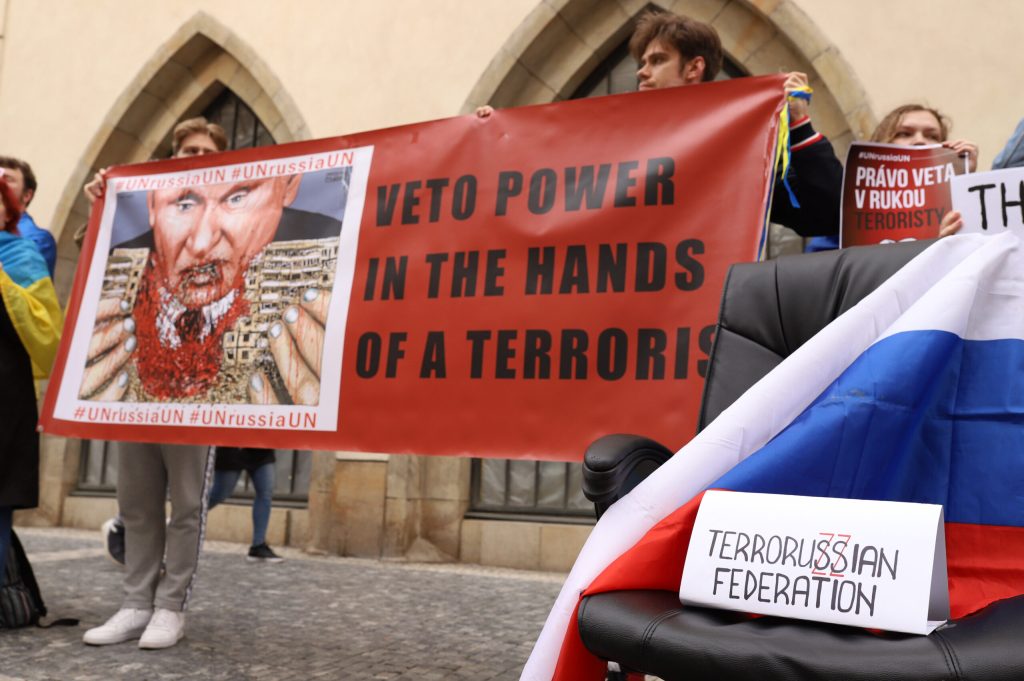
Photo from an action in Prague on March 24: on the chair — a Russian flag from the de-occupied city of Kupiansk (Kharkiv region, Ukraine). Photo by Andrii Kravchuk
“There is a huge difference between perceiving and understanding war when you see the consequences of the ‘Russian world’ through a smartphone and when you see them with your own eyes.”
UCBSS representative in the Czech Republic Anastasiia Sihnaievska, with a first-hand report from Kupiansk and an analysis of Russia’s geopolitical influence, in a piece for the Ukrainian Center for Security and Cooperation (the following is the author’s direct speech).
Recently, I had the opportunity to visit the Kharkiv region. Unfortunately, Kharkiv region was “lucky” due to its border location near Russia, which allowed the Russian army to seize part of the region almost immediately and remain there from February until September 2022, until the counteroffensive of the Armed Forces of Ukraine and the liberation of Ukrainian territories.
Today, the city of Kupiansk and the nearby settlement of Kupiansk-Vuzlovyi, where I arrived, resemble a continuous wasteland: burned-out military equipment, destroyed civilian cars, a damaged bridge, and buildings reduced to piles of bricks after artillery strikes.
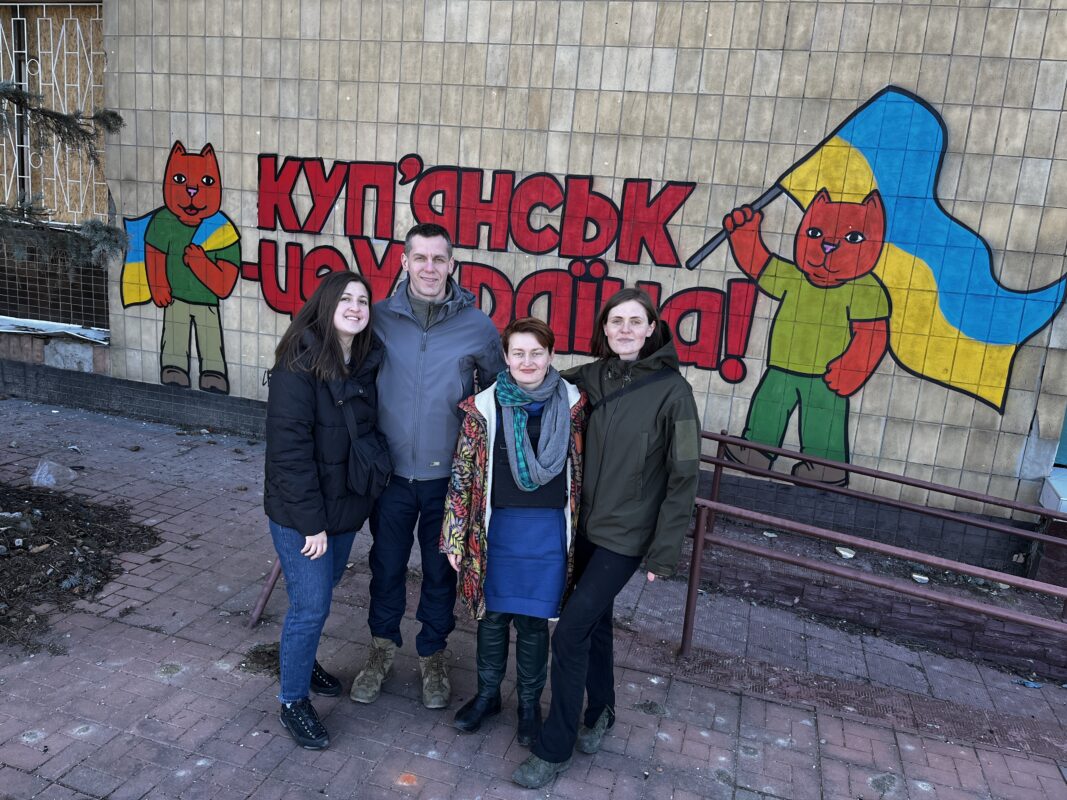
As we approach the Kupiansk city administration building, a Ukrainian flag is flying on the flagpole, and on one of the walls there is a huge graffiti reading “Kupiansk is Ukraine.” Right beneath this inscription lies a pile of construction debris: window frames and glass, plastic bags, bricks — and a Russian tricolor. I ask a nearby soldier, “What is that?” pointing to the aggressor state’s flag. “It used to be here on all government buildings. Many people did not believe we would be able to drive the enemy out, but the most important thing now is for everyone to believe and support the Armed Forces of Ukraine — and then we will succeed. Now every flag is in its proper place.”
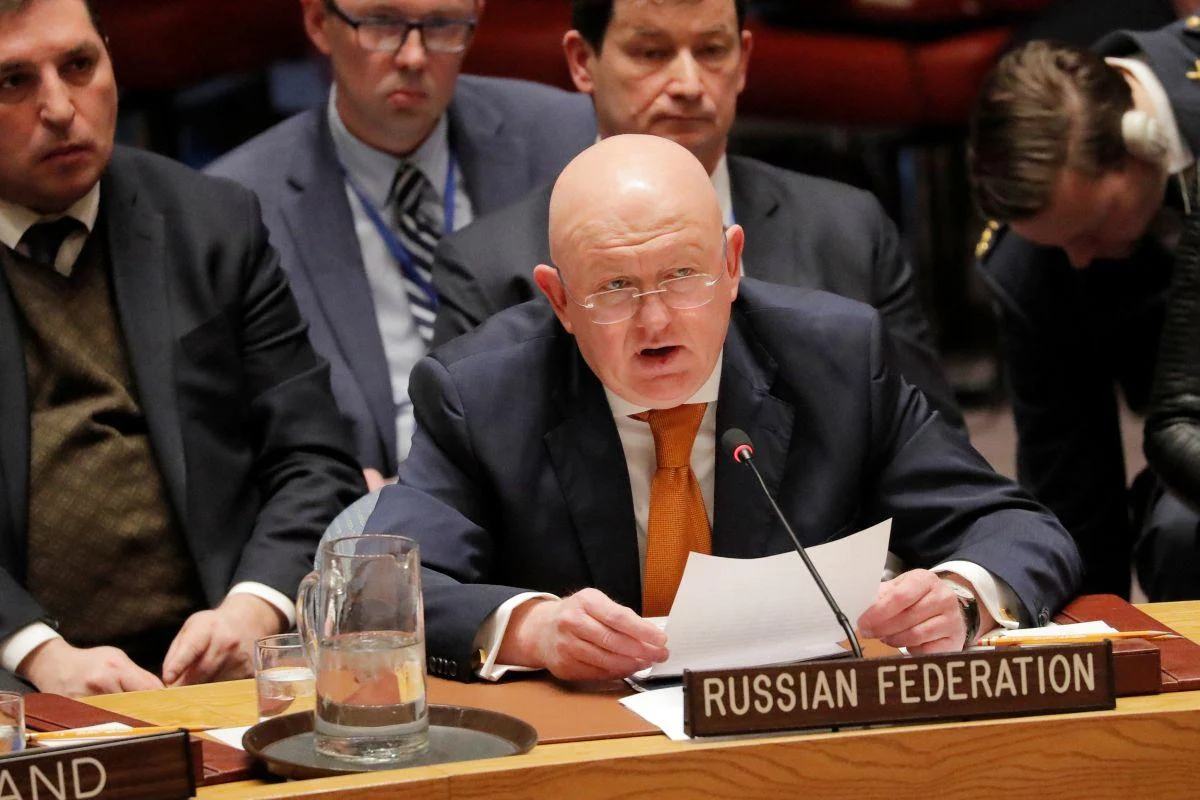
That flag is like an illustration of how Russia’s presence poisons everything around it, and how the place of the aggressor state is in isolation from the civilized world. In the same way, Russia’s still-occupied seat on the UN Security Council prevents the organization from fulfilling its original purpose — protecting the world from war. Through its influence on the domestic political situations of European countries, Russian propaganda attempts to turn societies against their own governments and against Ukraine.
For example, the Czech Republic, where I found myself after the full-scale invasion, is a vivid example of a country that is still forced to fight Russian influence and knows firsthand what Kremlin occupation means. On August 21, 1968, thousands of Soviet troops entered the territory of former Czechoslovakia, and Soviet tanks rolled through the center of Prague. The occupation was accompanied by numerous protest actions: Czechs placed posters on buildings with Russian-language slogans such as “No vodka, go home,” “We didn’t invite you,” and others. Despite all efforts, Soviet troops remained in the country for more than 20 years, and history was filled with the names of hundreds of fighters against communism who lost their lives. Even a country that is now a member of the EU and NATO is still forced to defend its democracy.


The historical experience and collective memory of the Czech people regarding war were shaped by the deeply treacherous Munich Agreement toward Czechoslovakia, when the Sudetenland was handed over to Nazi Germany. Later came the Prague Spring of 1968, which aimed to liberalize the communist regime and ended with the occupation of the country by Soviet troops. This history allows Czech society to better understand Russia’s actions and Ukraine’s warnings that Russia will not stop at Ukraine’s borders. By supporting Ukraine, Czechs are also defending themselves.
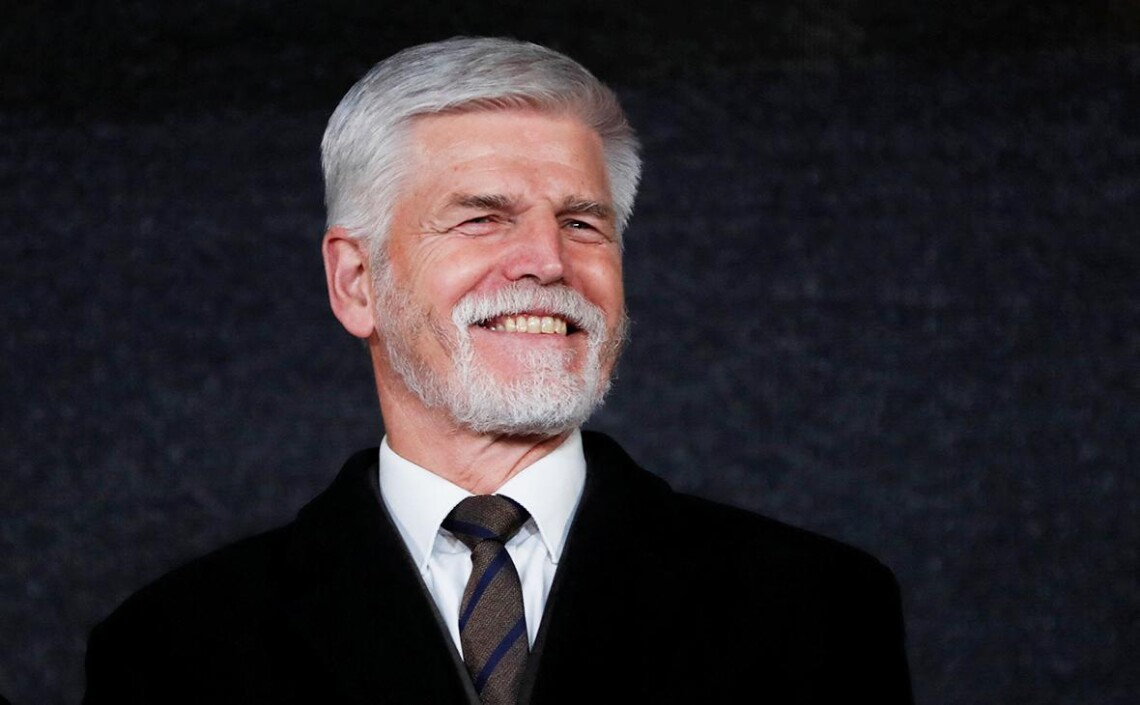
Fortunately, a pro-Ukrainian stance is demonstrated both by the government of the Czech Republic and by the public, which in the most recent elections chose former NATO General Petr Pavel as president. Unlike his pro-Russian opponent Andrej Babiš, he has expressed full readiness to support Ukraine until its victory.
However, in every society there is a segment of the population susceptible to disinformation, which Russia exploits. Under the guise of anti-government sentiment, the Russian propaganda machine tries to push the idea of ending support for Ukraine: recent allegedly anti-government protests in Prague included demands to stop arms supplies to Ukraine and to dismiss a government that is one of our strongest partners. These methods are neither new nor unique to the Czech Republic — similar situations are unfolding in Moldova, Germany, and Serbia.


Pro-Russian rally in the Czech Republic, October 12, 2022 — source: PrahaIN.cz
Attempts by Russian propaganda to create the impression that Czech society not only does not support, but is opposed to helping Ukraine have failed. All these demonstrations, even when thousands of protesters are brought in by buses from different parts of the country, are not representative of the Czech Republic. Public pressure from Czech pro-democracy civil society is producing tangible results on issues crucial for Ukraine — from the need to supply more weapons to, for example, the Senate’s adoption of a resolution against the participation of Russian and Belarusian athletes in the Olympic Games.
It is precisely these decisions by the Czech authorities that can serve as an example and motivation to ensure that public pressure does not subside, but only intensifies. The participation of every country in blocking and condemning the actions of the Russian Federation must ultimately lead to the result — Russia’s expulsion from the UN Security Council and its disappearance from political interaction with the world.
Read also: Campaign #unrussiaUN to expel Russia from the UN Security Council
Anastasiia Sihnaievska, co-coordinator of the Czech-Ukrainian initiative “Hlas Ukrajiny,” UCBSS representative in the Czech Republic
for the Ukrainian Center for Security and Cooperation, March 20, 2023
18.05.2026
When Russia launched its full-scale invasion of Ukraine in 2022, Mariupol quickly became the site of…

05.05.2026
Russia pressed every Donbas sector in April, with assault tempo at a two-month high. The territorial…

16.03.2026
It is in the war against Ukraine that Russia is trying to adhere to this non-linear…


