


Mariupol is Putin’s blueprint for occupation, and the world is barely paying attention
18.05.2026
When Russia launched its full-scale invasion of Ukraine in 2022, Mariupol quickly became the site of…
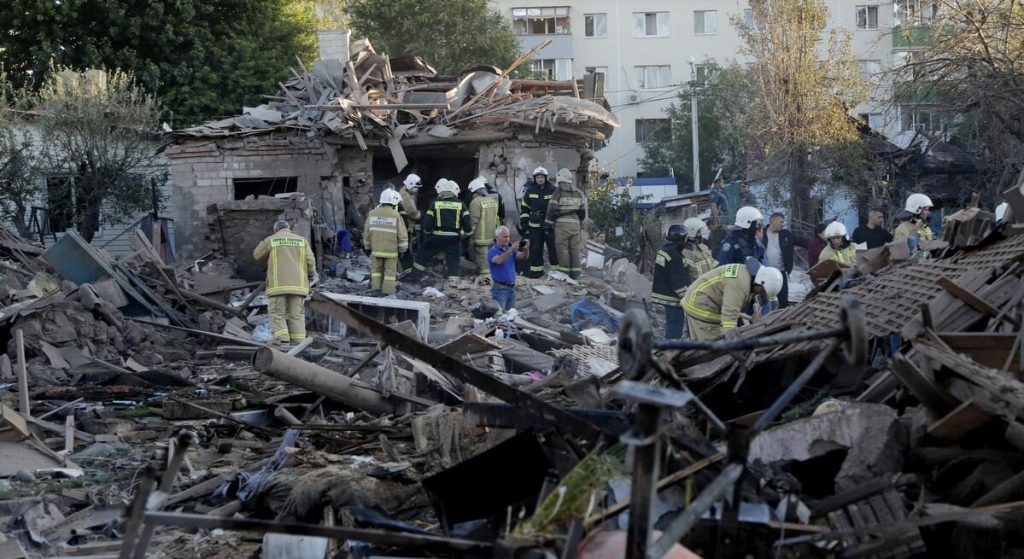
The aftermath of the explosion in Belgorod. Source: BBC
More than a year after the start of the full-scale invasion, Ukrainian forces pushed the frontline in Chernihiv, Sumy, and Kharkiv regions almost back to the Russian border. It was at that moment that residents of Belgorod Oblast and other border regions—who had previously planned to buy summer houses in Ukraine—fully experienced life under “cotton explosions,” the operations of Russian volunteer battalions, and the Kremlin’s real “concern” for the so-called “Russian-speaking population.”
WAR ON RUSSIAN TERRITORY
Ukraine’s defense of its own land against Russian forces is a long game. As a result of successful counteroffensive actions by the Armed Forces of Ukraine in spring 2022, the entire territory of Sumy Oblast was liberated. By September, Ukraine’s Defense Forces had liberated almost all of Kharkiv Oblast from Russian troops.
These successes also enabled Ukraine to strike back at the aggressor, conduct deep reconnaissance, sabotage operations, drone attacks, and even raids by Russian volunteer units behind enemy lines. The capabilities of Ukraine’s Defense Forces made their move: the war came to Russia itself. Predictably, however, this topic is absent from the “agenda” of Russian media and authorities, who continue to cling to the narrative that “everything is going according to plan.”
A FRONTLINE CITY OF THE “GREAT RUSSIA”
Residents of the Russian border city of Belgorod—located just 72 km from Ukraine’s second-largest city, Kharkiv—would strongly disagree. Before the war, Belgorod residents frequently traveled to Kharkiv for shopping and leisure. Since February 23, however, Belgorod Oblast has regularly served as a launch site for missile systems and multiple rocket launchers targeting Ukraine, often using inaccurate weapons that cause destruction of residential buildings and civilian deaths.
Judging by posts on Belgorod social media and in local outlets, residents were largely indifferent to this—until Ukrainian forces pushed the occupiers back and Belgorod Oblast became a frontline region with all the consequences: refugees, shelling, sabotage incursions, and a heavy military presence. In addition, Russian units fighting on Ukraine’s side—the “Freedom of Russia” Legion (FRL) and the Russian Volunteer Corps (RVC)—began conducting raids into the region.
This combination of factors forced local authorities to evacuate border populations, allocate multimillion budgets for fortifications, and inspect bomb shelters. Some residents even began criticizing the shelling of Kharkiv to avoid retaliation, or asking authorities to “push the frontline away” from the city.
Source — RTVI
None of these statements, unfortunately, called on Russian authorities to end the war of aggression.
According to official Belgorod authorities, as of January 2023 there were over 6,500 refugees from border areas (given the Russian government’s suppression of war consequences, real numbers may be significantly higher).
In spring–summer 2023, following raids by the FRL and RVC, the evacuation of Shebekinsky District alone affected at least 85,000 registered residents, not counting other districts or unregistered residents. At the same time, authorities said Belgorod city could accept no more than 1,000 refugees, offering others relocation to Voronezh, Rostov, Tomsk, Yaroslavl, or Kaluga regions—each with limited capacity—sparking public outrage.
Internal displacement triggered numerous social media reports about poor living conditions and failures to deliver promised compensation. Residents reacted especially sharply to the allocation of free housing for people from occupied Ukrainian territories, particularly Kherson Oblast, whom the Kremlin attempted to resettle in Russia. Locals complained that Russians in Russia were unwanted and forgotten.
“It’s impossible to put into words what it’s like to leave your home,” Russian media quote a pensioner from border-area Shebekino. Experiencing what thousands of Ukrainians have endured since 2014—and especially since February 2022—did not prompt Russians to demand an end to the war. According to a June 2023 Levada Center poll, older Russians are the strongest supporters of the war: 82% (down slightly from 84% in April).
Since the start of the full-scale war, the world has seen that the title “the world’s second army” is a loud but misleading description of Russia’s armed forces. Looting, extreme brutality toward prisoners, disregard for civilian lives, and numerous war crimes have become the calling card of Russia’s military and the so-called “special operation.”
Beyond military activity and internal migration, Belgorod has fully experienced the “benefits” of Russia’s military presence. Missiles launched from the region toward Ukraine have repeatedly fallen back within the oblast. In a video published in July 2022, Iskander missiles were seen launched near an apartment building, failing and crashing to the ground.
Such incidents are no longer rare: on August 31, videos showed a missile veering off course and flying low toward the city. On September 22, 2022, another missile—likely also from an Iskander—fell after launch. On October 13, 2022, during an attempted strike on Kharkiv, three S-300 missiles self-destructed and one hit a residential building in Belgorod. These are only the cases residents managed to post online. Russian authorities have since tightened internet censorship; posting such footage can now result in fines for “discrediting” the armed forces.
Over time, failed bombings with more serious consequences became more frequent: on the evening of April 20, 2023, an explosion occurred on a central street in Belgorod, leaving a crater 20 meters wide. After various versions circulated—and likely due to the absence of casualties—the Russian Ministry of Defense admitted that a Russian Su-34 fighter jet had accidentally dropped a FAB-500-M62 bomb. Two days later, authorities evacuated 17 apartment buildings after discovering a second unexploded bomb.
In response to public outrage over why bomb-armed aircraft were flying over their own cities, propagandists issued denials: claiming bombs “deviated on their own” or that “no aircraft flew over the city”—claims questioned even by Russian experts.
TERRITORIAL DEFENSE, RUSSIAN STYLE
The “successes” of Russia’s army forced regional leaders to think independently about defending their territories. In late December, Belgorod Governor Gladkov announced the creation of territorial defense units to “protect their own homes.” A year earlier, Russian media had mocked Ukraine’s territorial defense forces.
According to official data, Belgorod’s territorial defense numbers around 3,000 people. Some have already received small arms, anti-drone guns, and UAZ vehicles.
Defense spending also became a priority. In 2022, nearly 10 billion rubles were spent on fortifications—more than twice the cost of two regional infectious disease centers. The structures sparked accusations of corruption, and ultimately neither the defenses nor territorial units prevented raids by the RVC and the Legion into the outskirts of Shebekino.
THE NUMBERS SPEAK: 28% OF RUSSIANS CONSIDER THE “SMO” UNSUCCESSFUL
A recent survey by the Russian analytical center Levada Center shows a notable shift, likely linked to events affecting border regions: volunteer raids into Belgorod Oblast, evacuations, Ukraine’s counteroffensive, Western arms deliveries, and internal turmoil in Russia—including Prigozhin’s Wagner mutiny.
Overall support for the “special operation” fell by 3% compared to May 2023.
In May, 61% said the operation was “successful”; by June, only 55% agreed. Meanwhile, 28% said it was unsuccessful, and the share of undecided respondents rose from 12% to 17%.
Support for peace talks with Ukraine increased to 53% in June (up from 46% in May), while support for continuing the war fell to 40%.
Asked what concerns them most about the “SMO,” respondents said:
93% — drone attacks on Russian border areas;
93% — shelling of border cities;
85% — the risk of nuclear weapons use;
80% — Western arms supplies to Ukraine;
67% — Ukraine’s counteroffensive.
As always, Russians are primarily concerned with their own problems and quiet nights, while waging a war of aggression against another nation remains routine for most.
Particularly striking are reports by Russian central media about shelling in border areas, where Ukraine’s forces are labeled “terrorists” or “Ukrainian Nazis,” and outrage is expressed over damage to civilian infrastructure. After countless civilian deaths, destroyed cities, flooded villages, and razed towns in Ukraine, the cynicism of such headlines is staggering.
NOT ACCORDING TO PLAN
In summary, the situation in Belgorod Oblast highlights several key points.
Blinded by dreams of “Kyiv in three days,” Russian authorities neither expected nor planned to defend their own border regions. The issue of Russian refugees is rarely acknowledged by the Kremlin, as it contradicts the narrative of a “successful SMO.”
Belgorod authorities were unprepared for an influx of internal refugees and military failures and now attempt to maintain an appearance of normalcy while suppressing panic and dissatisfaction.
The Russian army routinely hides behind civilians during shelling—now using its own citizens as a human shield. Residents of Shebekino have experienced firsthand the consequences of Putin’s “special operation” and the true attitude of the state toward ordinary people.
A combination of volunteer raids, Ukrainian drone activity, the counteroffensive, prolonged war without tangible success, and continued Western arms deliveries is shaping public sentiment in Russia and weakening support for the war.
18.05.2026
When Russia launched its full-scale invasion of Ukraine in 2022, Mariupol quickly became the site of…

05.05.2026
Russia pressed every Donbas sector in April, with assault tempo at a two-month high. The territorial…

16.03.2026
It is in the war against Ukraine that Russia is trying to adhere to this non-linear…


