


Ukraine Is a Key Pillar of Europe’s Defense
13.06.2025
At the summit of the Bucharest Nine (B9) and Nordic countries held on June 2, 2025,…
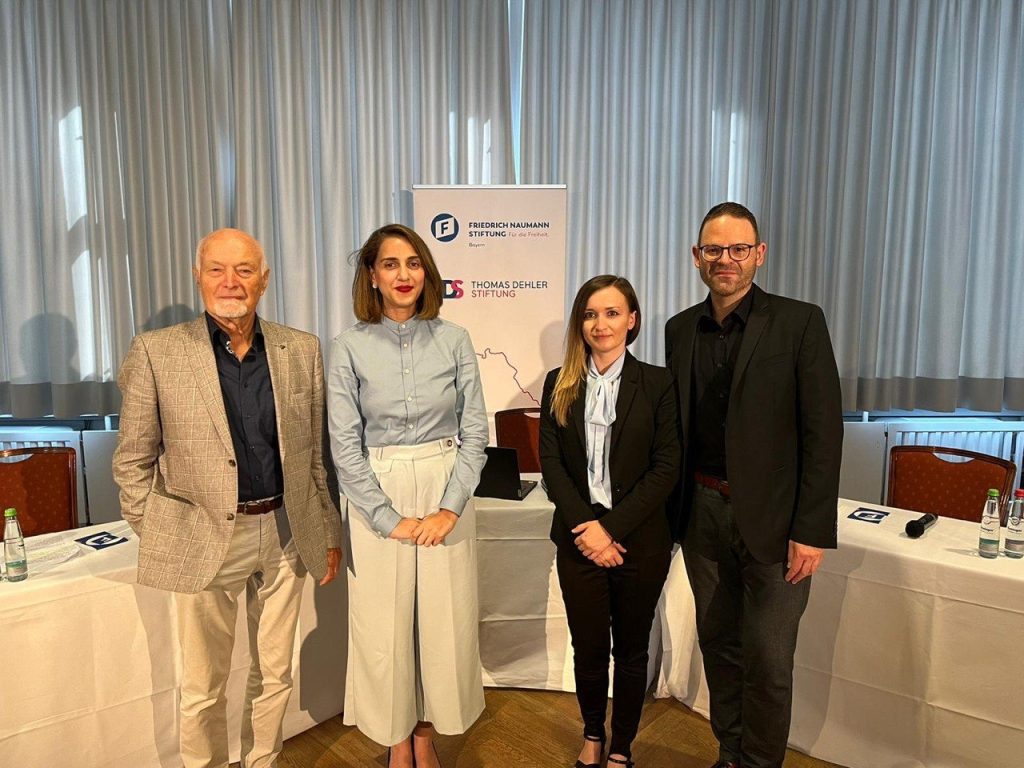
Speakers of the panel discussion “Russian Culture and Russia’s War of Aggression Against Ukraine”, July 28, 2023
During the discussion, the speakers addressed the issue of the interdependence between Russian culture and politics during the war. The event was held in cooperation with UCBSS partners in Germany — the Friedrich Naumann Foundation for Freedom, the Thomas Dehler Foundation, and the Ukrainischer Verein Augsburg e.V. (Ukrainian Association of Augsburg).
The speakers of the discussion were:
Alina Ponypalyak — expert at the Ukrainian Center for Security and Cooperation, PhD in History.
Heinrich Olszewski — Honorary Professor of Polish Studies at Humboldt University of Berlin.
The discussion was moderated by Kostiantyn Hrot — PhD in History, Program Officer at the Friedrich Naumann Foundation for Freedom and the Thomas Dehler Foundation.
We thank Kateryna Matei, the UCBSS representative in Germany, for her assistance in organizing the discussion.
After the start of the full-scale war, the entire world witnessed the true nature of the so-called “great Russian culture” in museums in the Kharkiv region, in Irpin, Bucha, Borodianka, and in the bombed-out center of Odesa. The war, at the cost of the lives of hundreds of Ukrainian civilians and hundreds of Ukrainian cultural heritage sites, demonstrated what Russia and the Russian people are, and what “Russian culture” and mentality truly represent.
Russian culture has been artificially constructed by appropriating the achievements of other nations — cuisine, ballet, opera, literature, and more. However, it was precisely through this culture that Russia promoted its national brand on the global stage for centuries.
“In hybrid warfare, Russian cultural centers and institutions established in Europe with Kremlin support played one of the key roles. Through their institutions and a pre-established network of connections, Russians spread propaganda and influence in order to sway our Western partners to Russia’s side or, conversely, toward isolationism,” commented UCBSS expert Alina Ponypalyak.
Russia has long used culture as an element of its hybrid war both against Ukraine and against the West. In Ukraine, this manifested itself in the replacement of our cultural and historical heritage with artificially constructed Russian narratives, and the denigration of Ukrainian culture as rural and irrelevant in contrast to the so-called “great Russian culture.” In the West, Russian culture served as a smokescreen to place the Russian Federation on an equal footing with other states and to divert attention from its chauvinistic and terrorist nature.
“The concept of culture is first and foremost about the mentality of a people. Therefore, today we face an extremely important task: to question the responsibility of all segments of Russian society, including culture, for the destruction and crimes against humanity they are committing in Ukraine,” noted Heinrich Olszewski, Honorary Professor of Polish Studies at Humboldt University of Berlin.
Russian culture, as demonstrated by Moscow to the world over the past nearly year and a half, is genocide, mass killings, and crimes against humanity, whose victims are Ukrainians. Its rethinking in the West, particularly in Germany, which was under Soviet influence for a long time, is essential for understanding the Russian state as a phenomenon and for shaping a future strategy toward Russia.
We express our gratitude to the partners of the Ukrainian Center for Security and Cooperation — the Friedrich Naumann Foundation for Freedom, Thomas Dehler Foundation, and Ukrainischer Verein Augsburg e.V. for their support in organizing the event and for their participation in Ukraine’s struggle.
13.06.2025
At the summit of the Bucharest Nine (B9) and Nordic countries held on June 2, 2025,…

13.06.2025
The full-scale war against Ukraine is setting new rules and military doctrines that must be taken…

09.06.2025
In the fall of 2024, the Kremlin took another step toward renewed nuclear blackmail. On September…


