


Mariupol is Putin’s blueprint for occupation, and the world is barely paying attention
18.05.2026
When Russia launched its full-scale invasion of Ukraine in 2022, Mariupol quickly became the site of…
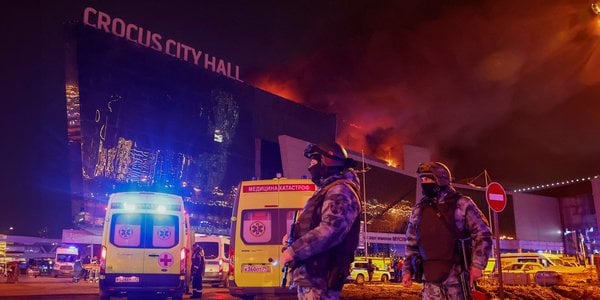
While the Kremlin is trying at all costs to link the terrorist attack at “Crocus City Hall” to Ukraine, responsibility for the shooting at the concert venue in Krasnogorsk near Moscow was claimed by the “Islamic State” (ISIS), specifically its Afghan branch known as ISIS-K.
The Islamic group calling itself the Khorasan State (Khorasan – ISIS-K) is named after the historical region that once included parts of Iran, Turkmenistan, and Afghanistan. It emerged in eastern Afghanistan in late 2014 and quickly gained a reputation for extreme brutality.
Among the motives for this group to view Russia as its enemy, experts cite Moscow’s involvement in the global fight against ISIS and its affiliates—particularly through Russian military operations in Syria and its efforts to establish ties with the Afghan Taliban, a rival of ISIS-K in the region.
So, there is a motive for committing a terrorist attack—but is it really worth placing Russia and ISIS on opposite sides of the barricades?
Russia is the main “exporter” of ISIS fighters
Since the very emergence of ISIS, information has repeatedly surfaced suggesting that Russia has an interest in the existence of such a terrorist organization in the Middle East.
Back in 2015, the Chief of the General Staff of the Free Syrian Army (FSA), Major General Ahmed Khalid Birri, stated that “…Russia cooperates both with the regime and with ISIS. In other words, Russia does not aim to fight terrorism.” He suggested that through its actions in Syria, Russia sought to exploit, for its own benefit, the world’s second-largest gas fields located east of the city of Homs and in other parts of the country.
In addition, the general emphasized that only 5 percent of Russian strikes were directed against ISIS, while the remaining 95 percent targeted positions of the Free Syrian Army.
“The existence and activity of ISIS were indeed beneficial for Russia, as the group’s presence and the fight against it (or an imitation of such a fight) contributed to higher oil prices. Moreover, the ‘fight’ against the ‘Islamic Caliphate’ has been and remains a convenient pretext for increasing Russia’s military presence in the Middle East and Central Asia, as well as for deeper military-political integration of regional states with Russia,”
says Serhii Kuzan, head of the Ukrainian Center for Security and Cooperation.
Given such actions and statements, it is hardly surprising that Russians themselves are fueling this movement.
According to the report “Beyond the Caliphate: Foreign Fighters and the Threat of Return,” published in October 2017 by the consulting company Soufan Group, Russia turned out to be the main “exporter” of fighters to the terrorist organization “Islamic State.” At that time, 3,417 Russians were fighting for ISIS.
“Few people talk about this, but within ISIS—the ‘Islamic State,’ this terrorist organization—Russians were the second-largest ethnic group. It was one of the most numerous groups. For years, Russian citizens traveled through Dagestan from the territory of the Russian Federation and ended up within ISIS, mainly in its Syrian branch. What is particularly interesting is that when they left through Dagestan, all of them were issued insurance through Russia’s Mandatory Medical Insurance Fund. They all had certain benefits and insurance,” says Oleksandr Kovalenko, a military-political analyst with the Information Resistance group.
Terror has a Russian face
By frightening the world with ISIS while simultaneously, as we can see, supporting it, Russia imposed on the international community the idea that terrorism cannot be defeated without Russia—and therefore must be fought together with it.
“The series of terrorist attacks that took place in Brussels confirms the correctness of those who urge the EU to cooperate with Russia in the fight against terrorism and who emphasize that the main threat to European security comes not from Russia, but from international terrorist organizations,” said Alexey Pushkov, then head of the State Duma Committee on International Affairs, commenting on the 2016 terrorist attack in Belgium.
Other figures connected to Russian government circles expressed similar views, including Igor Korotchenko, head of the Public Council under Russia’s Ministry of Defense, who, against the backdrop of the terrorist attacks in Paris, called on Europe to abandon its sanctions policy against Russia.
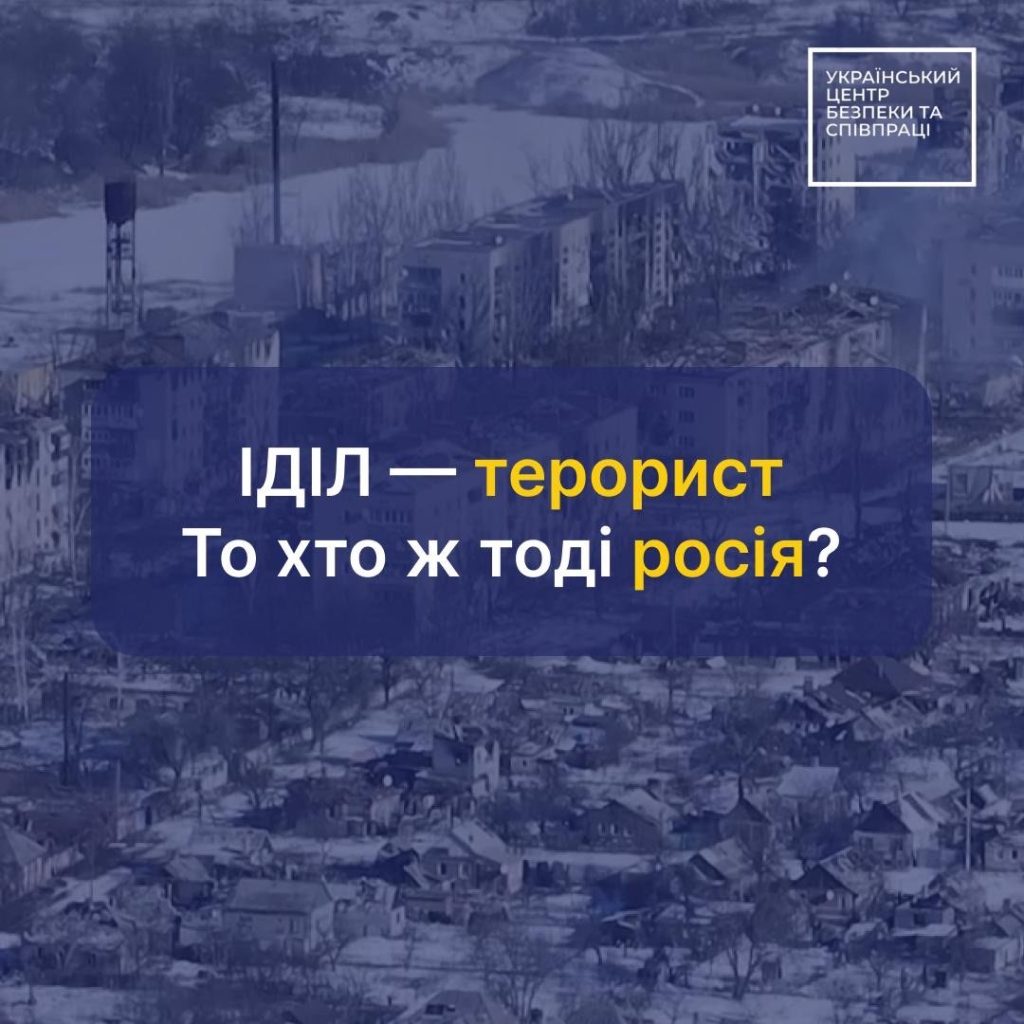
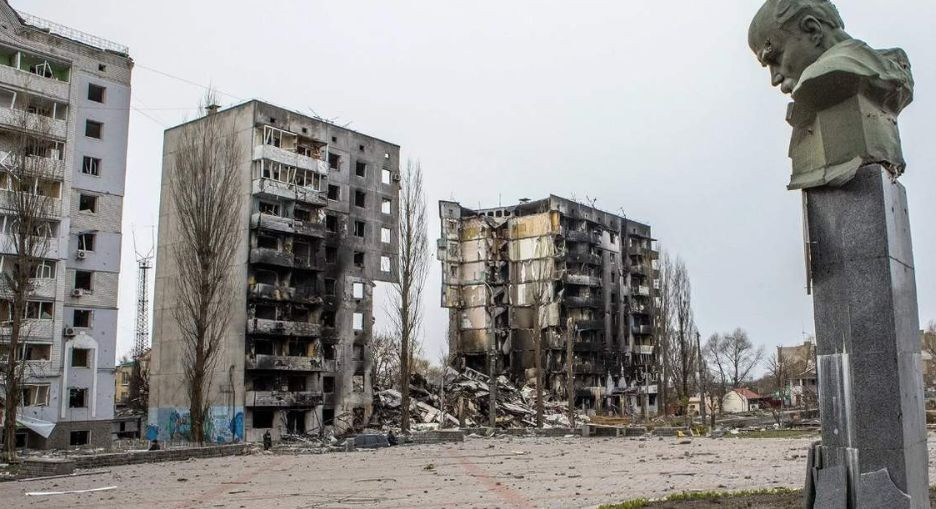
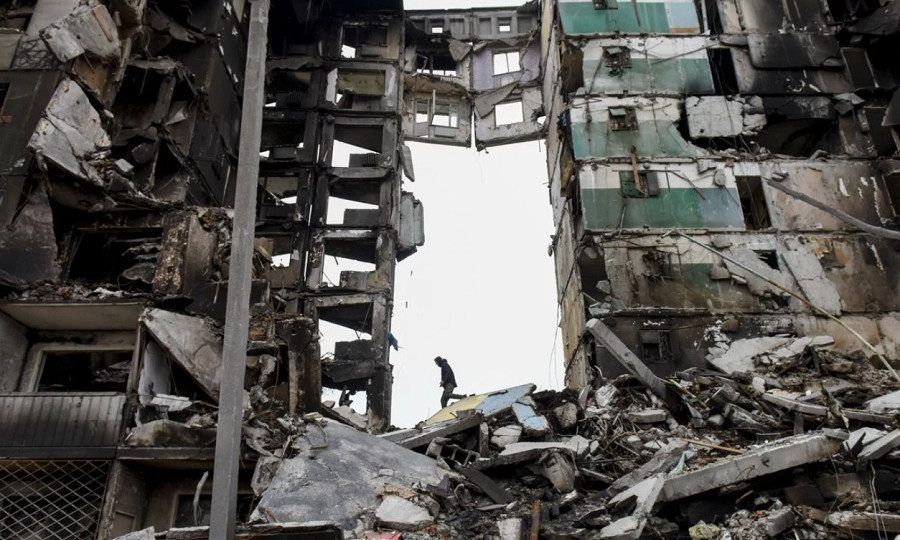
By shifting the attention of the global community toward searching for enemies beyond its borders and portraying itself as their victim, Russia, meanwhile, by the number and nature of its crimes, is incomparable to ISIS and currently holds the status of the world’s number one terrorist organization. After all, it is Russia that has unleashed the bloodiest war in Europe since World War II, is committing war crimes and genocide against civilians in Ukraine, threatening the world with nuclear war, and has seized Europe’s largest nuclear power plant.
At present, Russia has so much blood on its hands that it does not deserve the image of a victim state, nor the sympathy that comes with it, while it continues to destroy civilian cities and kill peaceful residents every day.
“Pay attention: the terrorist attack in the Moscow region, which Russian special services allowed to happen and which the Russian National Guard failed to prevent because its units are currently deployed in Ukraine, had no impact whatsoever on Russia’s plans to carry out missile strikes on Ukrainian cities and civilian infrastructure. In four days, starting from March 22, Russia used 270 weapons systems in aerial attacks against Ukraine (ballistic and cruise missiles, drones, and the hypersonic ‘Zircon’ missile). Among them was the March terrorist strike using a record number of weapons against critical infrastructure, including the Zaporizhzhia Hydroelectric Power Plant. How else can this be described if not as terror in its worst form?” asks S. Kuzan rhetorically.
According to UN reports, as a result of the war unleashed by Russia against Ukraine, more than 10,000 civilians have been killed according to official data alone. The actual number may be significantly higher.
The Unified Register of Pre-Trial Investigations, as reported by the Office of the Prosecutor General, contains records of more than 128,000 victims of Russian war crimes, and this number continues to grow every day. In addition, according to juvenile prosecutors, 1,796 children have been affected by Russia’s aggression, of whom 535 have been killed and 1,261 injured to varying degrees. Officials emphasize that these figures are not final, as work continues to establish them in areas of active hostilities, as well as in temporarily occupied and liberated territories.
Today, Russian forces carry out missile and bomb strikes daily on the border regions of Ukraine’s Sumy region, terrorizing civilians and wiping entire villages off the map with guided aerial bombs. Despite the version blaming ISIS for the Moscow attack, Russian pilots still accuse Ukrainians and even write “for the victims of Crocus City Hall” on the bombs they later use to destroy Ukrainian villages.
Likewise, despite the fact that two of the suspects detained in connection with the attack arrived from Turkey, Russia does not accuse Turkey of organizing the crime, instead stubbornly insisting on the existence of a “window” on the Ukrainian border.
However hard Moscow may try to conceal its crimes and pin them on others, the international community responds with skepticism.
The West does not believe in tears
Let us recall that on October 13, 2022, the Parliamentary Assembly of the Council of Europe adopted a resolution recognizing Russia as a terrorist regime. This was the first international institution to respond to President Volodymyr Zelenskyy’s call to officially label Russia’s actions in Ukraine as terrorism.
It is precisely through this lens that the statements made by leading countries of the world after the attack at “Crocus City Hall” should be viewed.
In the United States, for example, Ukraine’s involvement was immediately dismissed, with officials emphasizing that Russia had been warned in advance about the threat of such an attack.
In turn, the United Kingdom warned the Russian president against using the terrorist attack as a pretext to escalate the war. Alicia Kearns, Chair of the UK House of Commons Foreign Affairs Committee, also stressed that there were no signs linking the attack to Ukraine.
At the same time, in Germany, officials warned against portraying Russia as an excessive victim after the attack at Crocus City Hall. Michael Roth, Chair of the Bundestag Foreign Affairs Committee, recalled that Russia itself acts as a terrorist state: “We sympathize with the many innocent victims in Moscow. Nevertheless, we must not forget that Russia itself is a terrorist state that once again terrorized Ukrainian civilians with missile and drone attacks last night. Those who sow terror reap terror.”
Roderich Kiesewetter, foreign policy spokesperson for the parliamentary faction of the Christian Democratic Union and the Christian Social Union, does not rule out that the attack near Moscow was a false-flag operation organized by Russia itself.
“At this point, it cannot be ruled out that this was a false-flag operation organized by Russia itself, even if an Islamist background appears quite plausible, especially given that ISIS has claimed responsibility,” he said.
According to Serhii Kuzan, even ISIS’s claim of responsibility does not affect Putin’s desire to drag Ukraine into the terrorist attack.
“He wants to divert attention from the crimes committed by Russia in Ukraine. This is the same pattern as during the terrorist attacks of 1999. Through this disinformation, Russia pursues a dual goal: to force the West to reduce military assistance to Ukraine and to remobilize the Russian population, which is feeling war fatigue.”
comments on Russia’s intentions for the Belgian outlet L’Echo the head of the UCSS.
These statements suggest that the Kremlin itself would be capable of fighting terrorism if it did not send its own troops into Ukraine and did not focus its efforts on persecuting the opposition, detaining Russians for anti-war posts on social media, and using vast human and financial resources to justify and wage war. And if terror must be punished, then first and foremost that punishment should befall the one who unleashed it—Russia.
18.05.2026
When Russia launched its full-scale invasion of Ukraine in 2022, Mariupol quickly became the site of…

05.05.2026
Russia pressed every Donbas sector in April, with assault tempo at a two-month high. The territorial…

16.03.2026
It is in the war against Ukraine that Russia is trying to adhere to this non-linear…


