


Mariupol is Putin’s blueprint for occupation, and the world is barely paying attention
18.05.2026
When Russia launched its full-scale invasion of Ukraine in 2022, Mariupol quickly became the site of…
The full text of the article was published by The Moscow Times
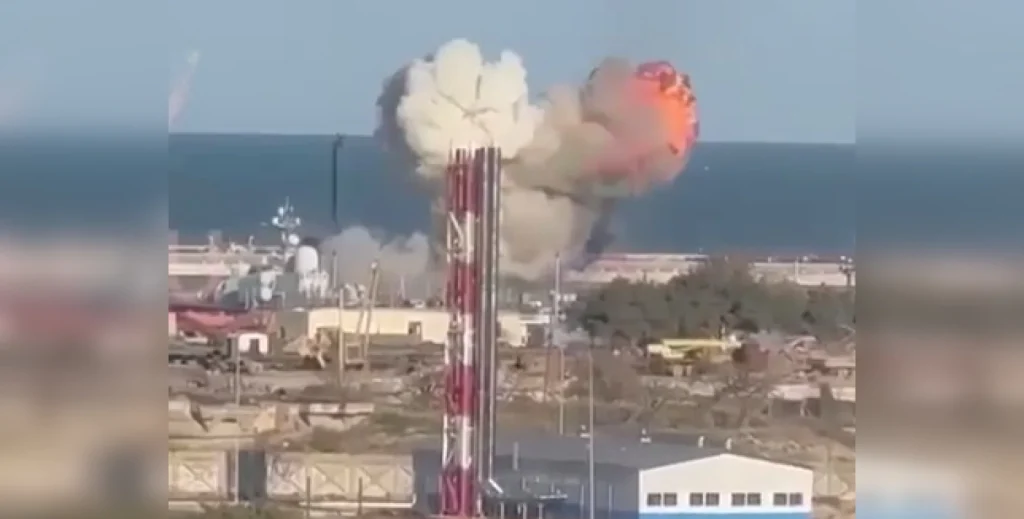
On November 6, a Ukrainian kamikaze drone (likely an A-22 “Flying Fox”) struck Russian military vessels in the Caspian Sea for the first time. According to Ukraine’s Main Intelligence Directorate of the Ministry of Defense, at least two targets were preliminarily damaged. These were likely the missile patrol ships “Tatarstan” and “Dagestan”, which were moored at Russia’s naval base in the city of Kaspiysk in the Republic of Dagestan. Russia had been using these ships to carry out missile strikes against Ukrainian territory.
The distance from Kaspiysk to Ukraine’s state border is approximately 1,500 kilometers.
In September 2024, Ukraine’s intelligence chief Kyrylo Budanov stated that Ukrainian drones are capable of striking enemy targets at distances of up to 1,800 kilometers. However, the events of November 6 (given that the drone reached the Caspian Sea itself) clearly came as a surprise to Russian security forces.
Despite calls by the head of Dagestan not to publish photos and videos of the incident, Dagestani and nationwide Russian channels are flooded with footage of the drone’s flight and impact from various angles.
The incident is also being widely discussed on local social media. During attempts to shoot down the drone, Russian military personnel spared no ammunition, and as a result some rounds hit residential buildings belonging to Kaspiysk residents. Bloggers complain that despite the allocation of 550 million rubles in state funds for the “Safe City” system, neither the Ministry of Emergency Situations’ warning system nor the civil defense system functioned. The mayor of Kaspiysk announced the introduction of forced restrictions: from 1:00 a.m. to 8:00 a.m., street lighting will be turned off “to minimize the presence of people on the streets at night.”
Overall, Dagestan is one of Russia’s most problematic regions and a major challenge for the Kremlin authorities.
In June 2023, the republic’s prime minister stated that, due to the “threat of actions by Ukrainian special services and nationalists,” counterterrorism security measures in the republic would be strengthened. However, this is a fairly standard attempt to explain internal problems and, accordingly, the public mood of the local population — an approach also used by Russia’s central authorities.
Photo: screenshot
Author: Oksana Kuzan, Head of the Analytical Department of the UCBP
18.05.2026
When Russia launched its full-scale invasion of Ukraine in 2022, Mariupol quickly became the site of…

05.05.2026
Russia pressed every Donbas sector in April, with assault tempo at a two-month high. The territorial…

16.03.2026
It is in the war against Ukraine that Russia is trying to adhere to this non-linear…


