


Even in the absence of U.S. assistance, Ukraine will offer desperate resistance to the aggressor — Head of the USCC
24.02.2024
Another attempt by U.S. President Joe Biden during a meeting with congressional leaders on February 27…
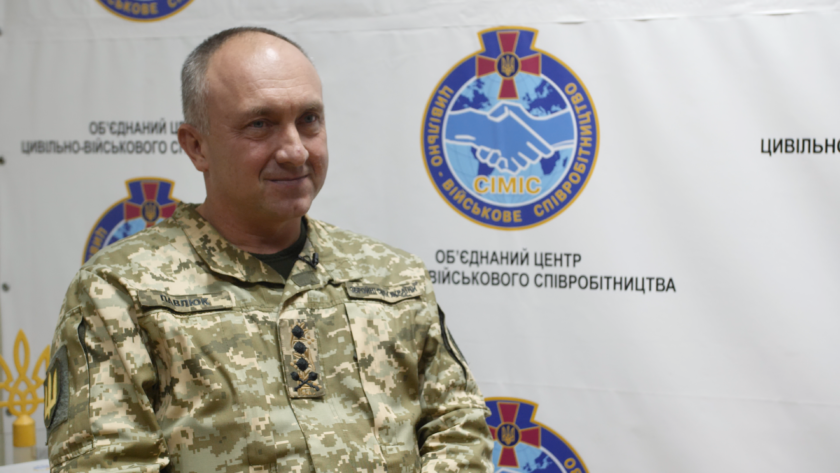
We continue a series of interviews with representatives of a new generation of Ukrainian military leaders who first took the oath to the modern Ukrainian state.
Read about Russian weapons used in the war, countering hybrid aggression, Western assistance, the use of Bayraktars, and changes in the Ukrainian military aimed at NATO membership in an exclusive interview with the Commander of the Joint Forces, Lieutenant General Oleksandr Pavliuk, conducted by American journalist Nolan Peterson as part of the “Mission East” project of the Ukrainian Center for Security and Cooperation.
— What are the main threats currently facing Ukrainian servicemen?
— At present, Ukraine adheres to the ceasefire. I do not consider representatives of the temporarily occupied districts as an independent force with their own position. They are merely puppets carrying out the Kremlin’s orders.
Provocations continue—directed by Russian curators—to inflict maximum losses on our personnel, undermine morale, and weaken Ukrainian society. The goal is to reduce Ukraine’s potential and force it into negotiations on Russia’s terms. They also attempt to portray Ukraine as the initiator of hostilities. However, our military is professional: we respond appropriately, hold our positions, and comply with all agreements. Unfortunately, the other side is bound by nothing. This has continued for eight years, and we will stand as long as necessary.
— Do you expect a possible escalation, and are you ready for it as Commander?
— Yes, we clearly understand and see this. For example, on September 8, Russian forces gathered civilians near the border for celebrations, then shelled their own positions and subsequently ours, placing artillery behind civilians to provoke a response. Thanks to the professionalism of our troops, who monitored the situation and did not fall for the provocation, escalation was avoided.
We understand who we are facing and how Russia wages war. We are ready for escalation, ready for a new phase of combat. In addition to stabilization operations, we have a defensive operation prepared and, if possible, a counteroffensive as well. The troops are ready.
— Are Bayraktar UAVs currently being used in combat?
— Bayraktars are used in accordance with the decision of the Commander-in-Chief in designated directions. All other details are military secrets.
— What helps the Ukrainian army adapt so quickly to Russia’s modern style of warfare?
— Ukraine’s entire history is war. It seems the nation would have to be destroyed to eradicate our free spirit. Neither the Holodomor nor other atrocities eliminated Ukrainian patriotism.
The Ukrainian army was once destroyed. No one believed it would survive, yet the war has lasted eight years. We combine what has proven effective with new technologies. We retain what works and add what is promising. Despite shortages in communications and counter-drone systems, we find solutions in every situation.
— Which weapons used against Ukraine prove the presence of Russian occupation forces?
— We document the use of modern Russian-made Orlan UAVs, which violate agreements, cross borders, conduct reconnaissance, and adjust artillery fire. These systems cannot be produced locally in the so-called “republics.” This alone is clear proof.
— What rules do Ukrainian soldiers follow on the front line?
— Each unit has the right to use weapons independently by decision of the on-site commander when human life is threatened. Human life is the priority. Many shots are fired without real threat, and we do not respond to such fire.
Commanders assess threats calmly. If there is danger, they neutralize it. If not, there is no reason to waste ammunition. Our professionalism allows us to remain calm and act only when necessary.
— How is morale maintained and soldiers motivated?
— The core remains—those who are patriotic and determined to fight until full liberation. Patriotism, trust in commanders, belief in victory and the future—these cannot be replaced by money. As long as people believe in victory, we are invincible.
— How do soldiers support one another on the front line?
— Experienced officers and NCOs set an example for younger soldiers. We never leave inexperienced troops alone on positions. Psychological readiness is critical. After several shellings, young soldiers gain confidence and perform their duties calmly.
— What role does the volunteer movement play today?
— The volunteer movement continues, perhaps on a smaller scale, but moral support remains essential. In 2014 it was vital due to the destruction of the Armed Forces. Today the military is self-sufficient, but volunteers still stand with their units.
— Has the Ukrainian army undergone decommunization and moved closer to Western standards?
— The key difference is valuing human life. Soviet doctrine prioritized missions regardless of losses. We adopted the Western approach: human life comes first.
Young soldiers trained under these standards now shape the army. The Armed Forces are more ready than any other institution in Ukraine to cooperate with partners.
— How has professionalism changed since the war began?
— A fighting army and one in peacetime training are entirely different. The army has grown and restored itself. Much depends on commanders—young leaders who joined after 2014, knowing they would go to war. They are the future of the Armed Forces.
— What has improved the most, and what remains the biggest challenge?
— Equipment and uniforms have improved significantly. We advanced in UAVs and technologies. However, replacing Soviet-era equipment remains slow due to economic constraints. Ukraine has fought for eight years largely on its own resources.
— Can Ukrainian soldiers teach partners anything?
— We share all the experience we have gained. Combined experience makes all armed forces stronger.
— What changes are needed for NATO membership?
— Only NATO’s political will. Militarily, Ukraine is ready. Our structures align with NATO standards, and our forces can integrate immediately.
— How do you define victory?
— Victory is when we raise our flags on our borders. When people on occupied territories realize Ukraine is their future. When children there shout “Glory to Ukraine.” Military victory is only part of the whole.
24.02.2024
Another attempt by U.S. President Joe Biden during a meeting with congressional leaders on February 27…
05.12.2023
The Chairman of the Verkhovna Rada of Ukraine Committee on National Security, Defense, and Intelligence, Oleksandr…
17.11.2023
Georgia—a country that for a long time had been moving toward European integration—has recently witnessed a…


