


Even in the absence of U.S. assistance, Ukraine will offer desperate resistance to the aggressor — Head of the USCC
24.02.2024
Another attempt by U.S. President Joe Biden during a meeting with congressional leaders on February 27…
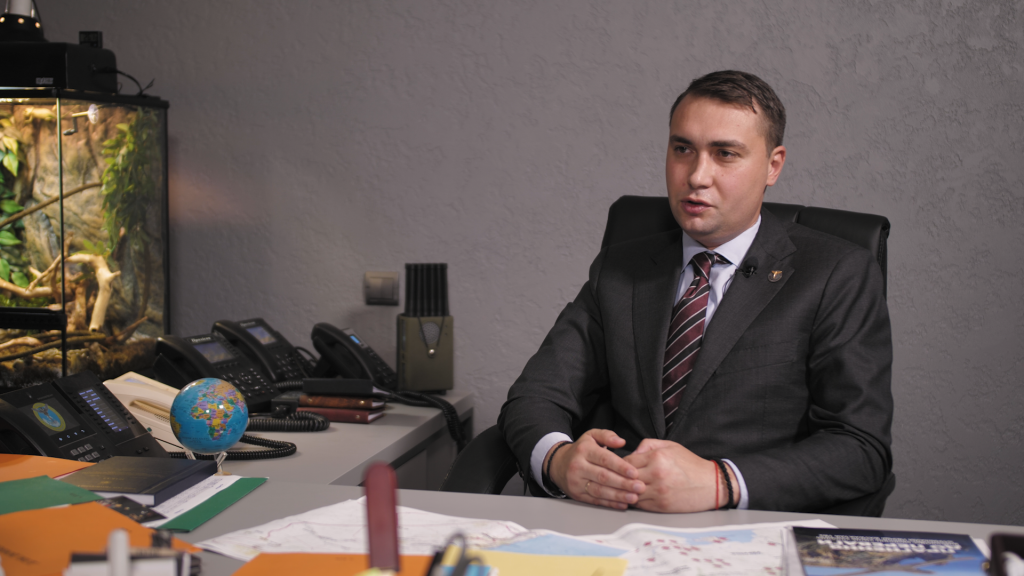
We present to your attention the text version of an interview with the Head of the Main Intelligence Directorate of the Ministry of Defense of Ukraine, Kyrylo Budanov, for the Ukrainian Center for Security and Cooperation (UCSC).
– Good afternoon. My name is Serhii Kuzan, I am the Head of the Ukrainian Center for Security and Cooperation, and today we are speaking with a legendary figure—a brigadier general, full holder of the Order “For Courage,” a man hunted by Russian intelligence services, the Head of the Main Intelligence Directorate of the Ministry of Defense, Kyrylo Budanov. Mr. Kyrylo, welcome.
– Greetings.
– You have conducted dozens of special operations against the enemy, survived multiple assassination attempts, and enjoy enormous respect among your colleagues. Please tell us a little about your combat path and your participation in the war.
– I chose my life path back in childhood. I firmly decided to become a military officer, so after finishing school I enrolled in the Odesa Military Institute, in what was then called the Airmobile Forces faculty, which I completed. After graduation, I began service in officer positions within a special unit of the Main Intelligence Directorate of the Ministry of Defense of Ukraine, where I served for quite a long time. It was in this unit that I witnessed the beginning of the war.
– So you always wanted to be an intelligence officer?
– Yes, absolutely.
– You can be identified as the embodiment of the new Ukrainian army; you do not belong to the old generation of Soviet commanders. How did you meet the war? How did young officers like you perceive it?
– Personally, for me and many of my colleagues in the special unit, there was no fear when these events began. On the contrary, we all wanted to enter the fight as soon as possible to defend our state. However, the political leadership of the country at that time was in no hurry to deploy us during the events related to the seizure of the Autonomous Republic of Crimea by Russian forces. As I said then and repeat now, this was a major mistake that cost us the loss of a huge part of our territory, and essentially that is where the entire war in Donbas began. If force had been applied at that time, most likely none of this would have followed. That is how we met those times.
– You say these sentiments were shared among your fellow officers?
– Yes. One must understand that the Main Intelligence Directorate consisted of professional military personnel; there were no conscripts or mobilized civilians. Everyone had different roles, but no one doubted that the units needed to be deployed.
– In 2014 we often heard that the Ukrainian military was unprepared, that there was fear, that Russia was considered a “brotherly nation,” and thus the army as well. Was there readiness to fight? Was there understanding that it was Russia carrying out the seizure?
– There was a clear understanding that these were actions by Russia. This was reported repeatedly, including long beforehand, for many years, that Russia was preparing such a plan. The policy of that time prohibited us—and this is a fact—from working on Russia. Therefore, all work related to Russia was carried out exclusively within Crimea, for the most part. Even that limited scope of work clearly showed that Russia was preparing to seize this territory. I emphasize again—this was reported many times.
– There is a question about the Yanukovych presidency, when Ukraine’s strategy was aimed at friendship with Russia and Russia was not considered an enemy. You say that young officers clearly understood the threat and reported it to the country’s leadership. How would you characterize that period, when even the Minister of Defense was a Russian citizen?
– You have essentially answered the question yourself—the Minister of Defense was a citizen of the Russian Federation. Work related to Russia was prohibited, with a small exception being Crimea, where we had an intelligence center at the time. It provided certain data on Russia’s activities within Crimea. Even from that information, it was clear that Russia was preparing to seize Ukrainian territory—not limited to Crimea or Eastern Ukraine. Russia was preparing and continues to prepare for a large-scale annexation of Ukrainian territory.
– Given the legends surrounding you, your group, and your special operations in Crimea, please tell us what you can about your service in that direction. Are there any facts you can disclose?
– I met the beginning of the war in a special forces unit, primarily dealing with military intelligence matters. As you mentioned, the army was paralyzed, and tasks normally handled by standard intelligence units of the Armed Forces were severely lagging. So we assisted in addressing those issues. That was most of 2014. Later, the situation began to change, and we increasingly focused on work inherent to us: intelligence and agent operations, sabotage, and so on.
– Thus, your appointment as head was logical. Did it meet your expectations? How were you appointed to this position?
– It was a great honor for me when the President appointed me to this position. I am sincerely grateful for such trust. Expectations for the future include reforming the military intelligence system and significantly expanding its capabilities for operations abroad, because this branch had also been almost completely destroyed.
– We see that the President is making bold кадрові decisions, forming a new military-political elite. What do you think this is connected with? How would you assess such appointments, especially in the military?
– Changes are needed, and they are timely. Unfortunately, for quite a long time the Armed Forces lived with an unreformed Soviet legacy. Had there been a full transition to NATO standards, perhaps the situation would have been different.
– No one can deny that you are an excellent combat commander, yet critics said you were too young and lacked the experience of Soviet generals. However, immediately after your appointment, your team participated in drafting a new Law of Ukraine on Intelligence, which was adopted, giving Ukrainian intelligence a completely new legal framework for the first time in 30 years. Please assess the impact of this law compared to before and after its adoption.
– I would change the wording. It is pleasant to hear, but it was not me lobbying the law; we participated in its creation and adoption. It was a huge collective effort by the parliamentary committee on intelligence, the Office of the President, and colleagues from other security agencies. The law standardized areas of activity that for nearly thirty years were not regulated at all, accelerating reforms and enabling us to fully rely on a clear legal framework.
– Can we say this law brings us closer to Western security standards?
– Ukrainian intelligence is a leader in adopting Western standards and integrating into the Western system. Cooperation with Western intelligence communities began over a decade ago and continues to this day.
– Would it be fair to call you an advocate of transitioning to Western standards?
– Yes, that would be correct.
– How do you assess the place of intelligence in the new Military Security Strategy of Ukraine?
– Military intelligence is one of the key aspects of military security, as its main task is to provide early warning of the enemy’s intentions at all levels—from subversive activities to open military threats.
– What kind of modern intelligence officer are you cultivating today?
– A modern intelligence officer must be, first and foremost, a patriot and a professional, equally so. A person with high intellect, capable of making quick, independent decisions—because in today’s war, decisions often rest on the individual on the ground.
– Is this approach being implemented across the entire Ukrainian military?
– I would like to believe so. Initiative and responsibility in decision-making are essential qualities of any leader.
– Ukraine has conducted joint operations with partners, including evacuations. Could you tell us more about that operation?
– The Main Intelligence Directorate played a key role. For our special unit, such operations are typical. Where others hesitate due to high risks, our approach is different. That is why we succeeded. The widely reported group was only one stage; earlier, 83 people were rescued.
– That requires significant logistics.
– Significant, but we are capable of conducting operations anywhere in the world if necessary. Decisions are made and executed.
– How quickly are such decisions made?
– Very quickly—within one day.
– Why are we hearing about such operations only now?
– Because this President is not afraid to take responsibility. Ukraine demonstrated to the world that it is a reliable and strong partner.
– How does cooperation with international intelligence services work?
– Our officers study many languages—from English and Portuguese to Persian, Arabic, Japanese, and Chinese. There is no language barrier.
– How important is knowledge of the Ukrainian language?
– A citizen of Ukraine must know the Ukrainian language. It is the sole official language.
– What do Western intelligence services learn from us?
– They learn how to conduct operations against a powerful adversary. We share experience; they assist us—this is how cooperation works.
– How has cooperation evolved?
– The level of cooperation has only increased. I am confident we will overcome misunderstandings regarding our role in NATO.
Read also: The Owl’s Flight Through the Storm. Ukrainian Military Intelligence during the Full-Scale Invasion
Watch the full video of the conversation with the Head of HUR MoD Kyrylo Budanov:
24.02.2024
Another attempt by U.S. President Joe Biden during a meeting with congressional leaders on February 27…
05.12.2023
The Chairman of the Verkhovna Rada of Ukraine Committee on National Security, Defense, and Intelligence, Oleksandr…
17.11.2023
Georgia—a country that for a long time had been moving toward European integration—has recently witnessed a…


