

Even in the absence of U.S. assistance, Ukraine will offer desperate resistance to the aggressor — Head of the USCC
24.02.2024
Another attempt by U.S. President Joe Biden during a meeting with congressional leaders on February 27…
Georgia—a country that for a long time had been moving toward European integration—has recently witnessed a shift in its political course. A key role in these changes is played by the Georgian Dream party, which previously promised to lead Georgia into the EU. Today, the party’s latest promises and actions directly contradict the country’s prospects of joining the European Union (EU).
INTERNAL DIVISION
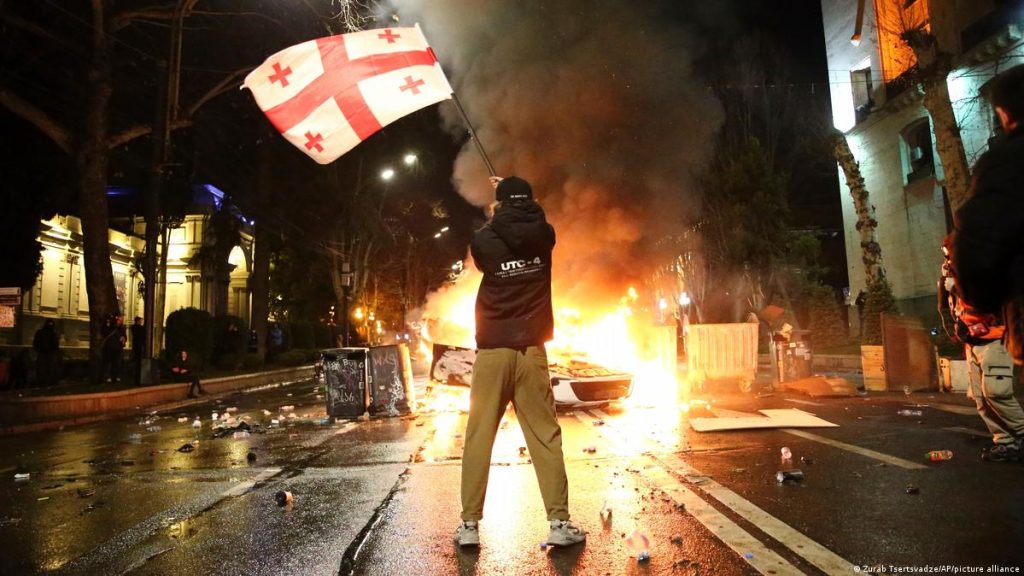
In October 2020, parliamentary elections in Georgia triggered a political crisis. The ruling Georgian Dream party won with 48.22% of the vote, securing 90 out of 150 seats. After the results were announced, opposition parties and civil society organizations accused the authorities of electoral fraud and a lack of transparency in the voting process. This led to mass protests erupting in Tbilisi and other Georgian cities.
Protests in Georgia, 2020. Source – European Pravda
In November, the European Commission sent its representative, Charles Michel, to mediate and attempt to resolve the crisis. Under his leadership, a Memorandum outlining ways out of the political crisis was signed, including electoral reform and repeat elections in districts where violations had been identified.
This document deepened divisions within Georgia’s political landscape. By late February 2021, Georgian Dream decided to withdraw from the Memorandum and abandon repeat elections, stating that electoral reform would not proceed under opposition conditions. Shortly afterward, opposition headquarters were raided and opposition leader Nika Melia was arrested. These decisions caused outrage among Georgia’s Western partners monitoring the crisis.
Despite these steps, the country attempted to maintain the appearance of a pro-Western course. In May 2021, Georgia, Moldova, and Ukraine signed the Associated Trio Memorandum, followed in July by the Batumi Summit Declaration. In these documents, the three countries reaffirmed their commitment to the European path, emphasizing that European integration remains the only acceptable choice and that no third party can influence this sovereign decision.
Signing of the Associated Trio Memorandum in 2021. Source – Suspilne
“POLICY OF PATIENCE” OR A GESTURE TOWARD RUSSIA?
After the start of Russia’s full-scale invasion of Ukraine, Georgia’s anti-Western actions became increasingly visible. Despite criticism, Georgia refused to join anti-Russian sanctions imposed by most democratic countries and instead expanded economic cooperation and dependence on Russia.
“Anyone who calls on Georgia to impose bilateral sanctions against Russia is calling on Georgia to risk escalation with Russia—that is, the risk of a possible war with Russia.”
Shalva Papuashvili, Speaker of the Georgian Parliament (Georgian Dream)
In May 2023, Georgia resumed direct flights with Russia, provoking outrage and an official demarche from the EU. Ukraine responded by imposing sanctions on Georgian Airways—a move Georgia’s economy minister called a “political decision,” stating that “Georgia’s context differs from that of EU member states.”
Georgia’s growing interest in ties with Moscow did not go unnoticed. Russia responded by lifting visa requirements for Georgian citizens and removing the ban on flights to Georgia.
WHERE IS GEORGIA HEADED IN 2024?
The conflict between President Salome Zurabishvili and Georgian Dream escalated in 2023. Despite government attempts to limit her travel, the president conducted a European tour, ignoring impeachment threats that ultimately failed. EU High Representative Josep Borrell warned that impeachment attempts risked further destabilization.
Public opinion strongly favors the president’s pro-European stance. Research by the International Republican Institute shows that 78% of Georgians oppose visa-free entry for Russian citizens and granting them rights to register businesses or purchase real estate.
Over the past year, the rating of the Georgian Dream party has significantly declined amid protests against decisions contradicting the country’s European course.
INSTEAD OF CONCLUSIONS
Today, Georgia stands at a crossroads that will define its future and European trajectory. Ukrainians faced a similar moment in 2013, when they fought for their country’s right to move toward the democratic West.
Georgia once had a real opportunity for accelerated EU integration as part of the Associated Trio, led by Ukraine. Instead, the ruling party chose a policy of appeasing Russia—at a time when the world increasingly recognizes that the Kremlin understands only the “language of force.” This course risks drawing Georgia into instability and serious negative consequences, including the possibility of active hostilities—an inseparable part of Russia’s so-called offers of friendship.
Yaroslav Onenko for the Ukrainian Center for Security and Cooperation
24.02.2024
Another attempt by U.S. President Joe Biden during a meeting with congressional leaders on February 27…

05.12.2023
The Chairman of the Verkhovna Rada of Ukraine Committee on National Security, Defense, and Intelligence, Oleksandr…
02.11.2021
He served as commander of the Ukrainian peacekeeping contingent in Kosovo (2006–2007). It was there that…


